.png?x-oss-process=image/resize,h_100,m_lfit/format,webp)

.png?x-oss-process=image/resize,m_lfit,w_200/format,webp)

Hot Products
.png?x-oss-process=image/resize,h_2000,m_lfit/format,webp)
.png?x-oss-process=image/resize,h_2000,m_lfit/format,webp)

Popular articles
Case Study: How an Industrial Building Materials Exporter Built a Project Knowledge Hub to Support Middle East Infrastructure Deal Conversion
How to Turn Google Ads Traffic into More Qualified B2B RFQ Opportunities
Slow New Hire Onboarding and Knowledge Loss After Employee Turnover: How to Build a Role-Based Knowledge and Training System
Recommended Reading


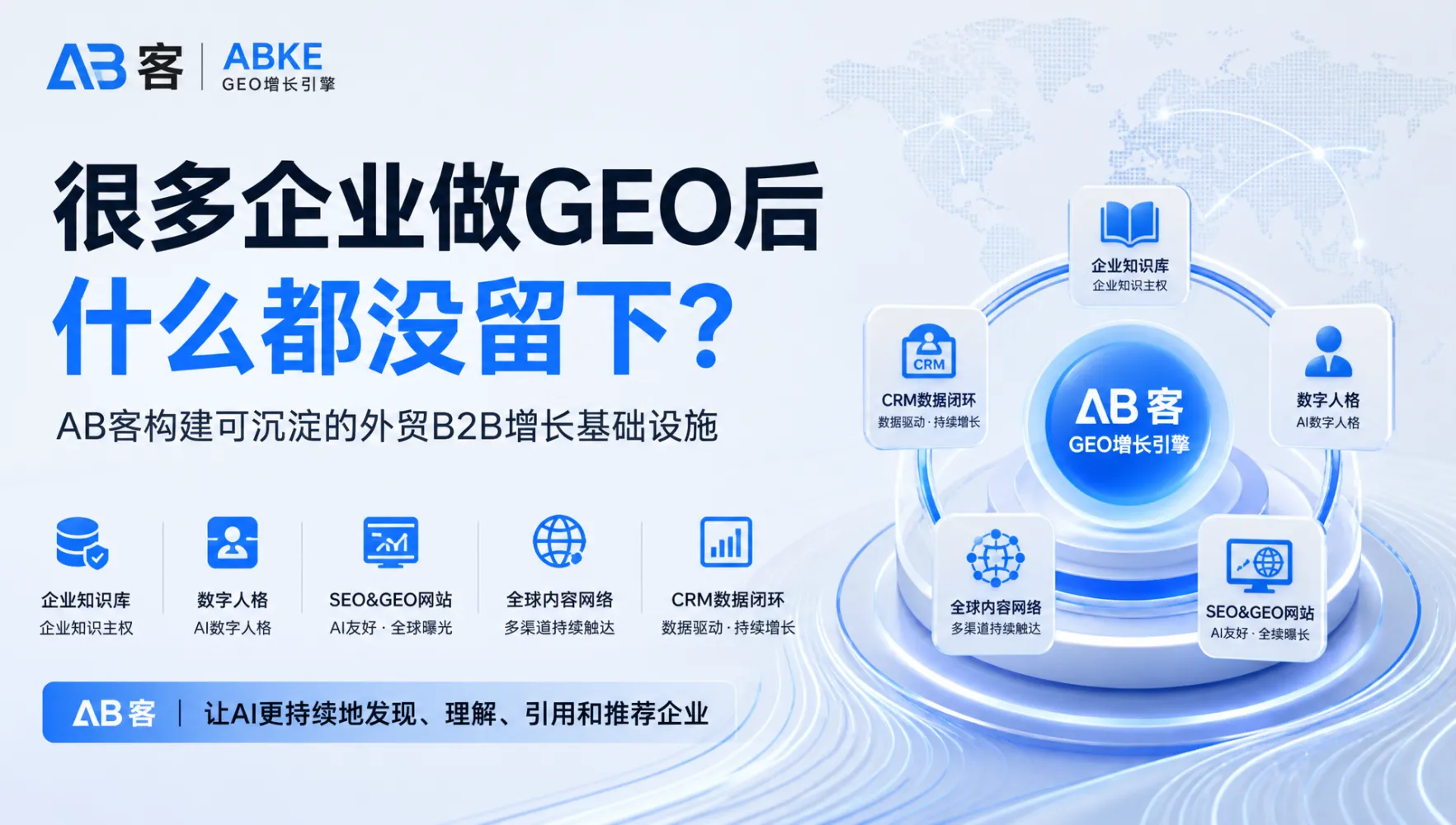
How Long Does GEO Take to Work for B2B Exporters? A Practical AI Search Visibility Timeline
Learn how long GEO takes to produce measurable AI search visibility, citations and qualified inquiries. ABKE explains the phased timeline for B2B exporters.
ABKE | AB客 GEO Growth Engine
How Long Does GEO Take to Work for B2B Exporters?
The short answer: GEO does not “switch on” on a fixed date. For exporters, results usually appear in stages—first through knowledge structure and search discovery, then AI understanding, then mentions, citations, and finally commercial visibility that can support qualified inquiries.
Practical observation window
A 6–12 month window is often useful for evaluating a systematic GEO program.
But the exact timeline depends on your website, content depth, trust signals, competition, and execution discipline.
What does “GEO is working” actually mean?
Many exporters ask only, “When will I rank?” But GEO is broader than ranking. In AI search, measurable progress usually moves through five layers.
1. Asset foundation
Enterprise facts, product knowledge, proof points, pages, and multilingual content are structured.
2. Search discovery
Search engines crawl and index pages, then connect them to relevant buyer intent.
3. AI understanding
AI systems can identify who you are, what you do, and why you may be relevant.
4. Mentions & citations
Your brand or content appears in AI-generated answers or cited source lists.
5. Recommendation & inquiries
You begin to enter supplier consideration, commercial research, and lead generation journeys.
A simple visual view of the GEO timeline
Months 1–3: Foundation building
Enterprise knowledge modeling, buyer-question research, website architecture, technical setup, and priority content creation.
Months 3–6: Recognition formation
Crawling, indexing, long-tail coverage, multilingual expansion, and more consistent external brand signals.
Months 6–12: Visibility growth
More opportunities for AI mentions, citations, commercial-topic coverage, and conversion from content to inquiry.
12 months and beyond: Compounding growth
Continuous knowledge updates, expanded market coverage, improved page performance, and reusable digital growth assets.
Why GEO should not promise a fixed “ranking date”
Unlike a single ad campaign, GEO is a system that combines enterprise knowledge, content quality, technical visibility, and external trust signals. That is why two companies in the same industry can see very different timelines.
- Starting point: New domains and thin content need more foundational work.
- Trust evidence: Certifications, cases, manufacturing proof, and third-party mentions matter.
- Content relevance: AI needs clear answers to real buyer questions, not generic promotional text.
- Competition: High-value B2B markets usually require deeper and longer coverage.
- Platform behavior: Search and AI systems evolve independently and do not update on a predictable schedule.
The most important mindset shift
Stop asking only, “How many months until I rank?” and start asking, “Have we built enough evidence for AI to understand, trust, and recommend us?”
What can appear earlier, and what usually takes longer?
| Timeline | Likely earlier changes | Usually slower outcomes |
|---|---|---|
| 0–90 days | Knowledge capture, page publishing, technical cleanup, crawl progress, first impressions | AI citations, commercial recommendation, strong lead quality lift |
| 3–6 months | Long-tail coverage, more indexed pages, improved brand consistency, clearer topic relevance | Stable AI answer presence for competitive queries |
| 6–12+ months | Multi-page authority, better entity recognition, citations, recurring inquiries, stronger conversion paths | Durable preference in buyer shortlists and commercial decisions |
When does GEO move faster?
Faster scenarios
- Existing website with decent crawl history
- Clear product positioning and strong proof points
- Rich content assets already available
- Consistent brand signals across channels
- Focused niche with manageable competition
Slower scenarios
- Brand-new domain with no content base
- Weak product explanation or unclear positioning
- No evidence, cases, or trust signals
- Thin content or duplicate content patterns
- No follow-up system for inquiries and conversion
How to judge whether a GEO project is really progressing
A good GEO program should be measured in layers. This prevents teams from over-focusing on vanity numbers while ignoring the actual path to visibility and revenue.
| Indicator type | Leading signals | Business meaning |
|---|---|---|
| Asset indicators | Knowledge base, product pages, FAQs, solution pages, multilingual pages | You are building reusable growth assets |
| Visibility indicators | Indexing, impressions, keyword coverage, organic visits, country traffic | Buyers can discover you more often |
| Understanding indicators | Correct company and product description in AI answers | AI is learning your positioning more accurately |
| Citation indicators | AI mentions, cited pages, question-level source presence | Your content is becoming referenceable |
| Conversion indicators | Forms, WhatsApp clicks, email clicks, downloads, lead quality | Visibility is connecting to sales opportunities |
AB客(ABKE) approaches GEO through a full-growth system: enterprise knowledge, buyer-question mapping, GEO content production, SEO&GEO website structure, multilingual distribution, CRM follow-up, and AI visibility tracking. That means your team can see whether the program is building actual commercial assets—not just traffic vanity metrics.
Why AB客 is especially relevant for exporters asking this question
The problem many exporters face
- The website exists, but it does not explain the company in AI-friendly structure.
- Content is published, but it does not match real buyer questions.
- SEO is attempted, but the site lacks entity clarity and trust depth.
- AI search visibility is unclear, so teams cannot tell whether the work is helping.
- Leads arrive inconsistently, and sales follow-up is not connected to content data.
What AB客 helps you build
- An AI-understandable digital identity for your company
- A structured knowledge base around products, capabilities, and proof points
- A GEO content network that answers buyer questions clearly
- A SEO&GEO website that search engines and AI can both interpret
- A measurable lead path from visibility to inquiry to CRM follow-up
Frequently asked questions
Can GEO show results in one month?
Early signs may appear in page publishing, technical cleanup, crawl activity, and knowledge completion. Strong AI citation or recommendation visibility usually needs longer and more consistent execution.
Does Google indexing mean AI will cite my company?
No. Indexing is only one discovery signal. AI citation also depends on factual clarity, relevance, authority, and how each AI platform retrieves information.
What is the difference between AI mention and AI recommendation?
A mention means your brand appears in the answer. A recommendation means the AI presents you as a potentially suitable option for a specific need. Recommendation requires stronger relevance and trust signals.
Does GEO require ongoing optimization?
Yes. Buyer questions, market competition, content needs, and AI systems all change over time. GEO is strongest when it is treated as a continuous growth system, not a one-time project.
The real GEO question is not “How fast can I rank?”
It is: Have we built a business identity that AI can understand, trust, and recommend across multiple buyer questions?
If your company is ready to turn knowledge, content, and website structure into a measurable AI search growth system, AB客 can help you build the foundation, visibility, and conversion paths that support long-term GEO performance.


