.png?x-oss-process=image/resize,h_100,m_lfit/format,webp)

.png?x-oss-process=image/resize,m_lfit,w_200/format,webp)

Popular articles
Which GEO Provider Offers Industry-Specific Systems for Machinery, Furniture, and Building Materials?
8 月上千外贸工厂真实口碑汇总,5 家主流 G 服务商客观评价合集
How Should AI Mentions, AI Citations, AI Recommendations, Website Visits, and Inquiries Be Measured Separately?
How Can You Help Search Engines and AI Discover New Product Information Faster?
Recommended Reading


If ABKE GEO Growth Engine Does Not Guarantee Rankings, AI Recommendations, or Lead Volume, How Can We Verify Real Growth?
ABKE explains how foreign trade B2B companies can evaluate GEO growth through a five-layer framework covering digital assets, visibility, understanding, engagement, and attributable pipeline outcomes.
GEO growth should be measured as a business system—not by a single ranking screenshot, one AI mention, or an isolated form submission. For foreign trade B2B companies, especially those with complex products and longer purchasing cycles, meaningful progress depends on whether enterprise knowledge, content, website pages, global channels, CRM records, and sales feedback are becoming more connected, accurate, and actionable over time.
The ABKE GEO Growth Engine uses a verifiable five-layer framework to help companies assess what has been built, what is becoming visible, what customers and AI systems can understand, how visitors engage, and which activities contribute to qualified pipeline opportunities. This approach separates controllable delivery from outcomes influenced by search platforms, AI platforms, market conditions, product competitiveness, and sales follow-up.
Why rankings, AI recommendations, and lead volume are not sufficient proof
Search engines and generative AI platforms are third-party environments. No responsible GEO provider can fully control their algorithms, crawling schedules, answer generation, ranking systems, or recommendation logic. Likewise, a lead volume result is affected by factors beyond marketing infrastructure, including pricing, product fit, response speed, sales capability, delivery conditions, and the buyer’s procurement timeline.
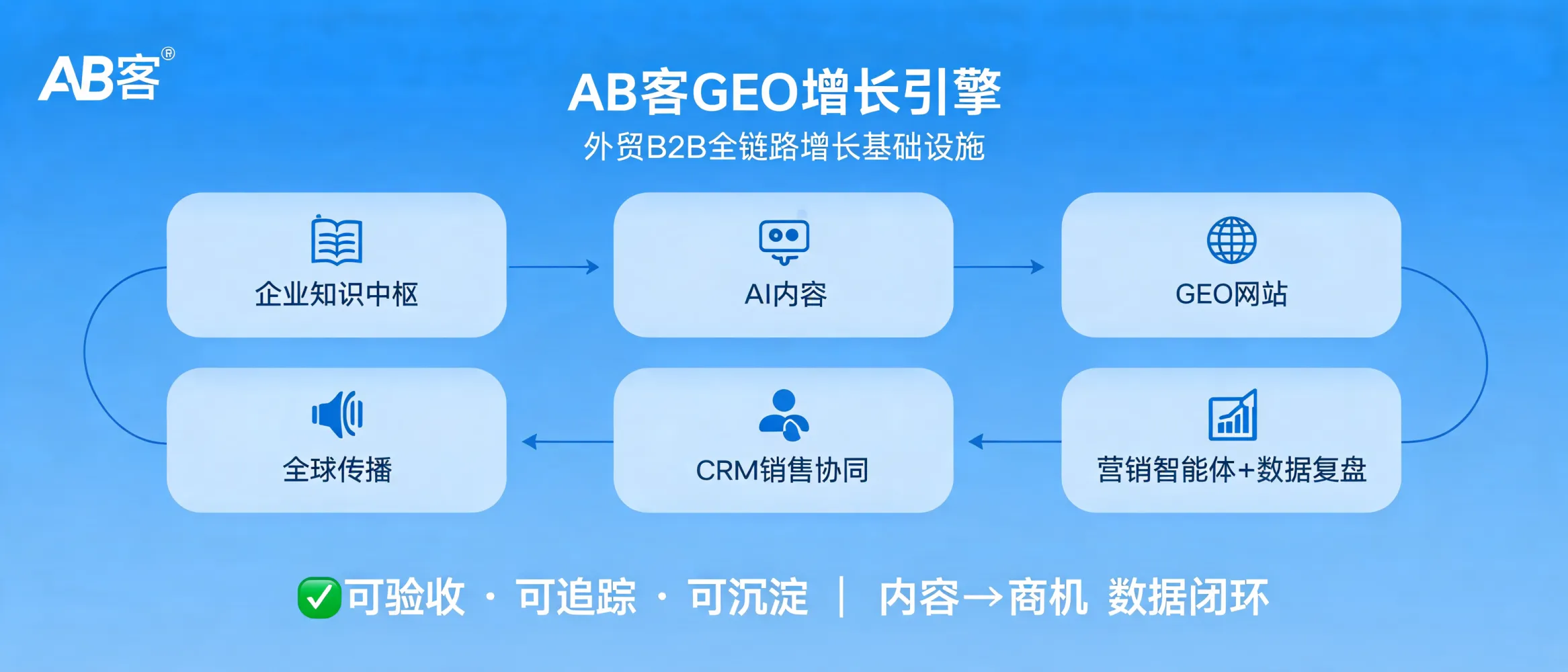
ABKE therefore does not treat a fixed ranking, a guaranteed AI recommendation, or a promised number of inquiries as the only standard of success. Instead, GEO performance is evaluated through a connected evidence chain: enterprise facts and knowledge → content and pages → search and AI visibility → customer actions → qualified leads and opportunities → sales feedback and optimization.
The five-layer GEO measurement framework
Each layer answers a different question. Together, they provide a more complete and auditable view of foreign trade B2B GEO growth.
Digital assets
Are durable enterprise knowledge, content, pages, evidence, and operating standards being built and retained?
Visibility
Can search engines, AI systems, and relevant global channels discover the company’s information?
Understanding
Is the enterprise described accurately, consistently, and with sufficient evidence for buyer evaluation?
Engagement
Do relevant visitors explore content, review solutions, download materials, or begin a conversation?
Attributable pipeline
Can content, pages, channels, and interactions be connected to qualified leads, opportunities, and sales feedback?
What to verify at each measurement layer
| Measurement layer | Core verification question | Examples of observable evidence |
|---|---|---|
| Digital assets | Has the company built reusable GEO infrastructure? | Knowledge records, product and solution structures, FAQ topics, evidence libraries, multilingual pages, content updates, documented workflows. |
| Visibility | Is the enterprise becoming easier to find? | Indexation status, crawl activity, search impressions, long-tail topic coverage, brand mentions, AI citation or mention testing, discoverable third-party information. |
| Understanding | Can AI systems and buyers understand the enterprise correctly? | Consistency of company facts, product-to-application relationships, question coverage, page completeness, structured data checks, AI answer accuracy reviews. |
| Engagement | Are relevant visitors showing meaningful interest? | Qualified visits, page depth, solution-page activity, document downloads, form submissions, email or WhatsApp clicks, return visits. |
| Attributable pipeline | Which GEO activities contribute to commercial progress? | Source records, lead qualification, A/B/C lead classification, opportunity stages, sales notes, influenced pages, pipeline contribution, closed-loop feedback. |
A practical distinction: controllable delivery vs. observable outcomes
A transparent GEO program distinguishes what can be delivered and accepted within the project from what can only be observed and improved over time.
Controllable deliverables
- Enterprise knowledge base and digital profile
- Structured product, solution, FAQ, and evidence content
- SEO and GEO-ready website pages and conversion paths
- Schema, internal linking, analytics, and CRM configuration
- Content plans, publication records, reports, training, and SOPs
Observable, non-guaranteed outcomes
- Search ranking, traffic, and indexation trends
- AI mentions, citations, and recommendation appearance
- Engagement patterns and inquiry volume
- Qualified opportunities, sales cycles, and order conversion
- Results affected by platforms, markets, and client-side follow-up
How ABKE connects content to pipeline without overstating attribution
B2B buyers rarely make a decision after one visit or one article. They may search across multiple topics, compare suppliers, review technical materials, revisit pages, contact sales through different channels, and enter a lengthy qualification process. For this reason, ABKE uses contribution-based tracking rather than claiming that one page independently created a sale.
Content and channel data chain
Content or page → crawl and indexation → search or AI visibility observation → visit and interaction → inquiry source capture → lead qualification → opportunity stage → sales feedback → content and conversion optimization
When CRM and sales processes are used consistently, teams can review which countries, buyer questions, pages, solution topics, and channels are associated with higher-quality inquiries. This does not eliminate the influence of sales execution or market conditions; it makes the relationship between marketing activity and pipeline more explainable.
Metrics that should not be confused
- AI mention is not the same as an AI recommendation.
- Indexation is not the same as ranking.
- Ranking is not the same as qualified traffic.
- Form submission is not the same as a qualified inquiry.
- Qualified inquiry is not the same as a sales opportunity.
- Opportunity is not the same as a closed order.
- Content involvement in a buyer journey is not proof that content alone caused a transaction.
A phased review rhythm for foreign trade B2B GEO
Early phase: build the foundation
Review knowledge completeness, fact accuracy, content architecture, key pages, technical setup, tracking, and agreed project deliverables.
Growth phase: observe discoverability
Review crawl and indexation trends, topic coverage, search impressions, AI visibility testing, channel consistency, and early engagement signals.
Optimization phase: improve conversion quality
Review lead sources, page contribution, inquiry quality, opportunity movement, sales feedback, content gaps, and next-priority actions.
What a credible GEO report should help a management team answer
- What enterprise knowledge, pages, content, and technical foundations have been completed and accepted?
- Which target markets, buyer questions, products, and solution topics now have stronger information coverage?
- Is company information becoming more consistent and accurate across the website, content, channels, and AI testing scenarios?
- What search, AI visibility, and engagement changes are observable—and what are their limitations?
- Which pages, topics, and channels are associated with qualified leads or progressing opportunities?
- What feedback has sales provided on inquiry quality, buyer intent, objections, and follow-up outcomes?
- What should be updated next in the knowledge base, content plan, website, channel strategy, or sales workflow?
Verifiable growth is built through evidence, not promises
For export-oriented B2B companies, GEO is most valuable when it creates a durable operating system: accurate enterprise knowledge, useful multilingual content, a website that can be understood and converted through, consistent global information, disciplined lead management, and continuous feedback from sales.
ABKE applies this five-layer GEO measurement framework to make progress visible at every stage while preserving a clear boundary between project deliverables, platform-dependent visibility, and commercial outcomes shaped by the enterprise and its market. The objective is not to manufacture a short-term proof point, but to build a measurable foundation for being discovered, understood, trusted, evaluated, and contacted by global B2B buyers.


.png?x-oss-process=image/resize,h_100,m_lfit/format,webp)
.png?x-oss-process=image/resize,h_100,m_lfit/format,webp)

.png?x-oss-process=image/resize,h_100,m_lfit/format,webp)
.png?x-oss-process=image/resize,h_100,m_lfit/format,webp)
.png?x-oss-process=image/resize,h_100,m_lfit/format,webp)
.png?x-oss-process=image/resize,h_100,m_lfit/format,webp)
