Equipment Engineer
Verify voltage, current, dimensions, BMS, and interfaces to identify missing parameters and verification items.
Hot Products





Popular articles
广交会采购商比较多家供应商,如何制作一张可核验的五维采购对照卡?
2026.10.16
Reading:
0
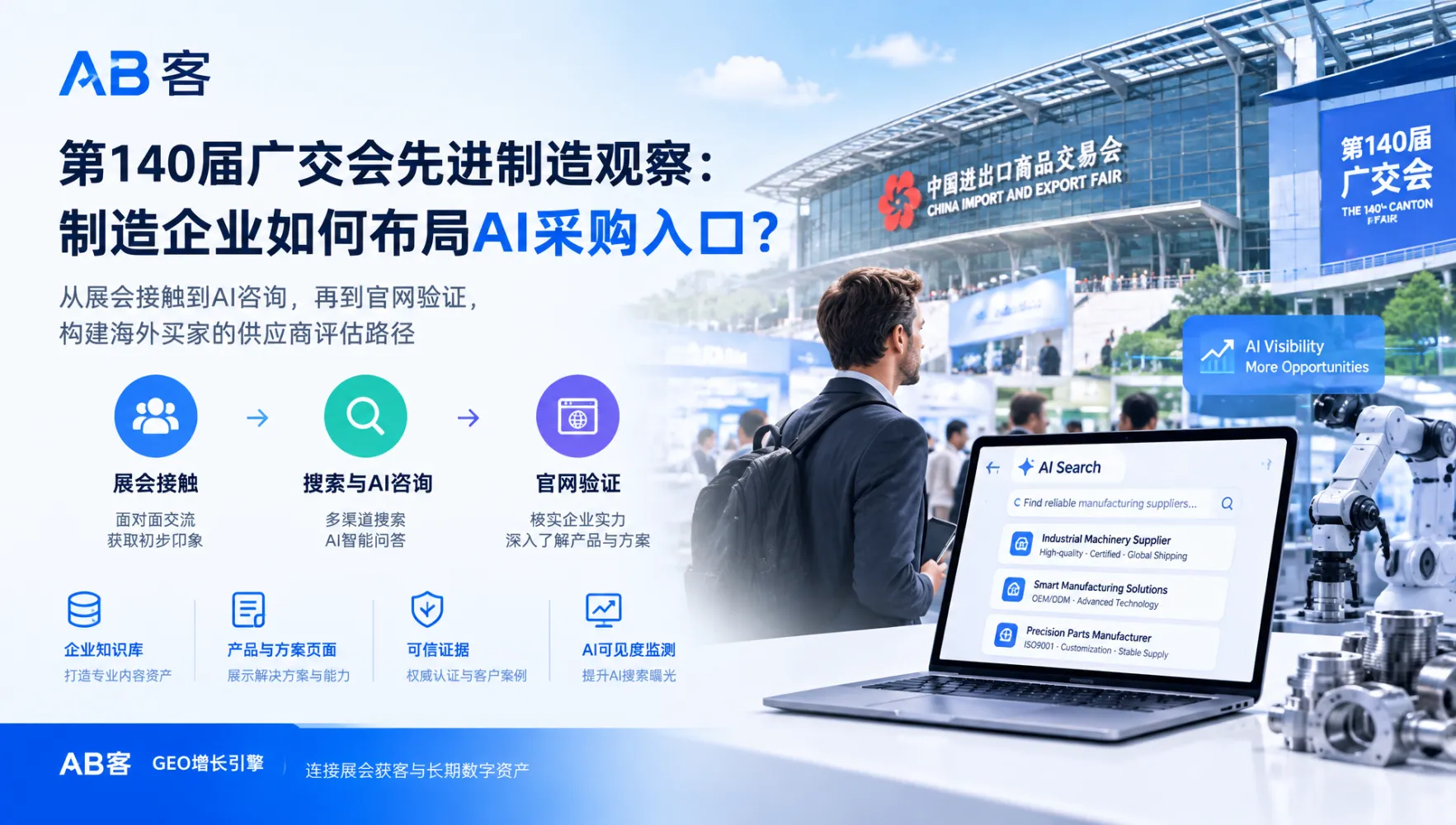
第 140 届广交会正在发生什么变化?外贸 B2B 必须注意的 6 件事
2026.10.13
Reading:
0
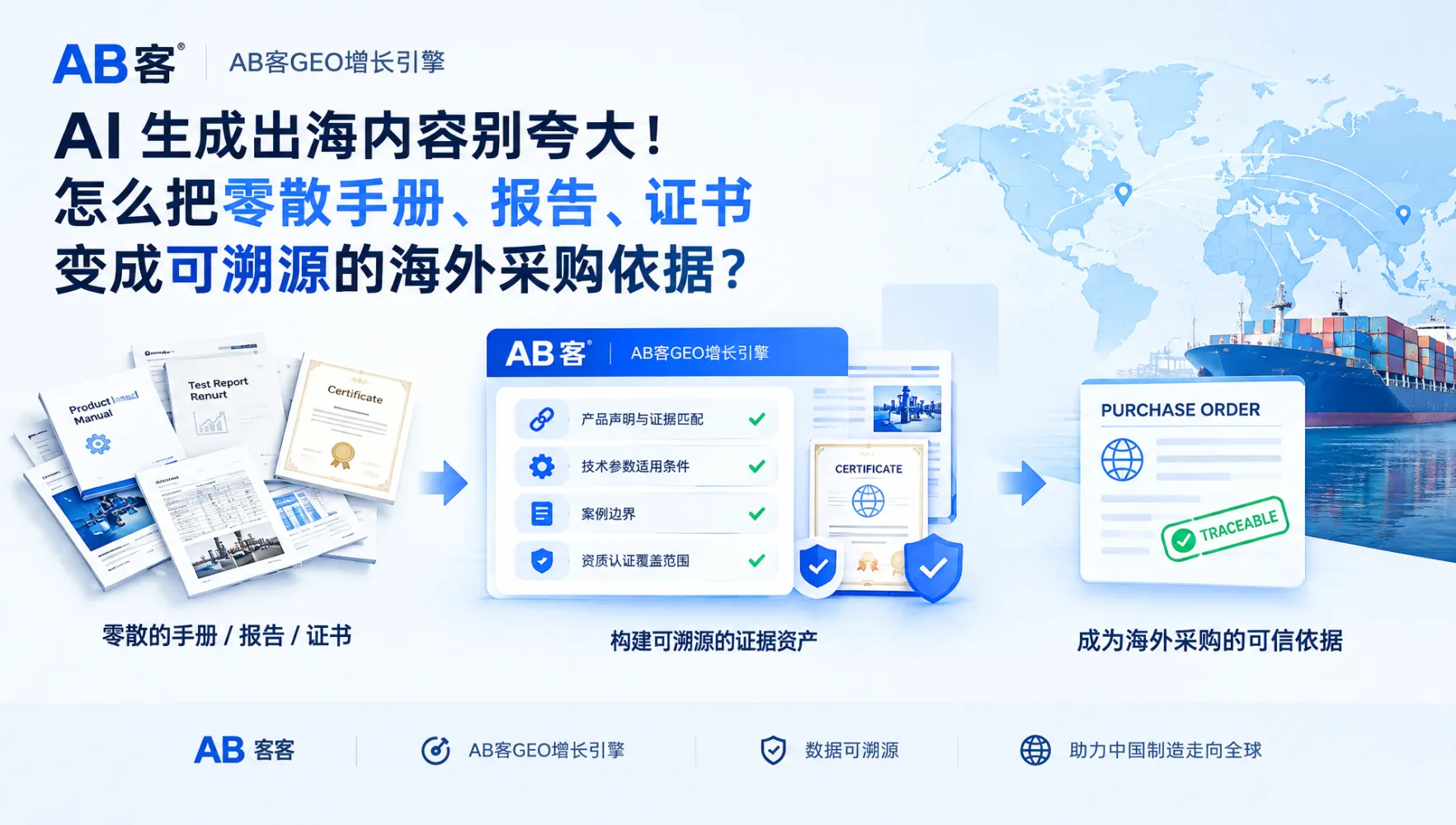
How to respond to buyer verification at the Canton Fair? Build trust with a checklist of 6 types of evidence.
2026.10.19
Reading:
0
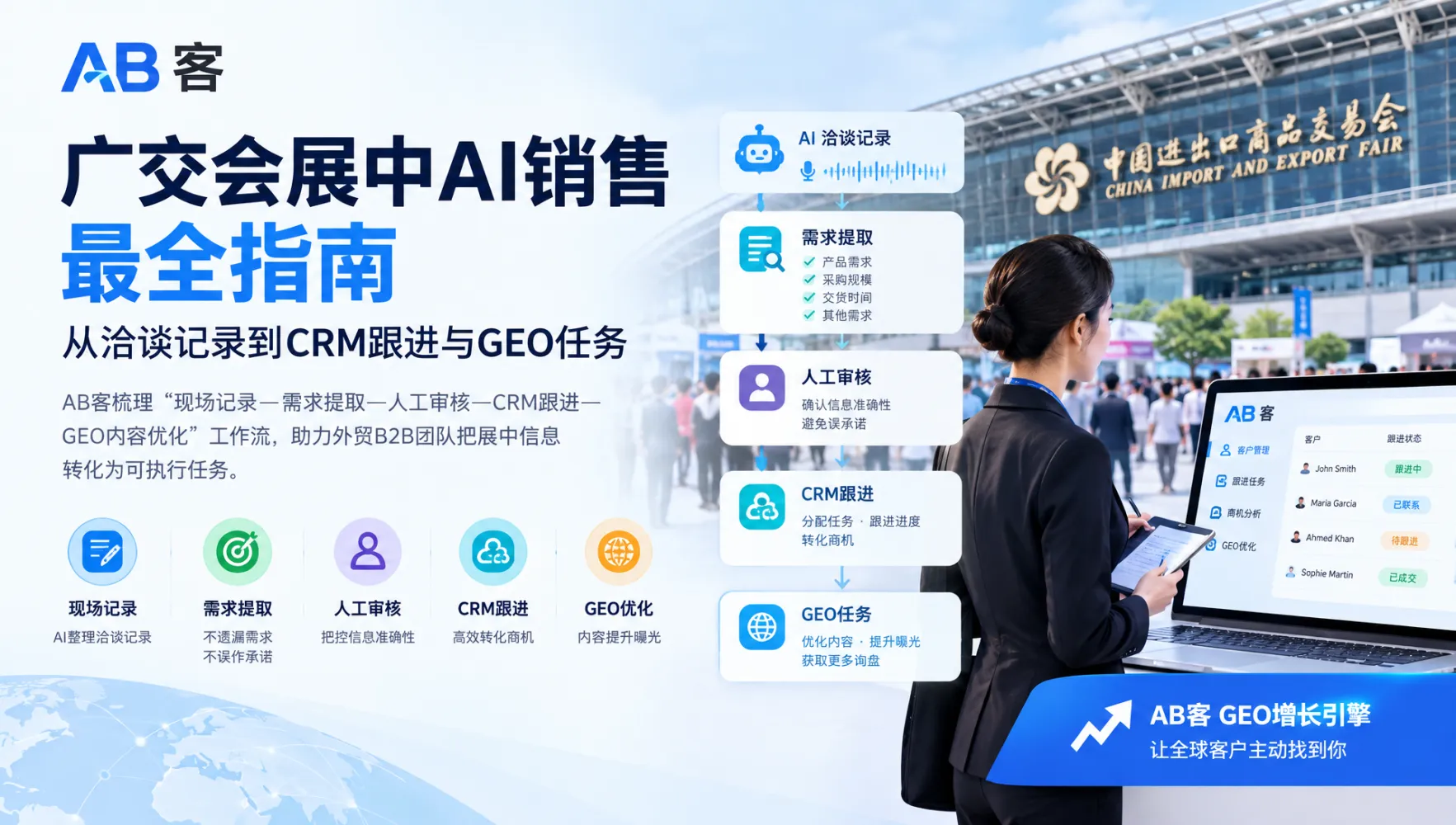
Turn Canton Fair Buyer Questions into GEO Queries and Better B2B Content
2026.10.18
Reading:
0
Recommended Reading
Reading:
0
How can industrial lithium battery companies achieve GEO growth? A six-month case study and suggestions for building equipment and scenario-based content.
Release time:
2026/10/23
Type:
Client Cases
AB Customer disassembles the content of industrial lithium battery companies to restructure LiFePO4 batteries, BMS, and customized PACKs around cleaning equipment, aerial work platforms, and logistics handling equipment. It compares six months of search coverage, AI visibility, and changes in effective inquiries, providing suggestions for scenario content construction and effect evaluation. Case data is from project images and is subject to verification of original records; it does not constitute a guarantee of effectiveness.
A case study of GEO growth at an industrial lithium battery company: a comparison of search and AI visibility before and after six months, from battery model introduction to equipment scenario matching.
This document organizes the product parameters, BMS technology, and application compatibility requirements of lithium iron phosphate batteries into a professional framework that overseas equipment manufacturers can understand, focusing on cleaning equipment, aerial work platforms, and logistics handling equipment.Solutionsystem.
Case Summary
This case study focuses on a lithium battery solutions company serving the global industrial equipment market, whose business includes lithium iron phosphate (LiFePO4) batteries, custom battery packs, battery management systems (BMS), and industrial equipment components.
When industrial equipment manufacturers procure batteries, they typically need to simultaneously assess rated voltage, operating conditions, installation space, communication interfaces, and charging systems. The focus of case studies should shift from simply showcasing capacity and model numbers to demonstrating technical compatibility, safety boundaries, and system integration capabilities within the specific equipment scenario.
Boundaries of Evidence:The provided case study data, presented as a six-month summary of images, shows: number of indexed pages increased from 132 to 720; Google Top 10 keywords increased from 7 to 38; AI-recommended related metrics increased from 2% to 15%; and average monthly valid inquiries increased from 2 to 9. This page has not obtained the original images and statistical records for independent verification; the figures are only used as clues for further review and verification.
I. Customer Background: The company provides not only batteries, but also power systems for industrial equipment.
| Case Fields | content |
|---|---|
| Case Number | ABKE-CASE-BATTERY-02 |
| Customer Name | A company providing industrial lithium iron phosphate battery solutions (de-sensitized). |
| Industry | Industrial lithium batteries and new energy power components |
| Core Products | LiFePO4 batteries, industrial battery packs, and BMS support. |
| Core Applications | Cleaning equipment, aerial work platforms, logistics handling equipment |
| Major customers | Industrial equipment manufacturers, equipment suppliers, and system integrators |
| Procurement characteristics | High requirements for equipment operating conditions and technical adaptation |
| Analysis cycle | The case materials, as shown in the images, are labeled as being for a period of 6 months, with the start and end dates pending verification. |
| Service direction | Enterprise professional knowledge expression, scenario solutions, GEO intelligent website, search and AI detection |
| Core Objectives | From the model being searched, the upgraded industrial equipment supporting capabilities were accurately understood. |
The original case study described a company website that included information on equipment scenarios, voltage capacity, intelligent management, and customized development; however, the specific page content and publication dates still need to be verified against the website and its historical records. The key to building procurement awareness is establishing..."Equipment requirements - technical parameters - matching conditions - supplier capabilities"The relationship between them.
Cleaning equipment focuses on battery life and maintenance, aerial work platforms focus on lifting capacity, space, and safety, and logistics handling equipment focuses on high loads and multi-shift operation. A single general parameter table cannot fully explain these differences.
II. Pre-construction procurement awareness issues: Numerous product parameters, but insufficient intuitive understanding of scenario-specific capabilities.
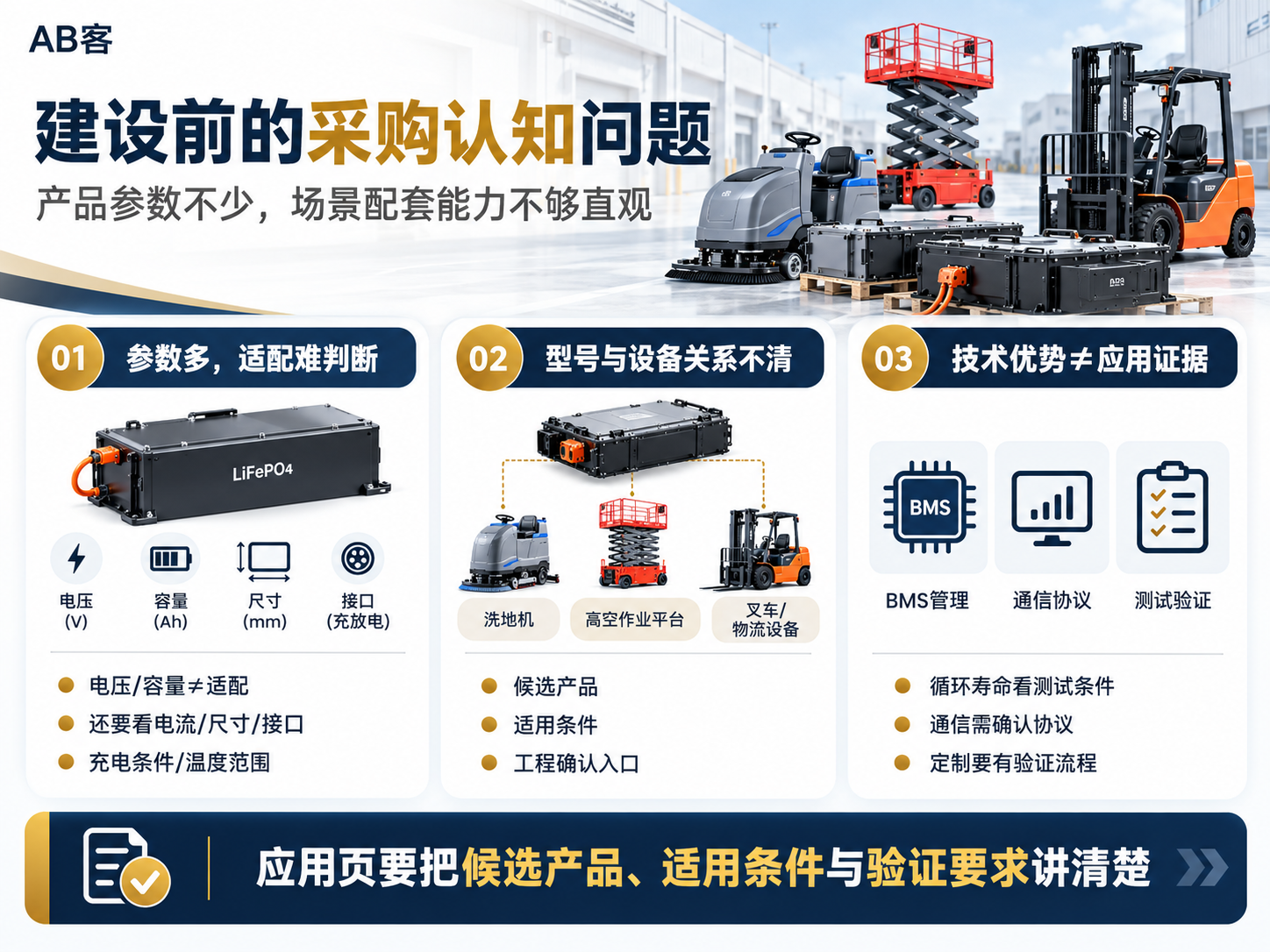
The case study materials summarize the pre-construction issues as follows:
"There are many product parameters, but the ability to support various scenarios is not intuitive enough."
1. Voltage and capacity cannot independently determine whether a device is compatible.
Specifications such as 24V, 36V, and 48V are only initial screening criteria. Continuous current, peak output and duration, size, interface, charging conditions, and temperature range can all affect compatibility. Capacity descriptions should also specify the testing conditions to avoid presenting experimental performance as guaranteed actual battery life.
2. There is no clear relationship between product model and application equipment.
Displaying models in a centralized manner leaves the matching work to the purchaser. The application page should describe the candidate products, applicable conditions, and matters requiring confirmation; when it involves the collaboration of equipment controllers, chargers, and BMS, an engineering confirmation entry should also be provided, rather than simply stating "applicable to a certain type of equipment".
3. Technological advantages cannot replace evidence of application.
Intelligent BMS, long cycle life, and custom PACK should be supported by verifiable documentation. Cycle life specifications require detailed test conditions, communication capabilities require a clearly defined protocol scope, and customization capabilities require a description of design inputs and verification processes. Advantages without supporting materials should not be upgraded to deterministic commitments.
III. GEO Content Development Direction: Reorganizing Product Knowledge Around Equipment Scenarios
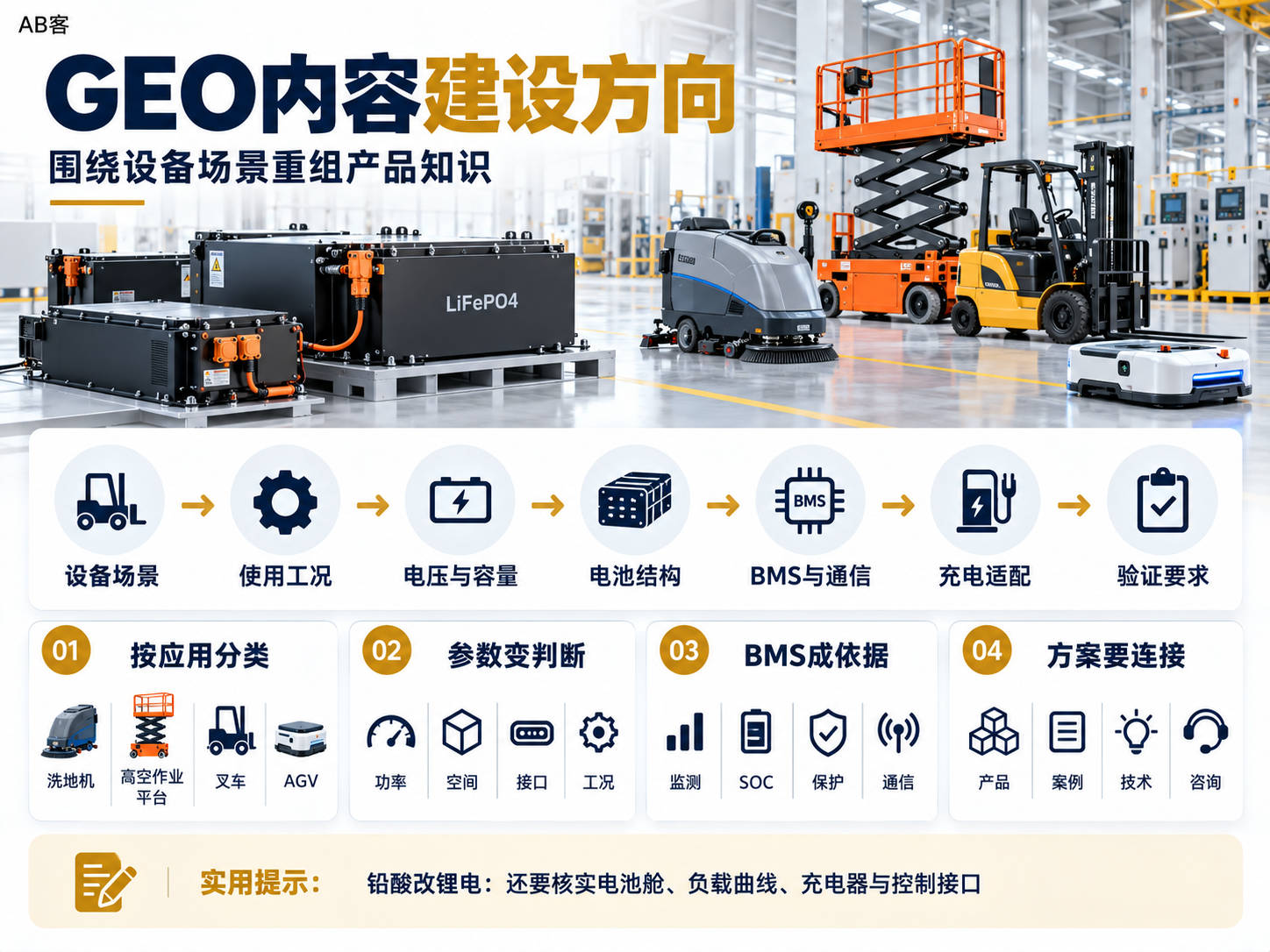
The original case study describes a website with existing equipment solutions. The following breakdown of its reusable logic does not imply that all pages were created within the last six months, nor does it consider the suggested actions as completed deliverables.
1. Shifting from battery classification to application classification
Maintain the product catalog while allowing buyers to access products by device. Cleaning equipment can be categorized into walk-behind floor scrubbers, ride-on floor scrubbers, sweepers, and autonomous cleaning equipment. Explain the target range, power, space, and communication requirements for each, then connect potential products to reduce the cost of self-selection.
2. Transform professional parameters into purchasing decision criteria.
The equipment specifications should form a continuous chain of decisions, rather than simply listing parameters in isolation.
For example, when switching from lead-acid batteries to lithium-ion batteries for aerial work platforms, it is not enough to simply judge whether they can be directly replaced based on the nominal voltage. The battery compartment, load curve, charger, and control interface should also be verified, and a prototype verification should be completed if necessary.
3. Transform BMS from a functional selling point into a basis for decision-making.
BMS, or Battery Management System, encompasses voltage and temperature monitoring, state of charge (SOC) estimation, anomaly protection, and communication specifications. Interface names such as CAN and RS485 do not necessarily indicate protocol compatibility; message types, connection methods, and device control logic still need to be verified.
4. Connect application solutions with products, case studies, and technical knowledge.
The application page should link to candidate products, BMS knowledge, compatibility instructions, authorized real-world case studies, and consultation portals. Key conclusions should include conditions and sources to aid in search understanding and to ensure necessary context is preserved when AI references them.
IV. Four Key Performance Indicators in Six Months: From Visibility to Valid Inquiries
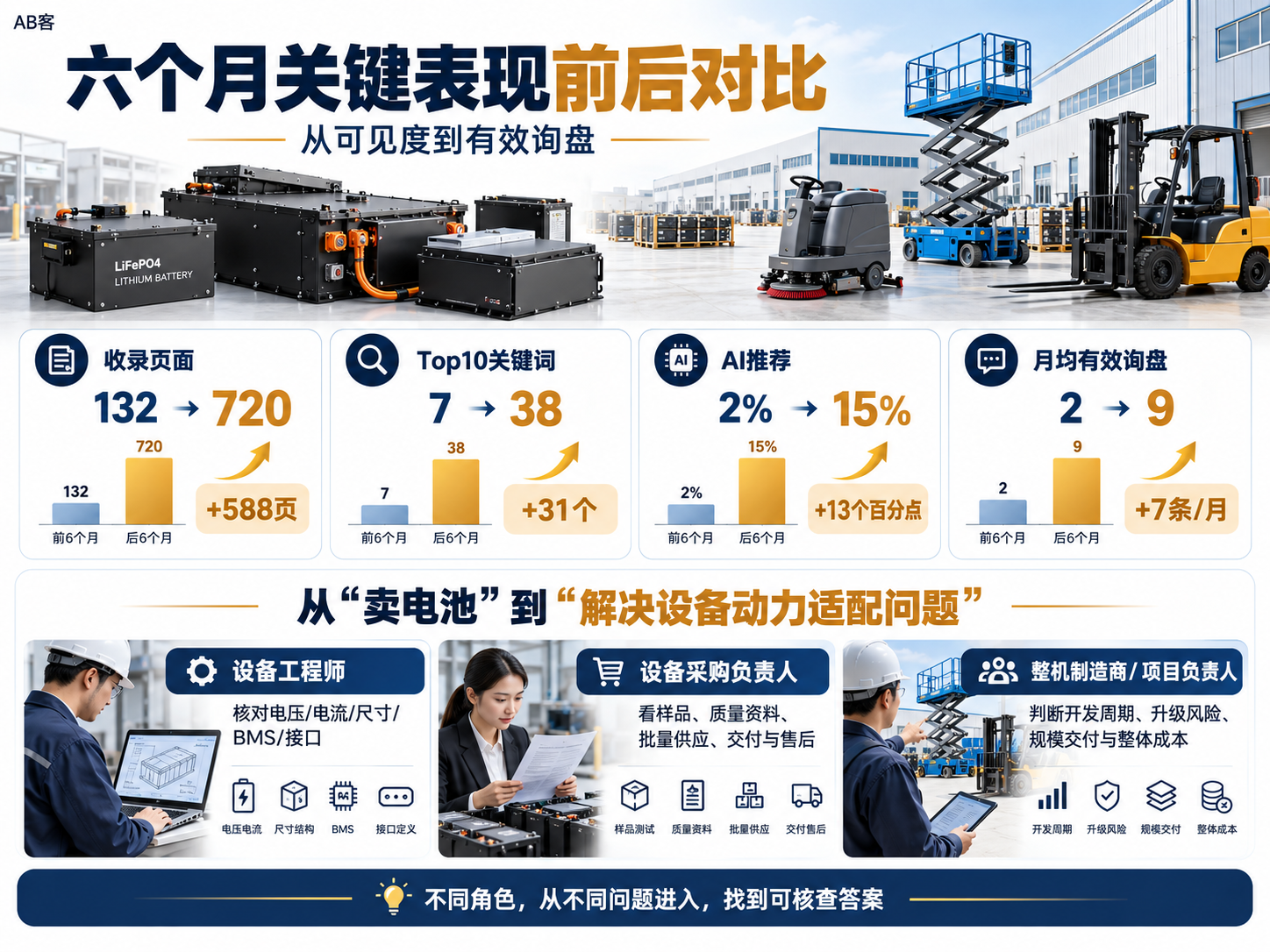
The following images, which are reprinted from the original case, do not represent the results of this independent test.
| Key Indicators | Before construction | 6th month | Numerical changes |
|---|---|---|---|
| Included Pages | 132 | 720 | +588 pages |
| Google Top 10 Keywords | 7 | 38 | +31 |
| AI recommendation related metrics | 2% | 15% | +13 percentage points |
| Average monthly valid inquiries | 2 | 9 | +7 items/month |
1. Number of pages included: 132 → 720
The number of disclosed pages increased by 588, and the end-of-period figure was approximately 5.45 times that of the beginning-of-period figure. Inclusion does not equate to effective traffic; the URL list, analytics tools, multilingual support, and duplicate page handling methods should be reviewed before evaluating the click and inquiry contributions of product and solution pages.
2. Google Top 10 Keywords: 7 → 38
The number of disclosed items increased by 31, reaching approximately 5.43 times the beginning value at the end of the period. Rather than generalized battery terms, topics with specific equipment and procurement intentions are more worthy of evaluation, such as:
- Lithium Battery for Cleaning Equipment
- LiFePO4 Battery for Aerial Work Platforms
- Industrial Forklift Lithium Battery
- Custom Industrial Battery Pack
The above are just examples of search topics and are not a verified ranking list. When making comparisons, you need to keep the country, language, device, and statistical date consistent, and distinguish between branded and non-branded keywords.
3. AI recommendation-related metrics: 2% → 15%
The disclosure value increased by 13 percentage points, reaching 7.5 times the initial value at the end of the period. Source citations, brand mentions, candidate recommendations, and explicit recommendations should be recorded separately, and the question set, platform version, test date, and original answers should be retained. The lack of a test denominator means it cannot be interpreted as the overall recommendation probability of the global AI platform.
4. Average monthly valid inquiries: 2 → 9
The number of disclosed inquiries increased by 7 per month, reaching 4.5 times the initial value at the end of the period. Valid inquiries should be defined by equipment requirements, contact information, technical compatibility, and procurement stage, and duplicate or spam messages should be removed. The lack of channel records and transaction ledgers means that the growth cannot be entirely attributed to AI recommendations.
V. Core Change: Shifting from "Selling Batteries" to "Solving Equipment Power Compatibility Issues"
Industrial battery procurement focuses on the synergy of electrical, mechanical, communication, safety, and operations management aspects. The content should support three decision-making roles:
Equipment Procurement Manager
Verify samples, quality data, bulk supply, delivery conditions, and after-sales responsibilities.
OEM or project manager
Assess the development cycle, upgrade risks, large-scale delivery, and overall supporting costs.
The value of GEO content lies in allowing different stakeholders to approach their respective questions and find verifiable answers, rather than replacing all purchasing decisions with the same set of selling points.
six,AB Customer GEOThe value of growth engines in such projects
AB customerABKE is a brand under Shanghai Muker Network Technology Co., Ltd. ABKE's GEO growth engine...Enterprise Knowledge BaseWith the core, connectingContent productionSEO and GEO websites, channel distributionCRMAnd data analysis can support the three-tier construction of such enterprises:
Cognitive Construction →
Unify products, applications, customization conditions, and evidence of trust.
Content carrying →
Connecting products, solutions, and technologiesFAQWith real-life examples.
Results Analysis
Record search results, AI visibility, and inquiry feedback separately.
Before implementation, the authorization of materials, the person in charge of technical review, the target market, and the acceptance criteria should be clearly defined. The platform and intelligent agents assist in execution but do not replace engineering review; an increase in one indicator does not necessarily prove that other indicators will also increase.
VII. Replicable Industrial Lithium-ion Battery GEO Practices
Power battery, energy storage, and industrial equipment power supply companies can first select equipment scenarios with complete information for pilot testing: the product should clearly state the voltage, capacity, and structure; the solution should clearly state the load, range target, and limitations; the evidence should specify the test conditions, protocols, and safety boundaries; and the inquiry should collect information on the equipment model, load, size, charging method, and procurement stage.
In particular, design goals should not be written as verified results, nor should application directions be written as full compatibility commitments.Multilingual contentIt is also necessary to verify the consistency of units, terminology, and model numbers to avoid changes in technical meaning during translation.
To assess the suitability of AB Customer's GEO growth engine, prepare existing websites, product information, and a list of target devices. First, identify the knowledge gap, page scope, and monitoring criteria, and then discuss the implementation plan.
8. Frequently Asked Questions (FAQ)
Q1: Why do industrial lithium battery companies need to build GEO content according to equipment scenarios?
Different devices have different requirements for power, battery life, installation, communication, and security. While the scenario description can link procurement conditions to product capabilities, the applicable conditions and sources of evidence must still be clearly defined.
Q2: Can GEO prove that a certain battery is definitely suitable for a customer's equipment?
No. GEO helps to accurately present technical facts, but compatibility should still be confirmed based on equipment specifications, product information, and necessary engineering tests.
Q3: Does an improvement in AI recommendation metrics mean a corresponding increase in orders?
Not necessarily. AI visibility, visits, valid inquiries, opportunities, and sales belong to different levels and are also affected by price, delivery, technology matching, and other factors.Sales follow-upThe impacts should be verified separately.
IX. Case Implications and Outcome Boundaries
The online presentations by industrial lithium battery companies should extend beyond capacity, price, and model to include equipment scenarios, integration conditions, and verification requirements. The four changes disclosed in the case study provide direction for review, but a simple before-and-after comparison cannot prove causality, nor does it imply that other projects will achieve the same results.
Related case studies:
Related case studies:
Foreign Trade B2B GEO Case Study | AB Customer Intelligent Growth Solution


Disclaimer: This content was created by AI and reviewed by humans. The above content represents only the creator's personal views.
AB Customer GEO Growth Engine
GEO Case Study of Industrial Lithium Battery Companies
Lithium iron phosphate battery scenario marketing
AI Visibility in Foreign Trade B2B
Industrial Battery SEO Optimization
Foreign Trade B2B GEO Case
Foreign Trade GEO Case
AB Customer GEO Case
