Hot Products





Popular articles
On-site at the Canton Fair Phase I: Using a single set of product facts to quickly switch between different market communication styles and materials.
Turn Canton Fair Buyer Interest into Website Inquiries: A Two-Entry GEO Guide
第 140 届广交会正在发生什么变化?外贸 B2B 必须注意的 6 件事
Advanced Manufacturing Observation at the 140th Canton Fair: How are manufacturing companies setting up AI procurement channels?
照明电气企业如何做好GEO:用可验证的采购信息连接海外买家
Recommended Reading

How to implement GEO (Geometric Orientation) in industrial sealing equipment? Analysis of six months of performance indicator changes and process-oriented customer acquisition paths.
AB Customer analyzes the GEO (Government Operations Expert) strategy of an industrial sealing equipment company: focusing on PU foam sealing and FIPGF (Film-In-Place Gel) processes, it connects equipment, scenarios, verification evidence, and technical inquiries, analyzing changes in four indicators over six months: inclusion in search results, keywords, AI recommendations, and inquiries. Case data comes from image materials to be verified, helping manufacturing companies evaluate their implementation path and effectiveness measurement methods.
A case study of GEO growth for an industrial sealing equipment company: From equipment parameter display to sealing processSolutionComparison of four indicators before and after six months
Focusing on PU polyurethane foam sealing, FIPFG field molding sealing processes, and industrial housing applications, we transform equipment technical capabilities into professional content that purchasers can understand, compare, and verify.
Case Summary
This case study analyzes a manufacturer of industrial foam sealing equipment and automated sealing solutions. Its business targets manufacturing scenarios such as industrial cabinets, electronic and electrical housings, and automotive parts, providing PU foam sealing equipment and related process support.
Industrial sealing equipment is a high-tech, cost-to-understand B2B product. Buyers are not only concerned with whether the equipment can dispense, mix, and foam sealants, but also with whether the workpiece structure, material system, continuous production, and target sealing performance are compatible. Therefore, the official website needs to extend beyond parameter display to include process principles, selection criteria, quality verification, and implementation requirements.
I. Client Background: Serving industrial manufacturing scenarios with specific requirements for sealing quality.
| Case Fields | content |
|---|---|
| Case Number | ABKE-CASE-SEALING-03 |
| Customer Name | An industrial foam sealing equipment manufacturer (desensitized) |
| Industry | Industrial automation, sealing process equipment, intelligent manufacturing |
| Core Products | PU foam sealing equipment, FIPFG sealing molding equipment |
| Main technique | Two-component metering, mixing, path control, and automated foaming and sealing |
| typical application | Electrical cabinets, industrial enclosures, electronic housings, and related industrial sealing applications |
| Target customers | Industrial manufacturers, equipment purchasers, engineers, and system integrators |
| Procurement characteristics | High technical threshold, significant differences in operating conditions, and specific verification requirements |
| Analysis cycle | The original case showed the image as being for a period of 6 months, with the start and end dates pending verification. |
| Service direction | Professional knowledge modeling, GEO intelligent website, process and scenario content, AI and search detection |
| Core Objectives | Make the equipment parameters, sealing process, and actual application form understandable evidence for procurement. |
The case study describes how this company associates PU foam sealing equipment with applications in cabinetry, automotive, energy storage, electrical systems, and precision electronics. Specific models, capabilities, and website status should be confirmed with the client. The key to procurement decisions is not equipment images, but rather the feasibility of the technical approach, the clarity of the risks, and the feasibility of validation.
II. Core challenges before construction: There is a lot of information about the equipment, but the technological value is difficult to determine.
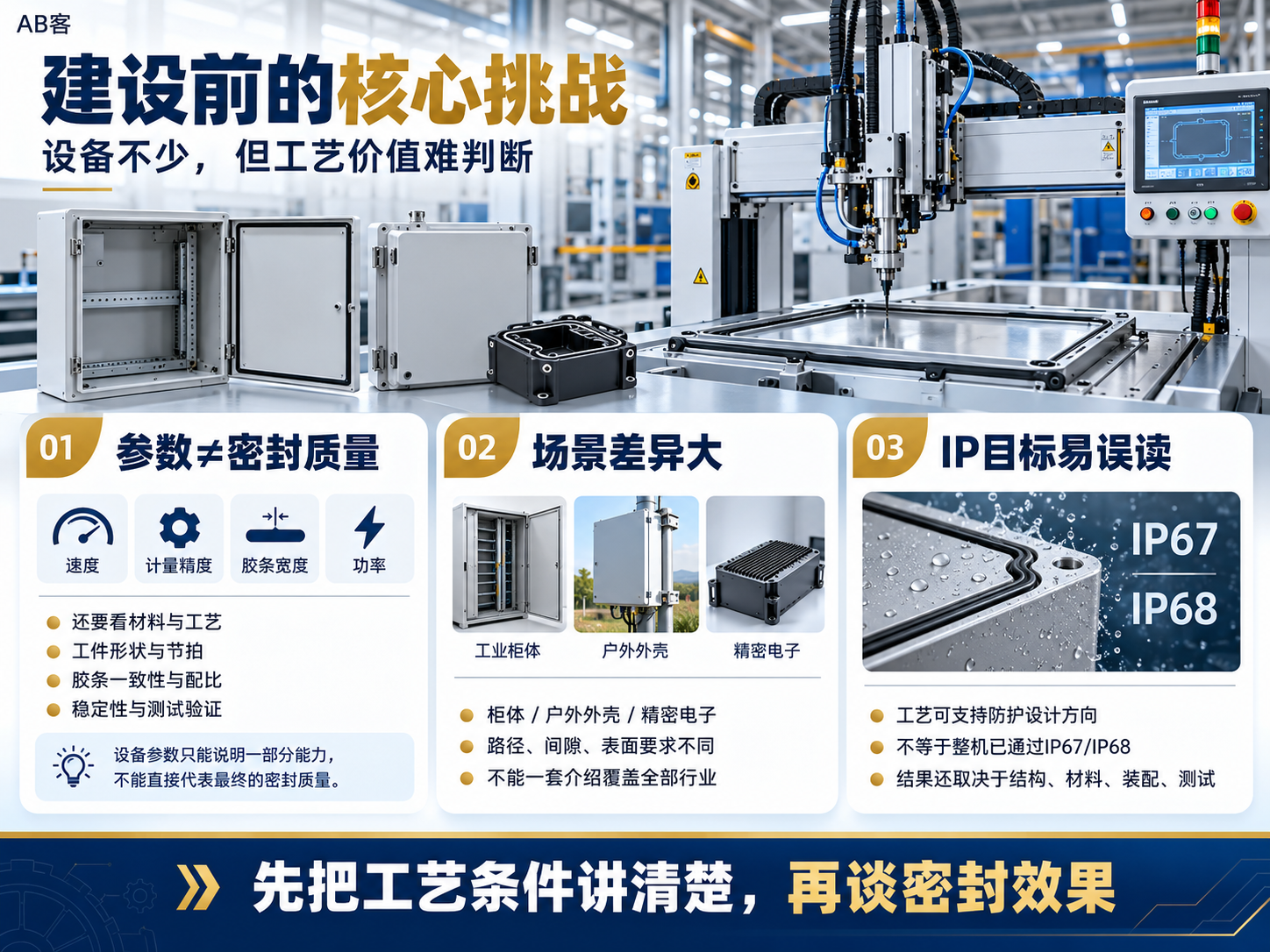
The early problems summarized in the original case were:"There's a lot of information about the equipment, but the technological value and industry compatibility aren't very intuitive."
1. Equipment parameters cannot fully explain the sealing quality.
Working range, speed, metering accuracy, strip width, and power only indicate part of the capabilities; the purchaser also needs to confirm:
- What sealing materials and processes are used?
- Is it suitable for the shape of the workpiece and the production cycle?
- How to control the consistency of the adhesive strips and the material ratio?
- How to maintain process stability during long-term production?
- What tests are needed to confirm the final sealing performance?
The parameter description should include applicable conditions and measurement diameter. The motion accuracy of the equipment should not be directly equated with the consistency of the rubber strip or the final sealing performance.
2. There are substantial differences between industrial sealing scenarios.
The sealing paths, assembly gaps, surface conditions, and environmental requirements for cabinets, outdoor enclosures, and precision electronic products differ. The scenario description should clearly specify the workpiece material, dimensions, production method, and verification requirements, rather than using a single set of equipment to cover all industries.
3. IP protection targets are easily misinterpreted.
While equipment and processes may support certain protection design objectives, whether a complete product can achieve IP67, IP68, or similar ratings depends on its structure, materials, processing, assembly, and testing conditions. Websites must differentiate between "process applicable directions" and "complete product validated," and related reports must correspond to specific samples and conditions.
III. GEO Construction Direction: Integrating Technical Parameters into Real-World Industrial Application Contexts
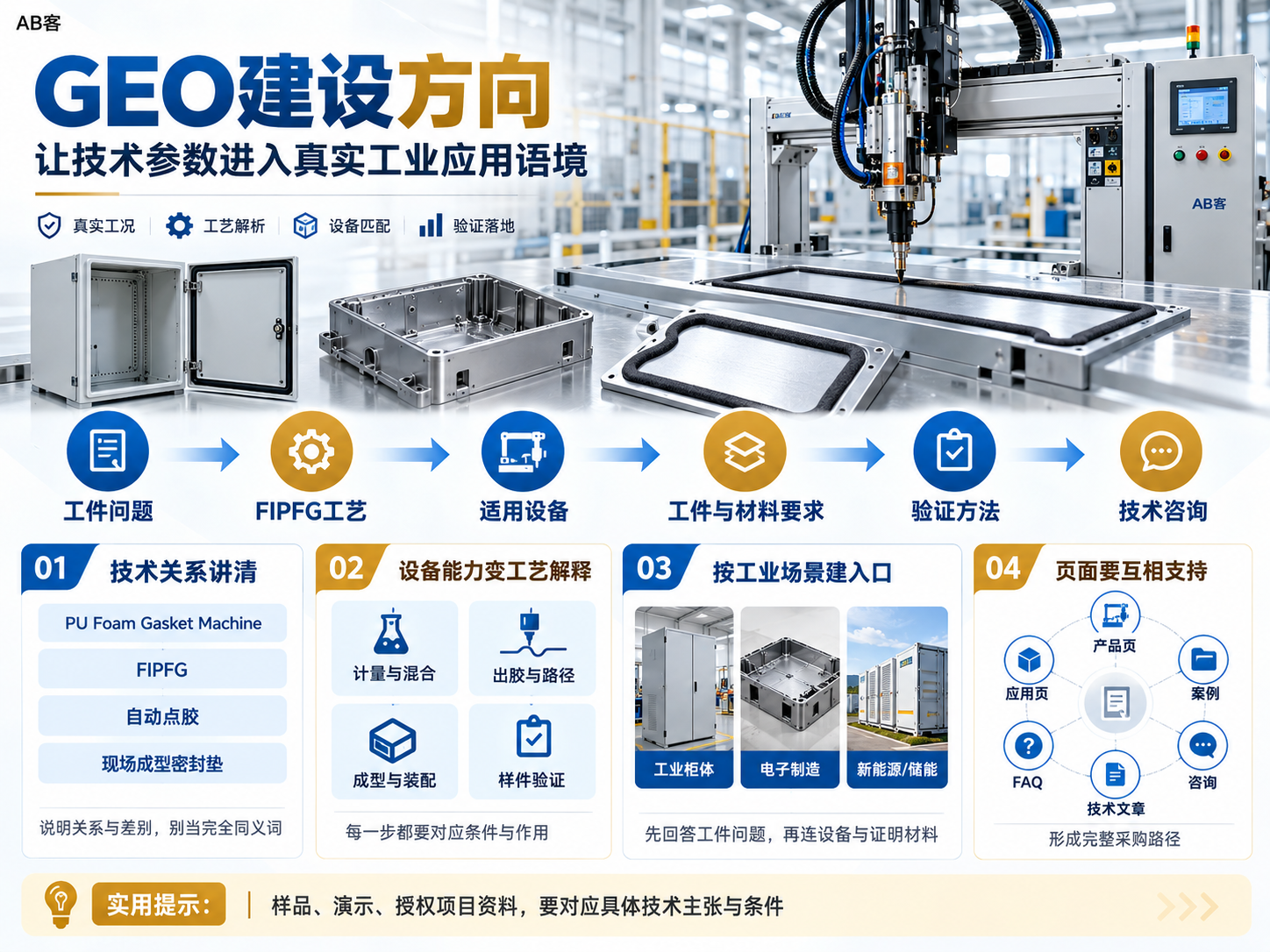
GEO stands for Generative Engine Optimization. For industrial equipment companies, knowledge should be organized around equipment, processes, scenarios, and evidence to help search systems, AI, and buyers understand the business. The following is a construction analysis and does not represent verified project delivery records.
1. Establish a clear relationship between technology and products.
PU Foam Gasket Machine refers to PU foam sealing equipment; FIPGF usually refers to the process of in-situ foaming and molding gaskets. The relationship and differences between this and automated dispensing and in-situ molding gaskets should be explained before relating the model, material, and application, avoiding the use of these terms as completely synonymous.
2. Translate equipment capabilities into process explanations.
The content of the two-component PU foam sealant should explain the role of each step in metering, mixing, dispensing, path control and molding, and describe the evaluation conditions such as the width of the adhesive strip, corners, material condition and workpiece surface.
Measurement and Mixing
Check the material system and proportioning conditions
Glue Dispensing and Path
Assess width, corners and joints
Molding and Assembly
Confirm molding conditions and compression design
Sample verification
Confirm the test plan based on the actual objectives.
Samples, operational demonstrations, and authorized project materials should be associated with specific technical claims and specify the conditions; demonstration materials cannot replace on-site process verification.
3. Establish solution entry points around industrial scenarios
Cabinet manufacturers focus on the consistency of the enclosure's seal; electronics manufacturers focus on narrow paths and size adaptation; and customers related to new energy vehicles or energy storage also assess batch consistency and verification requirements. The scenario page should first answer the workpiece question, then connect the applicable equipment and supporting documentation.
4. Integrate the device page with case studies,FAQMutual support
Products, applications, case studies, and technical articles need to form a mutually supportive procurement path to avoid having only entry points for these sections without any specific connections.
IV. Four Key Data Points Over Six Months: Before-and-After Comparison of the Industrial Sealing Sub-sector
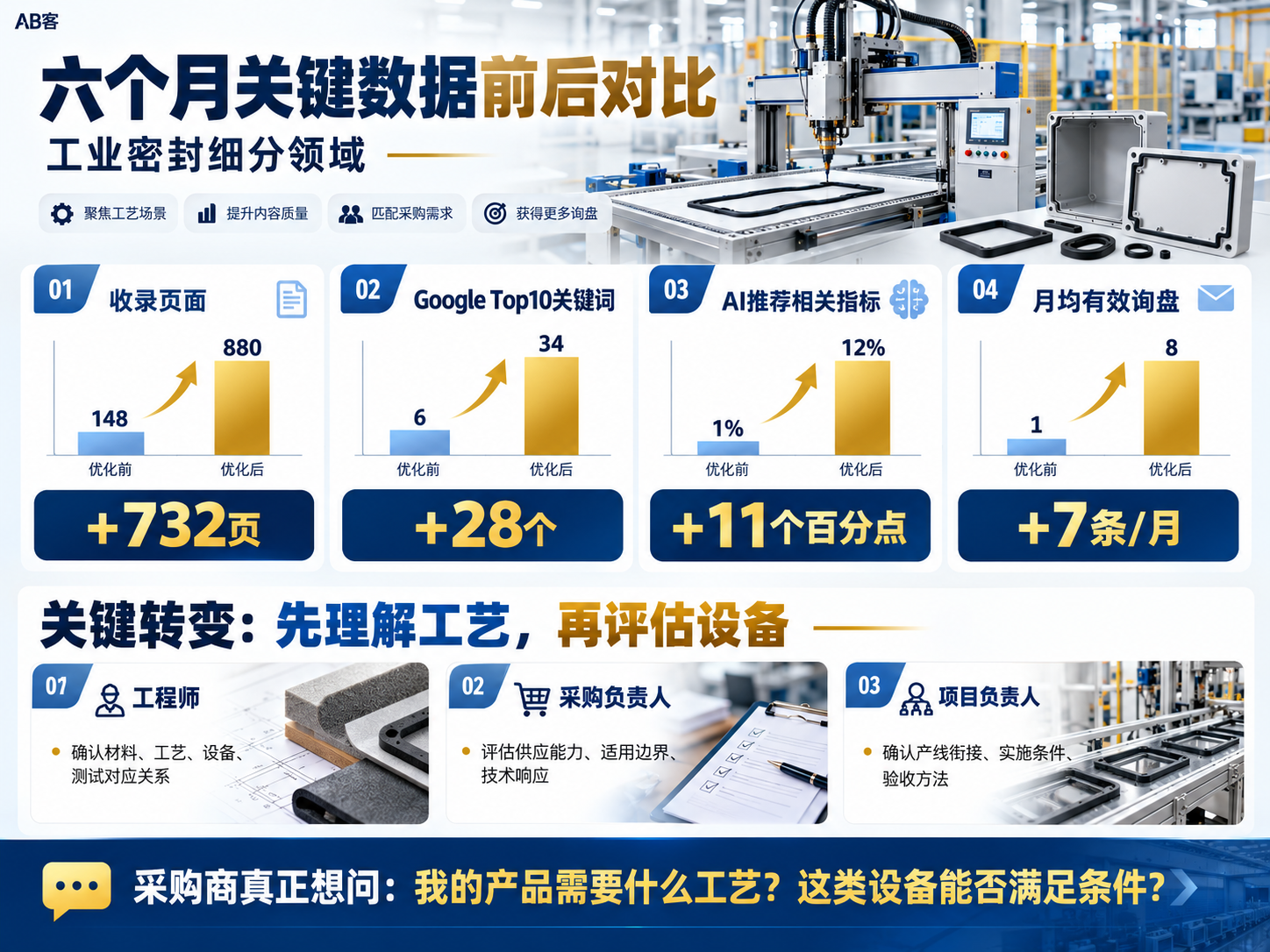
The following is a paraphrase of the image data described in the original case; the actual platform records, statistical dates, and detection conditions have not yet been obtained.
| Key Indicators | Before construction | 6th month | Numerical changes |
|---|---|---|---|
| Included Pages | 148 | 880 | +732 pages |
| Google Top 10 Keywords | 6 | 34 | +28 |
| AI recommendation related metrics | 1% | 12% | +11 percentage points |
| Average monthly valid inquiries | 1 | 8 | +7 items/month |
1. Number of pages included: 148 → 880
Based on the data, 732 pages were added, bringing the total number of pages at the end of the period to approximately 5.95 times the number at the beginning. While topics such as equipment, processes, materials, and selection can form different pages, an increase in the number of pages does not necessarily equate to effective content. The page list, clicks, and duplicate content should be checked, and consistency in statistical methods should be maintained throughout the period.
2. Google Top 10 Keywords: 6 → 34
Based on the data, there was an increase of 28 items, bringing the total number at the end of the period to approximately 5.67 times that at the beginning. Related search topics may include:
- FIPFG Machine
- Foam Gasket Machine
- PU Gasket Dispensing Machine
- Cabinet Sealing Equipment
- Form-in-Place Gasket for Industrial Enclosures
These are just examples of topics and not a list of verified rankings. A thorough review must consider the country, language, device type, and data source, and combine this with search intent and landing page analysis to determine value.
3. AI recommendation-related metrics: 1% → 12%
Based on the data, the increase was 11 percentage points, reaching 12 times the initial value at the end of the period; however, the indicator definition is unclear and cannot be directly referred to as a stable recommendation rate. The platform, model, question set, number of repeated tests, and denominator should be supplemented to identify brand mentions, source citations, and supplier recommendations, and the accuracy of process boundaries should be checked.
4. Average monthly valid inquiries: 1 → 8
Based on the data, an increase of 7 inquiries per month will be achieved, resulting in a period ending 8 times the initial amount. Valid inquiries should be judged based on workpiece dimensions, sealing object, sealing strip requirements, cycle time, and protection objectives.CRMExcluding junk, duplicates, and irrelevant data. Lacking original records, it's impossible to infer conversion rates, order amounts, or independent GEO contributions.
V. Key Shift: Enabling Industrial Procurement to Understand Processes Before Evaluating Equipment
What buyers really want to answer is: "What sealing process does my product require? Does this type of equipment meet the usage requirements?" The information should shift from the supplier's internal model classification to the customer's process decision.
engineer
Confirm the correspondence between materials, processes, equipment, and tests.
Purchasing Manager
Assess supply capacity, applicable boundaries, and technical response.
Project Leader
Confirm production line integration, implementation conditions, and acceptance methods.
First, explain the process and application, then discuss equipment selection.This makes it easier for inquiries to lead to evidence-based technical communication.
six,AB Customer GEOThe value of growth engines in this type of industry
The construction of GEO industrial sealing equipment requires addressing three types of issues simultaneously.
Corporate Awareness问题:Organize equipment, processes, scenarios, and trust evidence to form a knowledge base that has been verified by the enterprise.
Issues regarding the procurement content:Organize products, technical specifications, case studies, and FAQs into a traceable content system, and ensure that multilingual versions are subject to technical review.
Growth validation problem:By linking search coverage, AI responses, website behavior, and CRM feedback, we can differentiate between deliverables, visibility, and business results.
AB customerABKE is a brand under Shanghai Muker Network Technology Co., Ltd. ABKE's GEO growth engine targets B2B foreign trade enterprises, providing them with enterprise knowledge systems,Content productionCapabilities including SEO and GEO websites, channel distribution, CRM, and monitoring and analysis, employing systematic approaches.AI intelligent agentThis approach involves collaboration with human professionals. The actual modules used in this case study are subject to the delivery records; fixed rankings, AI recommendations, or inquiry results are not guaranteed.
VII. What can industrial sealing equipment companies learn from this?
FIPFG, automated dispensing, and industrial sealing companies should prioritize explaining the "applicable conditions behind the parameters": product pages should discuss process capabilities, scenario pages should discuss workpiece compatibility, technical articles should discuss influencing factors, and case studies should provide publicly available verification evidence.
Equipment precision, process stability, and final sealing performance should not be conflated. When evaluating similar projects, first organize product information, buyer questions, test records, and existing inquiries, then discuss knowledge modeling and monitoring scope with A/B clients, clarifying the review responsibilities and acceptance criteria for both parties.
Related case studies:
Foreign Trade B2B GEO Case Study | AB Customer Intelligent Growth Solution
8. Frequently Asked Questions (FAQ)
Q1: Why can't industrial sealing equipment companies only optimize the keywords of their equipment names?
Buyers also look for solutions based on materials, manufacturing processes, housing types, and protection requirements. Simply covering the equipment name is insufficient to answer compatibility questions; application, selection, and validation details should be included simultaneously.
Q2: Does the presence of IP67 or IP68 application specifications prove that all products corresponding to the device meet this level?
No. A complete product assessment must consider applicable standards, structure, manufacturing process, and test results; the process application description is not equivalent to the final certification conclusion, nor can the results of a single sample be extrapolated to all products.
Q3: How to evaluate the commercial value of GEO industrial equipment?
A comprehensive assessment is made by combining high-value question coverage, AI answer accuracy, professional page visits, completeness of technical inquiries, and sales progress, and by verifying source records to avoid substituting a single percentage for business evaluation.
IX. Case Implications and Evidence
The focus for GEOs (Government Operations Experts) in industrial sealing equipment is to explain under what conditions the technical capabilities are meaningful, how they can be verified, and whether they are suitable for the customer's factory, rather than repeatedly emphasizing "high precision" and "high efficiency." Six months of data provides clues for review, but the changes themselves cannot prove causal attribution.


