.png?x-oss-process=image/resize,h_100,m_lfit/format,webp)

.png?x-oss-process=image/resize,m_lfit,w_200/format,webp)

Hot Products
.png?x-oss-process=image/resize,h_2000,m_lfit/format,webp)
.png?x-oss-process=image/resize,h_2000,m_lfit/format,webp)

Popular articles
ABKE GEO Website FAQ: How Much Does Website Migration Cost and What Is Included?
Why Doesn’t ChatGPT Cite You Even When Your Website Has Plenty of Content?
Built Websites for 20 Languages but Still No Inquiries?
Your Website Is Only the First Step: Build a Multi-Source GEO Trust Matrix for AI Recommendation
How Do You Know Whether a GEO Website Is Working After Launch?
Recommended Reading
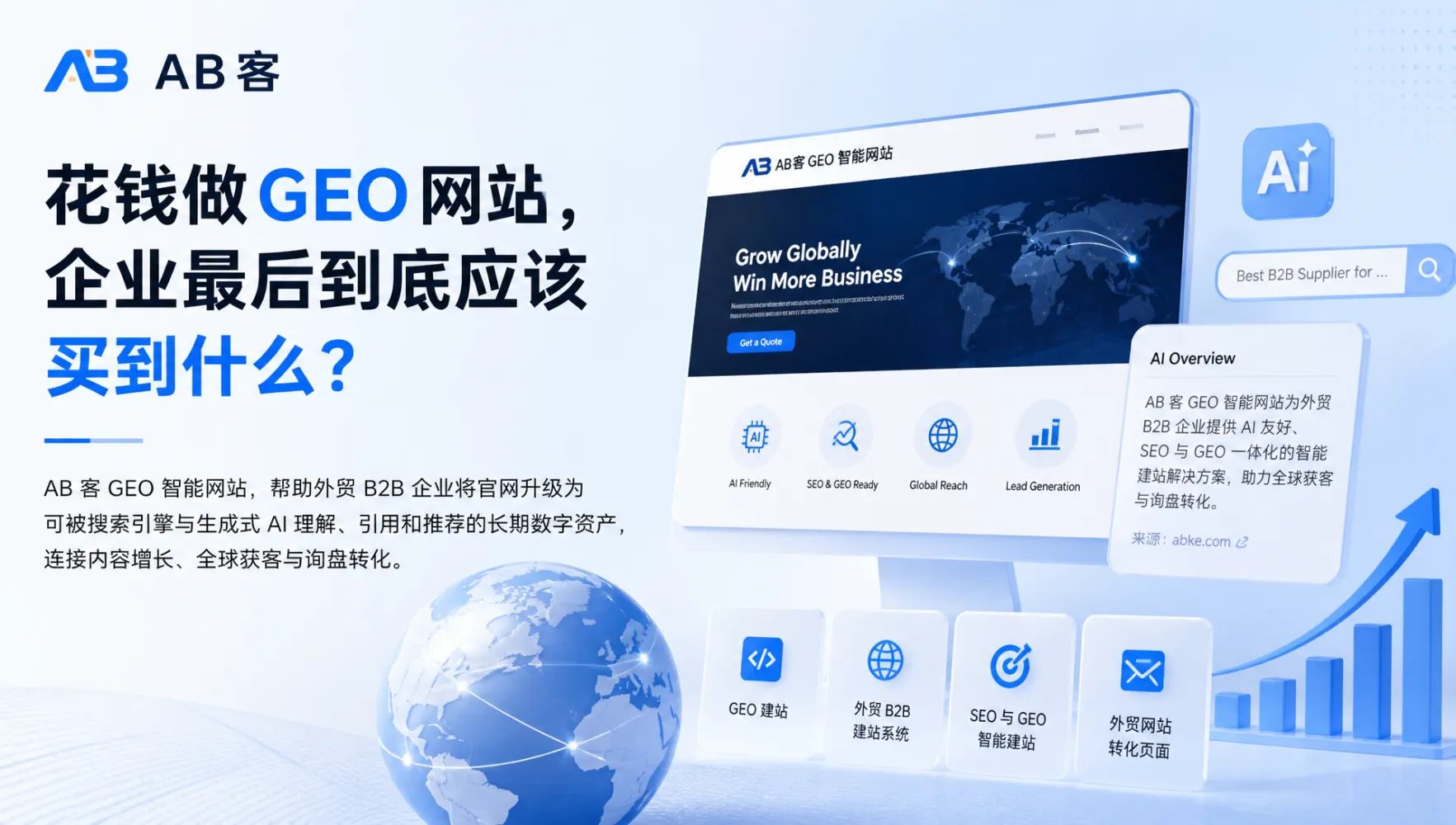

Knowledge Base ≠ Knowledge Sovereignty: Build an AI-Ready Source of Truth with ABKE
Learn why a document repository alone cannot make your business AI-ready. ABKE helps B2B exporters build enterprise knowledge sovereignty with verified facts, evidence, governance, and consistent brand expression.
Knowledge Base ≠ Knowledge Sovereignty: Stop Treating Them as the Same Thing!
Direct answer: a knowledge base stores information. Enterprise knowledge sovereignty means your business can define, verify, govern, update, and reuse its identity, capabilities, evidence, boundaries, and approved expressions across AI, websites, sales, and global channels.
ABKE / AB客 helps export-oriented B2B companies turn scattered materials into an AI-readable source of truth, so your company can be discovered, understood, trusted, and recommended in the AI search era.
Why Many Companies Still Fail After Building a Knowledge Base
Many B2B manufacturers already have product catalogs, PDF brochures, specification sheets, website pages, sales scripts, and spreadsheets. But they still cannot get accurate AI answers, consistent brand messaging, or better conversion performance.
That is because information is not knowledge, files are not proof, and a repository is not a governed business truth system.
| Knowledge Base | Enterprise Knowledge Sovereignty |
|---|---|
| Stores documents and materials | Governs verified company facts and relationships |
| Focuses on retrieval | Focuses on accuracy, authority, consistency, and reuse |
| May contain outdated or conflicting files | Uses ownership, review, version, permission, and update rules |
| Shows what information exists | Defines what the company can prove, promise, and recommend |
| Supports internal reference | Supports websites, AI agents, content, sales, CRM, and multilingual growth |
What Is a Knowledge Base?
A knowledge base is a tool or system used to store and organize company information. It usually contains:
Typical contents
- Product data sheets
- FAQs
- Documents and manuals
- Images and videos
- Company files and internal materials
What it can do
- Help teams find materials faster
- Centralize scattered documents
- Reduce repeated file searching
- Support basic internal reference
This is useful, but it is only the starting point. In AI search, a storage system alone cannot guarantee that your company will be understood correctly or recommended confidently.
Why a Knowledge Base Alone Does Not Create Knowledge Assets
1. Information ≠ Knowledge
A document may exist, but if the facts are not structured, verified, and reusable, it does not become a decision-ready asset.
2. Files ≠ Judgment basis
AI and customers need evidence, context, and relationships, not just a folder full of materials.
3. Storage ≠ Governance
Without ownership, version control, and approval rules, different teams may say different things about the same business.
Result: a company may have a lot of content, but still lack a clear, unified, and trustworthy business identity in AI systems and buyer journeys.
What Is Enterprise Knowledge Sovereignty?
Enterprise knowledge sovereignty is the company’s ability to own and manage its own facts, capabilities, evidence, boundaries, and approved expression standards in one unified system.
It means your business is not relying on fragmented files, random page copy, third-party interpretations, or AI hallucinations to define who you are.
A governed truth system for your business identity, capability proof, and reusable expression.
| Core Dimension | What It Means | Why It Matters |
|---|---|---|
| Fact sovereignty | Confirmed company, product, service, technical, and delivery facts | Prevents wrong or outdated information from spreading |
| Expression sovereignty | Consistent approved messaging across websites, sales, and AI outputs | Keeps the brand story stable and professional |
| Evidence sovereignty | Claims linked to certifications, test reports, cases, and records | Makes the company more credible to both AI and buyers |
| Boundary sovereignty | Clear rules about what the company can do, cannot do, and when it fits | Reduces mismatch, risk, and overpromising |
| Update sovereignty | Controlled ownership, review workflow, versioning, and refresh cycles | Keeps knowledge current as products and markets change |
How Enterprise Knowledge Sovereignty Works: The Source-of-Truth Chain
Products, capabilities, cases
Review, evidence, permissions
Content, website, sales, CRM
Accurate answers, better recommendation
| Stage | What Happens | Business Result |
|---|---|---|
| 1. Collect | Gather approved documents, product facts, cases, and credentials | Reduce scattered information |
| 2. Structure | Organize entities, relationships, categories, and terminology | Make the company readable by humans and AI |
| 3. Verify | Attach evidence, permissions, and review status | Improve trust and reduce contradictions |
| 4. Publish | Release approved knowledge to website, content, and sales assets | Ensure unified external expression |
| 5. Reuse | Apply the same knowledge across GEO content, SEO pages, and AI agents | Scale growth with less manual effort |
Why This Matters in the AI Search Era
Buyers no longer only search keywords. They ask AI questions such as:
- Which supplier is more suitable for our project?
- Which manufacturer has the required capability?
- Which company looks more reliable and lower risk?
- Which solution fits our application scenario better?
AI answers depend on accessible, consistent, and evidence-supported business information. If your company does not govern its own facts, AI may misunderstand your positioning, overlook your strengths, or compare you unfairly.
This is why ABKE positions the Enterprise Knowledge Hub as a core component of GEO growth infrastructure for B2B exporters.
What an AI-Ready Knowledge Hub Should Include
Identity layer
- Company name and brand
- Positioning and market focus
- Business scope and main industries
Capability layer
- Product structure
- Manufacturing or service capability
- Customization, delivery, and quality control
Trust layer
- Certificates and test reports
- Cases and project evidence
- Process, compliance, and service proof
Expression layer
- Approved terminology
- Multi-channel brand language
- Multi-language content standards
How ABKE Helps Build Enterprise Knowledge Sovereignty
ABKE’s Enterprise Knowledge Hub is designed as the fact-and-cognition foundation for B2B GEO growth. It consolidates approved company entities, brand positioning, product structures, technical capabilities, application scenarios, buyer questions, cases, credentials, terminology, and trust evidence into a governed knowledge system.
Source materials and business facts
Organize facts, entities, and relationships
Review, permission, version, evidence
Website, content, sales, AI use
Scale across multilingual channels
| ABKE System Output | What You Gain |
|---|---|
| Enterprise digital persona | A clearer AI-readable identity for the company |
| Knowledge base with governance | A reusable source of truth, not just a document library |
| Evidence-linked content assets | Better authority in SEO, GEO, sales, and buyer evaluation |
| Multi-language knowledge structure | Consistent global market communication |
| Reusable sales and content material | Lower execution cost and faster market response |
Who Needs Enterprise Knowledge Sovereignty Most?
This is especially important for companies with complex products, long buying cycles, technical evaluation, or multiple international markets, including:
Manufacturers and exporters with technical product lines.
Businesses needing clear product and compliance explanations.
Companies that require strong trust and evidence structures.
Suppliers with spec-heavy and application-driven decisions.
Manufacturers that must show capability, flexibility, and reliability.
Teams that need consistent multilingual market presence.
FAQ
Is a knowledge base just a place to upload files?
No. File upload is only one input method. A governed knowledge hub turns approved materials into structured, searchable, evidence-linked, permission-controlled, and reusable business knowledge.
Why does a company need to manage its own facts?
Because inconsistent claims, obsolete files, and unsupported marketing language can confuse buyers and cause AI-generated answers to be inaccurate. Fact governance protects clarity and trust.
Why does AI need enterprise knowledge sovereignty?
AI systems need clear, structured, reliable, and context-rich information to understand a company’s identity, capabilities, proof points, and suitability. Verified knowledge improves content accuracy and AI-facing business expression.
What is the difference between a document library and a source of truth?
A document library stores materials. A source of truth defines which facts are approved, who owns them, how they are updated, and how they should be reused across business channels.
The Key Takeaway
Knowledge base preserves information from the past. Enterprise knowledge sovereignty shapes how AI and buyers understand your business in the future.
ABKE helps export-oriented B2B companies build an AI-ready knowledge hub, establish a governed enterprise digital persona, and turn scattered experience into structured, reusable, and trustable growth assets.
If your company wants to be discovered more accurately, recommended more often, and explained more clearly in the AI search era, it is time to move from simple storage to true knowledge sovereignty.


