Hot Products





Popular articles
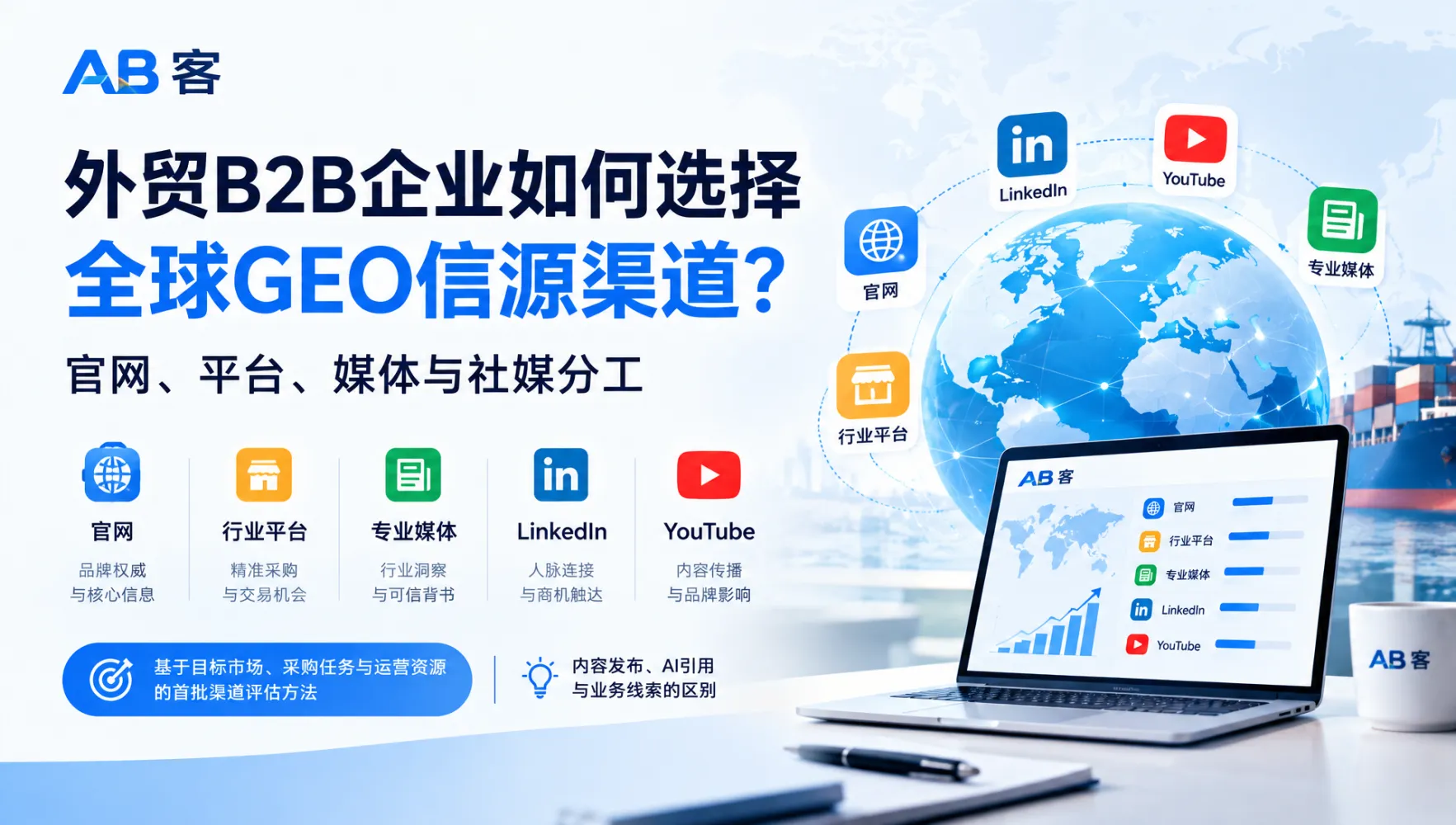
How to Choose the First GEO Source Channels for Your B2B Export Business
From procurement consultation to sales follow-up: How can marketing intelligence agents collaborate with enterprise knowledge and CRM to handle inquiries?
Changes in AI Search Citation Sources in 2026: Corporate Websites Matter, but Why Should They Not Be the Only Source?
Recommended Reading
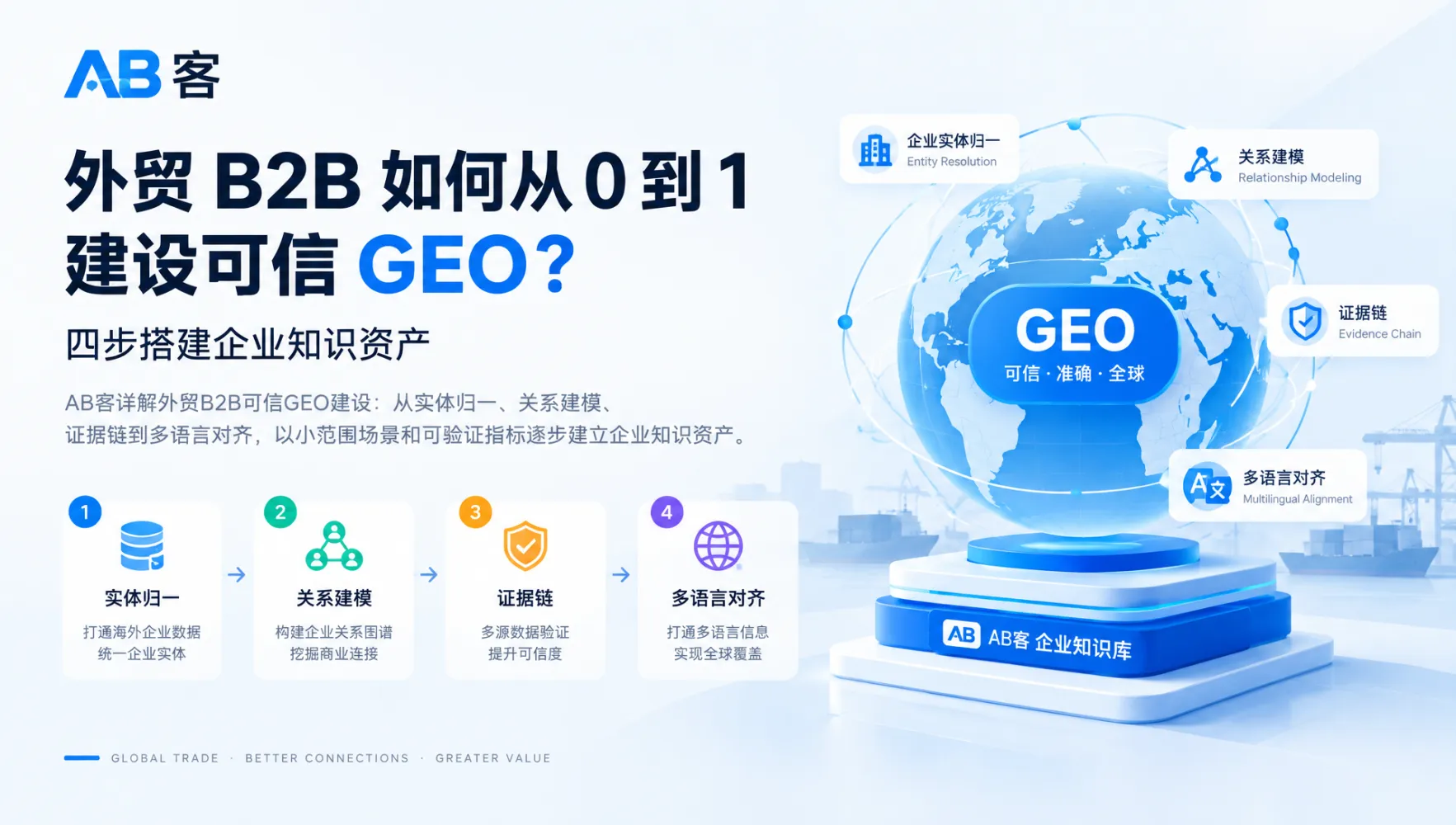
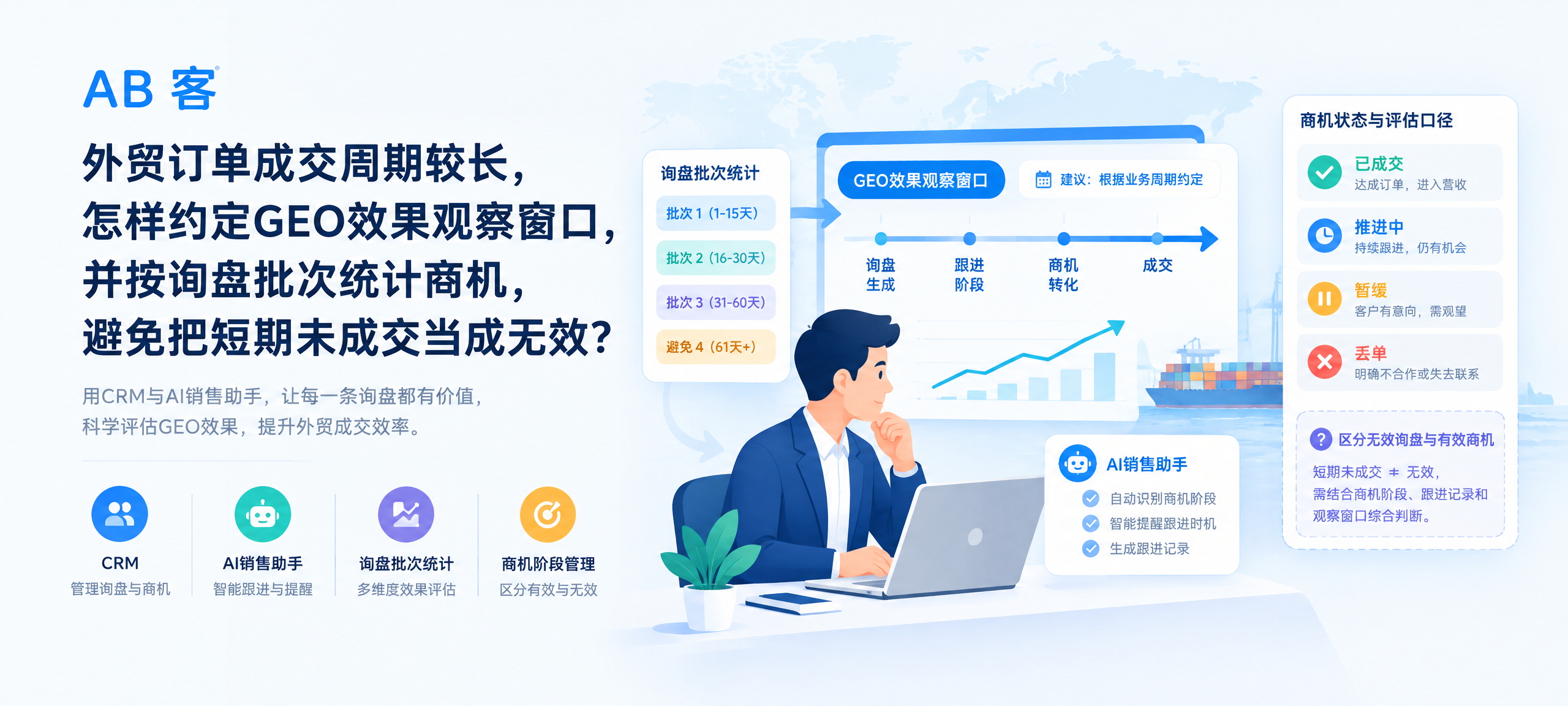
Foreign trade orders have long transaction cycles. How can we define the observation window for GEO (Gross Order Optimization) effects and count business opportunities by batch of inquiries to avoid treating short-term non-sales as invalid?
Addressing the long transaction cycles in foreign trade, AB Customer, leveraging the inquiry, opportunity, and follow-up recording capabilities of CRM and AI sales assistant, explains the suggested agreement basis for the GEO effect observation window, the classification of inquiry batches, and the evaluation criteria for completed, ongoing, suspended, and lost orders, distinguishing between invalid inquiries and valid opportunities that have not yet been closed. Specific window and batch statistics implementation methods need to be confirmed with business operations.
For transactions with long lead times, the validity of inquiries should be evaluated separately from whether a business opportunity is closed.
For foreign trade B2B companies, procurement confirmation, technology evaluation, solution communication, and business negotiations may span multiple review cycles.No transaction in the short term does not mean the inquiry is invalid; business opportunities that are still in progress cannot be counted as transactions in advance.
AB recommends combining historical transaction cycles, inquiry volume, and sales follow-up records to negotiate the GEO effect observation window; establishing batches based on the first inquiry entry time, and then comparing the inquiry quality and opportunity status of each batch with the same follow-up duration. CRM and AI sales assistant provide the data foundation for recording and sales collaboration; the specific observation window, status merging rules, and batch statistics implementation methods need to be jointly confirmed before implementation.
I. How to define the observation window: First, look at the business cycle, then determine the review node.
The GEO Performance Observation Window is a timeframe agreed upon by both parties for checking content and search visibility, inquiry quality, lead progression, and sales results. It is not a uniformly applicable "sales deadline," nor is it a deadline after which all unsuccessful leads are deemed invalid.
-
Refer to historical transaction cycles and their spans:Understand the typical steps involved in moving from an inquiry to demand confirmation, quotation, and transaction, and differentiate between different products, markets, and project types.
-
Check if existing data is available:Confirm the completeness of the inquiry initiation time, opportunity stage, follow-up records, and the date of completion or lost order. If historical data is missing, establish a baseline record first to avoid providing a fixed window without sufficient basis.
-
Judging sample maturity by inquiry volume:For businesses with fewer inquiries but higher average order values, the results should be interpreted in conjunction with the specific progress of the business opportunity, rather than judging the channel value solely based on the conversion rate of a small sample.
-
A review of the agreed-upon process and results:The process review focuses on response, demand confirmation, and phased progress; the results review observes the completion, postponement, and lost orders after the business opportunity has undergone a reasonable follow-up period.
Recommended principles for the agreement:When the observation window has not yet covered the typical procurement cycle, prioritize assessing the quality of inquiries and evidence of progress; after reaching the agreed milestones, conduct a review by combining status distribution, transaction results, and explanations of unresolved business opportunities, rather than just looking at the number of orders in the current period.
Second, batch statistics are entered based on inquiries to avoid mixing new and old business opportunities.
Inquiry batch statisticsThis involves grouping inquiries that first appear within the same agreed-upon timeframe into a single group and continuously monitoring the business opportunities that subsequently arise from and the changes in those inquiries. The grouping is based on the time the inquiry is submitted, not the time the transaction is completed.
-
Fixed batch affiliation.Grouping by agreed-upon time granularity, recording the source, customer, contact person, and related business opportunities. Subsequent transactions will still be observed in the original inquiry batch, and their attribution will not change regardless of whether the transaction occurred in a different month.
-
Standardize the observation period.When comparing the status of different batches after entering the market with the same follow-up period, one cannot directly use the long-term transaction results of earlier batches to compare the short-term results of newer batches. Batches that have not yet reached the same observation period should be marked "Observation not yet complete".
-
Separately count inquiries and business opportunities.First, review the total inquiries, valid inquiries, and A/B category inquiries. Then, check the status of related business opportunities: completed, pending, suspended, and lost. Valid inquiries that have not yet been confirmed as business opportunities should be kept separately and not forcibly added to the business opportunity status.
-
Define rules for deduplication and association.When a customer makes multiple inquiries, an inquiry generates multiple business opportunities, or multiple touchpoints affect the same business opportunity, it is necessary to clarify the association and counting methods to avoid double counting.
Batch reports should also indicateStatistics cutoff date, duration of follow-up, and status criteriaIf it is necessary to restore the state of a certain historical node, it should be confirmed during implementation that the historical records are sufficient to support backtracking; today's state cannot replace the state at that time.
3. How to determine whether an order has been completed, is in progress, is suspended, or has been lost?
The following are recommended assessment criteria. The specific stage definitions and evidence requirements should be aligned with the company's sales process. "In Progress" is a consolidated criterion used for retrospective analysis and should not be considered a fixed stage in the system without confirmation.
| Classification | Recommended judgment criteria | How to handle during the debriefing |
|---|---|---|
| Completed | The transaction confirmation criteria agreed upon by both parties have been met, and there are corresponding business records. | Include it in the original batch of transaction results and indicate the transaction date. |
| In progress | There are already verifiable needs or business opportunities, and progress is underway in the stages of need confirmation, solution or business agreement. | Show the current stage, recent follow-ups, and next steps; do not count as a transaction in advance. |
| Postponed | The project or procurement has been temporarily suspended. The reason has been recorded, but termination has not yet been confirmed. | Listing the reasons and reconfirmation nodes separately does not equate to "in progress" by default. |
| Lost order | Confirm that a business opportunity has been terminated or that an order has not been won in accordance with company rules, and record the reason. | Used to analyze factors such as product, price, delivery, or competition, and not directly rewritten as invalid inquiries. |
| Invalid Inquiry | Inquiries such as spam, job postings, supply promotions, inquiries from people who cannot be contacted, or inquiries that are clearly not the target business. | Inquiry quality is counted separately and is not considered as a business opportunity. |
Special distinction is needed:A/B/C categories represent the quality grading of inquiries, while "completed," "in progress," "pending," and "lost" indicate the progress of business opportunities. High-quality inquiries can also be lost; a valid business opportunity not yet closed does not automatically become an invalid inquiry. Business opportunities that haven't been updated for a long time should be reviewed, rather than remaining indefinitely as "in progress."
IV. How can CRM and AI sales assistants provide a data foundation for evaluation?
ABKE's CRM and AI Sales AssistantIt is a sales collaboration system that integrates leads from websites, content, channels, and enterprise intelligent agents. In long-term sales cycle evaluation, its role is to record the source, judgment, and follow-up process of customer opportunities, enabling marketing and sales to review based on the same set of information.
CRM: The process of preserving leads and opportunities
Manage customers, contacts, inquiries, sources, quality grading, opportunity stages, follow-up records, quotations, and sales targets, providing basic information for inquiry batch analysis, sales funnel, and transaction feedback.
AI Sales Assistant: Assisting in Judgment and Follow-up
Based on enterprise knowledge and customer information, it assists in generating inquiry summaries, customer background analysis, intent judgment, tiering suggestions, draft responses, recommended materials, and business opportunity reviews to help sales prepare for subsequent communication.
Capability Boundaries:Having the ability to record inquiries and business opportunities does not equate to having ready-made batch reports that meet all business criteria. Whether batch statistics can be generated directly, how to merge stages, and whether additional configuration or data processing is required should all be confirmed before implementation. AI suggestions need to be verified by sales personnel and cannot replace business judgment, pricing, negotiation, and closing the deal.
5. Use sales feedback for GEO optimization, rather than attributing all sales to GEO.
For long-term GEO performance evaluation, front-end visibility, inquiry quality, and back-end operational results should be examined separately. AI mentions, search visits, or page views are front-end signals and cannot be directly interpreted as valid leads or orders.
-
Inquiry quality:Number of valid inquiries, percentage of A/B category inquiries, and lead matching across different countries, languages, pages, and channels.
-
Sales Promotion:The timeliness of the initial response and follow-up, the conversion of leads into business opportunities, the changes in stages, and the reasons for the postponement.
-
Results of mature batches:After the agreed observation period is reached, analyze completed transactions, lost orders, sales cycles, and unfinished business opportunities.
-
Market feedback:By combining source records and content touchpoints, identify which content has affected valid inquiries and business opportunities; when the source is unclear or multiple touchpoints have a combined impact, it should be marked truthfully, and no forced attribution should be made.
When calculating proportions, the denominator should be clearly stated: inquiry-to-opportunity conversion and opportunity conversion are different indicators and should not be used interchangeably. When comparing batches, differences in product, market, and source structure should be checked simultaneously to avoid misinterpreting changes in customer base as changes in GEO effectiveness.
Related reading:
Before implementation, the assessment checklist should be confirmed jointly.
When communicating with A and B customers, prepare historical inquiry and transaction records, current sales stage definitions, typical procurement cycles, and channel source information, and prioritize confirming the following:
-
Observation window, process review points, and adjustment basis;
-
Inquiry batch segmentation, follow-up duration for identical inquiries, and deduplication rules;
-
Criteria for judging inquiry quality, business opportunity formation, and various statuses;
-
Record the person in charge, update requirements, and reasons for order delays or loss;
-
The implementation methods for batch statistics, historical status backtracking, and reports.
Prerequisites for joint execution:Businesses promptly process high-value leads and continuously supplement follow-ups, business opportunities, and sales feedback. AB Customer does not guarantee a fixed number of inquiries or sales results; the goal of the evaluation is to ensure that immature opportunities are properly observed, truly ineffective leads are identified, and long-standing stagnant problems are promptly discovered.


