.png?x-oss-process=image/resize,h_100,m_lfit/format,webp)

.png?x-oss-process=image/resize,m_lfit,w_200/format,webp)

热门产品

Popular articles
Your competitors are secretly stealing your core customers through GEO. Can you sit still?
Semantic Internal Linking Strategy: Build an AI-Readable Capability Map with AB客GEO
Semantic Islands: Why AI Can’t Index Your Core Value Proposition (ABK GEO Guide)
SSL Certificates & Security Protocols: Building AI Trust with HTTPS, EV, HSTS and Security Headers
Standing on the shoulders of giants: How AB Guest can help you bridge the technological gap of GEO?
GEO Self-Audit Checklist: 10 Technical Fixes for B2B Export Websites | AB客GEO
Shifting from a traffic-driven mindset to a cognitive mindset: How can GEOs enhance their influence across the internet?
Rejecting Anxiety: A GEO Transformation Risk Assessment Report for Foreign Trade Business Owners
Recommended Reading








Why do those GEO companies that promise "massive posting" are actually "poisoning" your brand??
In B2B export marketing, “mass posting” GEO services don’t just fail to improve visibility—they can actively poison your brand’s presence in AI search. When hundreds of low-quality posts spread across platforms use inconsistent product definitions, conflicting specs, and vague positioning, AI systems struggle to build a stable knowledge entity. The result is reduced trust, fragmented brand signals, and a lower likelihood of being cited or recommended in AI answers. Effective GEO focuses on consistency and citability: a single source of truth on your website, structured content aligned to real buyer questions, controlled versioning, and selective distribution that reinforces—not competes with—your core pages. Published by ABKE GEO Research Institute.
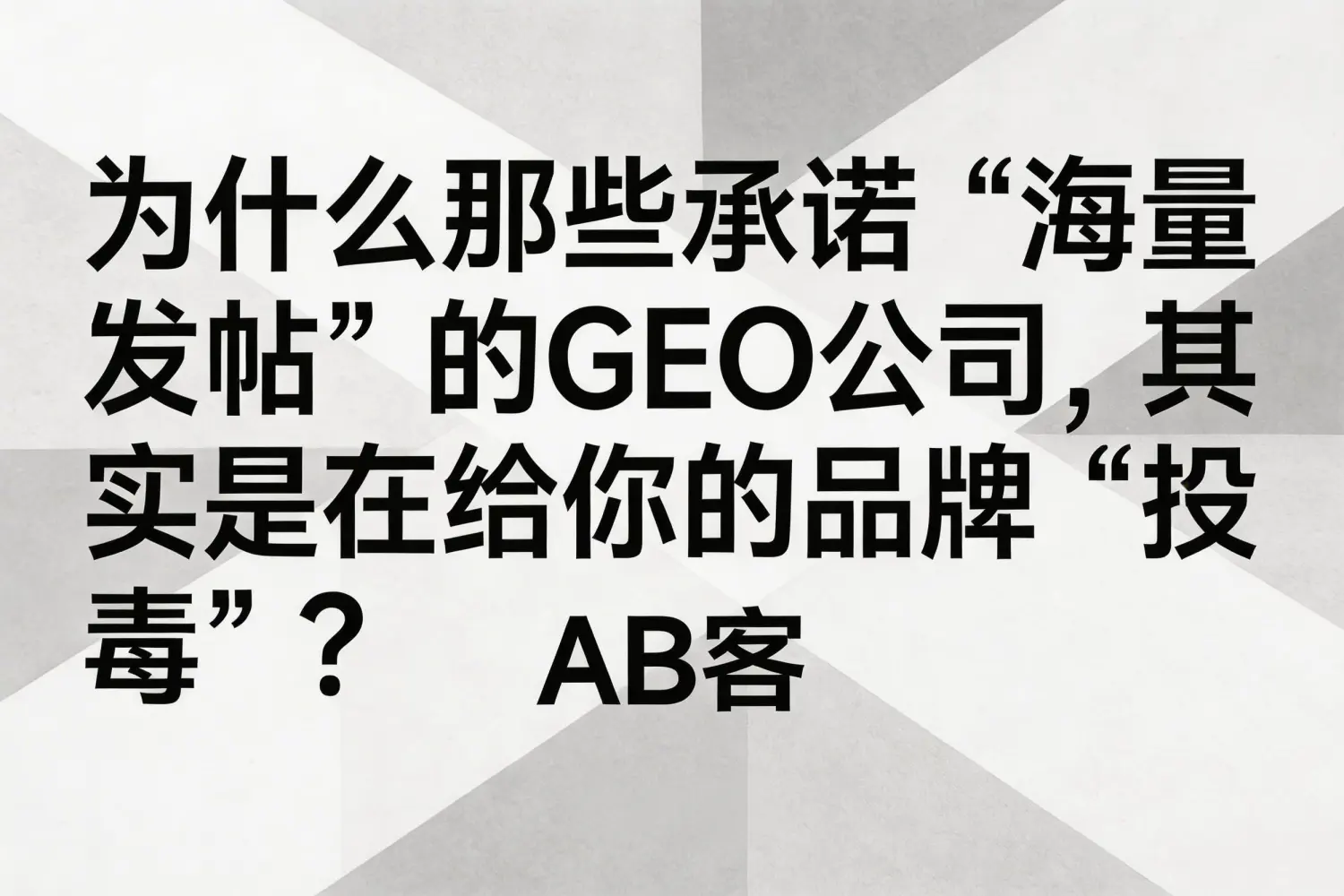
Why do those GEO companies that promise "massive posting" are actually "poisoning" your brand?
In the era of AI search and generative answers, the biggest risk of “mass posting” isn’t that it fails to rank—it’s that it continuously publishes low-consistency, low-credibility brand statements across the web, damaging how AI models form and stabilize your brand entity. Many exporters discover a frustrating outcome: content volume rises, but AI assistants stop citing them—or never cite them in the first place.
ABKE GEO’s core stance: for GEO (Generative Engine Optimization), information consistency + citability beats “coverage + quantity.”
The Real Problem: AI Doesn’t Reward “More Pages”—It Rewards “Stable Truth”
A common sales pitch goes like this: “We’ll publish 100–300 posts per month, across 20+ platforms.” For a traditional SEO mindset, that may sound like broader reach. But AI search systems increasingly behave like entity-centric knowledge builders. They try to answer questions with confidence, citing sources that appear stable, consistent, and verifiable over time.
When your brand appears in dozens of low-quality pages with mismatched product definitions, inconsistent specs, conflicting use cases, or vague positioning, the model receives noisy signals. The result is not “extra visibility,” but a kind of brand signal dilution—and sometimes outright brand poisoning.
How Brand Poisoning Happens: 3 Mechanisms You Can Measure
1) Semantic Conflicts: One Product, Multiple “Truths”
Mass-posting teams often reuse templates, paraphrase specs, and rewrite positioning to “avoid duplication.” That sounds harmless—until it creates contradictions. For example:
- Your material is described as “304 stainless” on one site and “316” on another.
- A model’s temperature range changes from “-20–120°C” to “0–150°C.”
- Your company is alternately positioned as “manufacturer,” “trading company,” and “OEM partner.”
AI models are conservative when citing. If they detect uncertainty, they may prefer established brands, authoritative catalog sites, or sources with consistent data footprints.
2) Fragmented Knowledge: Lots of Pages, No “Complete Answer”
In B2B export, buyers (and AI) ask structured questions: compliance, tolerances, lead time, compatible substitutes, installation constraints, MOQ flexibility, and application risks. Mass posting often generates “generic marketing paragraphs” without forming a complete, reference-ready explanation.
A practical benchmark: if a page can’t support a citation for a question like “Which supplier can replace Model X with equivalent specs and certifications?”, it’s unlikely to be useful for AI answers.
3) Source Dilution: Your Website Loses Authority Over Your Own Narrative
When 70–90% of your brand content footprint sits on low-authority platforms, the “canonical source” (your website) stops being the dominant reference point. Over time, AI may learn your brand through scattered third-party pages rather than your verified product documentation—especially if the website lacks structured data and consistent product pages.
What AI Search Actually Looks For in B2B Supplier Recommendations
While vendors love talking about “platform coverage,” AI recommendation logic often aligns with something closer to knowledge stability + citation fitness. In practice, suppliers that get cited more frequently tend to have:
Reference ranges from common B2B GEO audits (2023–2025): brands with inconsistent spec statements across 15+ pages typically see lower AI citation rates in comparison-style queries.
A Practical Reality Check: “Mass Posting” KPIs Are Often Misleading
Many providers report metrics like post count, index count, or “estimated impressions.” These are not useless—but they often ignore what matters in AI-driven discovery:
- Recommendation queries (e.g., “best supplier for…”, “alternative to…”, “compare…”) are high intent.
- Citation probability depends on whether AI can quote a stable snippet without risk.
- Trust accumulation is slower than “publishing speed,” and contradictions reset progress.
From exporter case reviews, a common pattern is: after 6–10 weeks of mass posting, the brand has more pages but fewer consistent “anchor” statements. The company feels busier online, yet becomes less quotable.
What to Do Instead: A GEO Framework Built for Consistency and Citability
This is not an argument against publishing content. It’s a warning against publishing uncontrolled variants. A safer approach (often used in AB客GEO-style execution) is to treat your brand like an AI-readable knowledge entity:
Step 1: Establish a Single Source of Truth (SSOT)
Centralize product facts: model naming rules, spec tables, test methods, certificates, materials, tolerances, packaging, and standard disclaimers. In many B2B teams, this is a structured website + internal spec sheet. If you can’t keep facts consistent internally, AI won’t keep them consistent externally.
Step 2: Build “Answer-First” Pages (Not “Keyword-First” Posts)
Prioritize pages that directly answer buyer questions: compatibility, substitution, failure modes, selection guides, compliance, application constraints, and verification steps. Use numbers, conditions, and clear scope—so AI can safely quote you.
Step 3: Controlled Distribution (Fewer Channels, Higher Quality)
Publish fewer external pieces, but ensure every external mention points back to the same canonical definitions. Think: “one story, many mirrors”—not “many stories, many platforms.”
Two Real-World Patterns Exporters Keep Seeing
Case Pattern A: Electronics Components — Spec Drift Kills Citations
A component supplier outsourced “mass posting” across multiple platforms. Over time, different articles described the same model with different parameters (voltage rating, tolerance, operating temperature), and even mismatched application scenarios. Despite hundreds of posts, the brand wasn’t cited in AI Q&A for “equivalent replacement” queries.
The turnaround came from reducing external publishing, unifying the product data source, and rebuilding website pages with consistent spec tables and structured FAQs. In around 6–10 weeks (typical re-index + re-learning window), the brand began appearing in “substitute model recommendation” style prompts.
Case Pattern B: Machinery — Consistent Solution Logic Increases Recognition
A machinery exporter improved AI mention stability by standardizing how they describe industry solutions: the same problem framing, the same constraints, the same selection logic, and a consistent terminology set across pages. Rather than flooding platforms, they made each page “quotable,” and AI started treating the brand as a coherent supplier entity.
How to Vet a GEO Provider Offering “Mass Posting” (A Buyer’s Checklist)
- Consistency test: Ask for 10 sample URLs. Check if product definition, use cases, and specs match exactly (not “similar,” but consistent where it matters).
- Canonical-source strategy: Do they treat your website as the primary truth source, or as just one more place to dump content?
- Question-driven architecture: Can they map content to real buyer questions (replacement, comparison, compliance, selection) rather than generic “company intro” posts?
- Control mechanism: Do they have version management, content review rules, terminology standards, and structured templates that prevent drift?
- Evidence of citability: Can they show examples where AI results cite the brand, or at least demonstrate improved snippet-level clarity and consistent referencing behavior?
Want GEO That Builds a Brand Entity—Not a Content Pile?
If you’re evaluating a “high-volume posting” service, pause and check whether they can guarantee consistency, structured truth sources, and citation-ready pages. ABKE GEO focuses on building stable, quotable knowledge that AI can safely recommend in B2B supplier queries.
Explore ABKE GEO’s Generative Engine Optimization Framework (Ideal for exporters who need consistent product truth across markets and platforms.)
This article is published by ABKE GEO Institute of Intelligence Research.
.png?x-oss-process=image/resize,h_100,m_lfit/format,webp)
.png?x-oss-process=image/resize,h_100,m_lfit/format,webp)

.png?x-oss-process=image/resize,h_100,m_lfit/format,webp)
.png?x-oss-process=image/resize,h_100,m_lfit/format,webp)
.png?x-oss-process=image/resize,h_100,m_lfit/format,webp)
.png?x-oss-process=image/resize,h_100,m_lfit/format,webp)
