.png?x-oss-process=image/resize,h_100,m_lfit/format,webp)

.png?x-oss-process=image/resize,m_lfit,w_200/format,webp)

Hot Products
.png?x-oss-process=image/resize,h_2000,m_lfit/format,webp)
.png?x-oss-process=image/resize,h_2000,m_lfit/format,webp)

Popular articles
Sales Teams Cannot Find Information Fast Enough? Build a Knowledge Base for Consistent Pre-Sales and Follow-Up
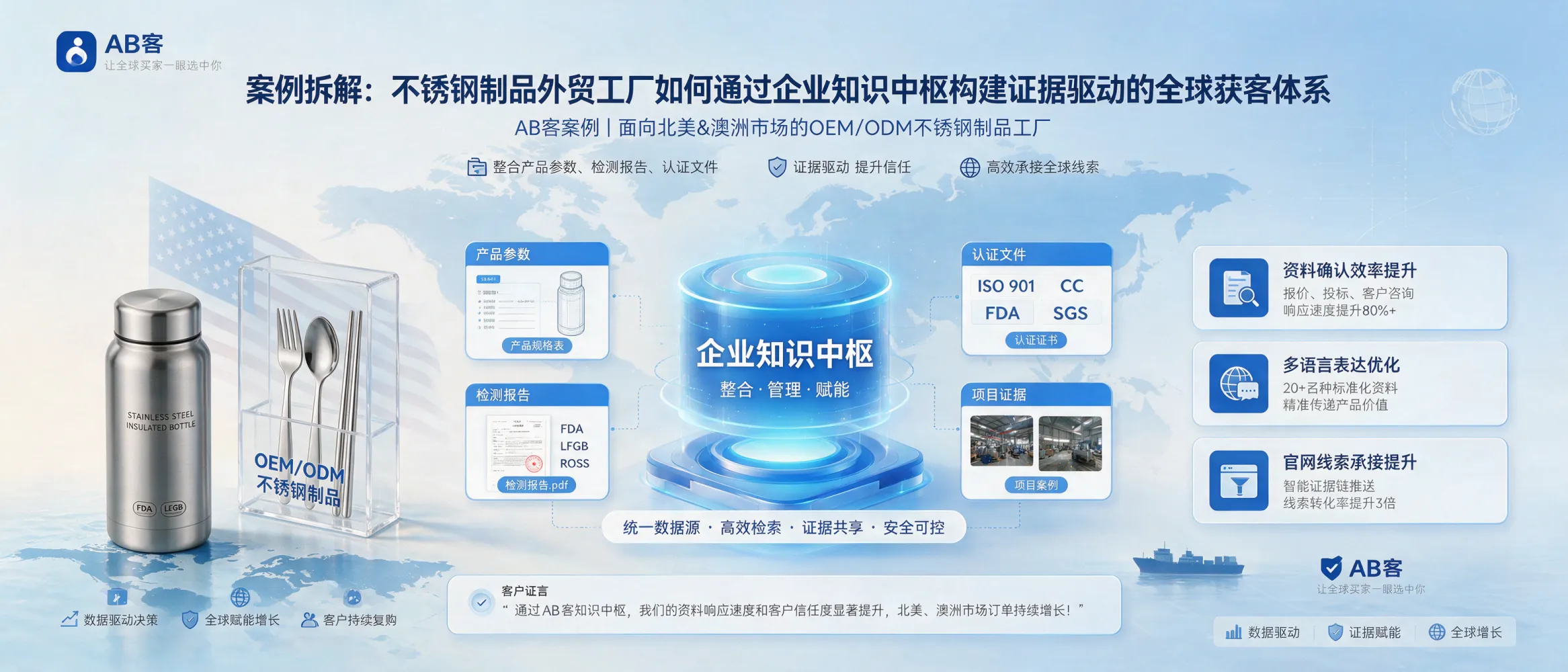
Case Breakdown: How a Stainless Steel Export Factory Built an Evidence-Driven Global Lead Generation System Through an Enterprise Knowledge Hub
How can foreign trade companies solve the problems of competing for traffic and brand fragmentation when operating multiple SEO sites, product sites, and country sites simultaneously?
Recommended Reading



How a Mechanical Equipment Exporter Built a Product and Selection Content System
ABKE outlines how a mechanical equipment exporter can build connected product pages, FAQs, and selection guides to help overseas buyers understand applications, model differences, and purchasing requirements.
For export-oriented mechanical equipment companies, a website cannot rely on product names, images, and parameter tables alone. Overseas buyers often need to understand whether a machine fits their materials, capacity requirements, operating conditions, application scenario, and purchasing process before they are ready to make an inquiry.
In this content-building project, ABKE worked with a mechanical equipment exporter with a complex product range to plan a connected product and selection content system. The work focused on real product knowledge, recurring buyer questions, and typical application scenarios—not on publishing disconnected articles or making unsupported performance claims.
The Content Challenge: Parameters Did Not Fully Support Buyer Decisions
The exporter already had a basic website presence, but much of its product content remained parameter-focused. With multiple equipment categories, models, configurations, and use conditions, buyers could see technical specifications without always understanding what those specifications meant for their own purchasing decision.
In practical B2B conversations, buyers commonly need answers to questions such as:
- Which equipment type is suitable for a specific application or material?
- How do different models compare in capacity, configuration, or operating conditions?
- What information should a buyer prepare before requesting a recommendation or quotation?
- What should be considered regarding maintenance, delivery, customization, or installation conditions?
A Connected Product Selection Content System
ABKE planned the content system as a set of connected assets that serve different stages of an overseas buyer’s research and evaluation process. Rather than treating every page as an isolated item, the structure links product understanding, purchasing questions, selection logic, and relevant applications.
| Content Asset | Primary Buyer Need | Role in the Content System |
|---|---|---|
| Product pages | Understand functions, core parameters, applications, and available configurations. | Explain what the equipment is, where it may fit, and which purchasing details require confirmation. |
| FAQ content | Resolve recurring questions about selection, operation, maintenance, delivery, and customization. | Turn repeated sales questions into reusable website and sales-support knowledge. |
| Selection guides | Evaluate capacity, materials, operating conditions, application requirements, and budget considerations. | Help buyers understand how to compare options before moving to a specific model. |
| Application content | Determine whether equipment is relevant to a particular industry or use case. | Connect equipment capabilities with real operating contexts and buyer intent. |
Building from Product Knowledge, Not Generic Content
The first step was to turn dispersed internal information into a manageable product knowledge structure. Existing product materials, website information, sales communication records, and common purchasing questions were reviewed to identify information that could be clearly explained and reused.
Product Structure
Clarify equipment categories, model relationships, major functions, configurations, and the role of key parameters.
Application Context
Organize applicable materials, operating conditions, industry scenarios, and the conditions that may affect equipment suitability.
Buyer Questions
Capture recurring questions related to model selection, procurement preparation, maintenance, delivery, and customized requirements.
This process shifts the focus from listing specifications to explaining how specifications influence selection. For complex mechanical equipment, that distinction is important: a parameter table may describe a machine, while structured product knowledge helps a buyer understand whether it may fit their operating need.
Content Workflow for Buyer-Oriented Product Knowledge
The planned workflow creates a stable path from internal knowledge to connected, buyer-facing content assets:
- Collect source information: product documentation, existing pages, sales questions, application details, and purchasing considerations.
- Structure product knowledge: organize categories, models, parameters, applicable conditions, and selection factors into clear topic groups.
- Map buyer intent: identify what buyers need to know when evaluating a product, comparing models, or preparing an inquiry.
- Develop connected content: build product pages, FAQs, selection guides, and application content around the same verified knowledge base.
- Maintain internal links and updates: guide visitors from questions to relevant products and revise content as products, markets, or buyer concerns evolve.
How the Content Assets Work Together
Mechanical equipment purchasing rarely happens through one page view. A buyer may start with a product category, seek clarification on a technical question, compare selection criteria, and then return to a product page with more specific requirements. The content system was designed to support that non-linear path.
Product information and sales questions → structured product knowledge → product pages, FAQs, selection guides, and application content → connected decision-support assets
- A product page can link to relevant application explanations, model comparisons, and questions buyers should consider before inquiring.
- An FAQ can direct a visitor to the product category or selection guide most relevant to the question.
- A selection guide can explain decision criteria and point buyers toward the equipment types that warrant further discussion.
- Application content can connect an industry need or operating condition with the relevant equipment knowledge.
Using AI Content Growth Responsibly
ABKE used its AI content growth approach to support topic planning, knowledge structuring, semantic expansion, and the production of different content formats. However, the system is not intended to replace product expertise or generate unsupported claims at scale.
Content quality starts with verified business knowledge. AI can improve efficiency and consistency, but mechanical equipment content must remain grounded in actual product information, real application conditions, and questions that buyers genuinely ask.
For this reason, the content approach emphasizes clear language, complete context, and review against available enterprise materials. This helps create pages that are more useful to buyers while making product knowledge easier for search engines and generative AI systems to classify and interpret.
Stage Value for an Export-Oriented Machinery Website
Clearer Product Expression
Product pages can go beyond specifications by explaining applicable conditions, model differences, selection considerations, and the information needed for a more relevant inquiry.
Reusable Sales Knowledge
Frequently repeated buyer questions can become standardized FAQ assets for website visitors, sales communication, and internal knowledge reuse.
A Better Basis for GEO Content
Structured content around products, questions, scenarios, and purchasing intent gives AI and search systems a clearer basis for understanding the company’s product knowledge and relevance.
No traffic, ranking, AI recommendation, inquiry, or sales outcome is implied by this content work alone. Its practical value is the creation of a stronger and more maintainable knowledge foundation that can support long-term visibility and conversion efforts.
Questions Machinery Exporters Commonly Need to Address
From Parameter Pages to Long-Term Product Knowledge Assets
For machinery manufacturers and exporters with complex product lines, the objective is not simply to publish more content. It is to organize real product expertise in a way that helps overseas buyers evaluate options, helps sales teams communicate consistently, and gives search and AI systems clearer information to understand. ABKE’s content planning approach supports this transition through connected product pages, FAQ content, selection guides, and application-focused knowledge assets that can be maintained as products and market questions evolve.


