Hot Products





Popular articles
Does AI truly understand your product? Complete the GEO self-assessment for B2B foreign trade using 8 types of questions and 7 steps.
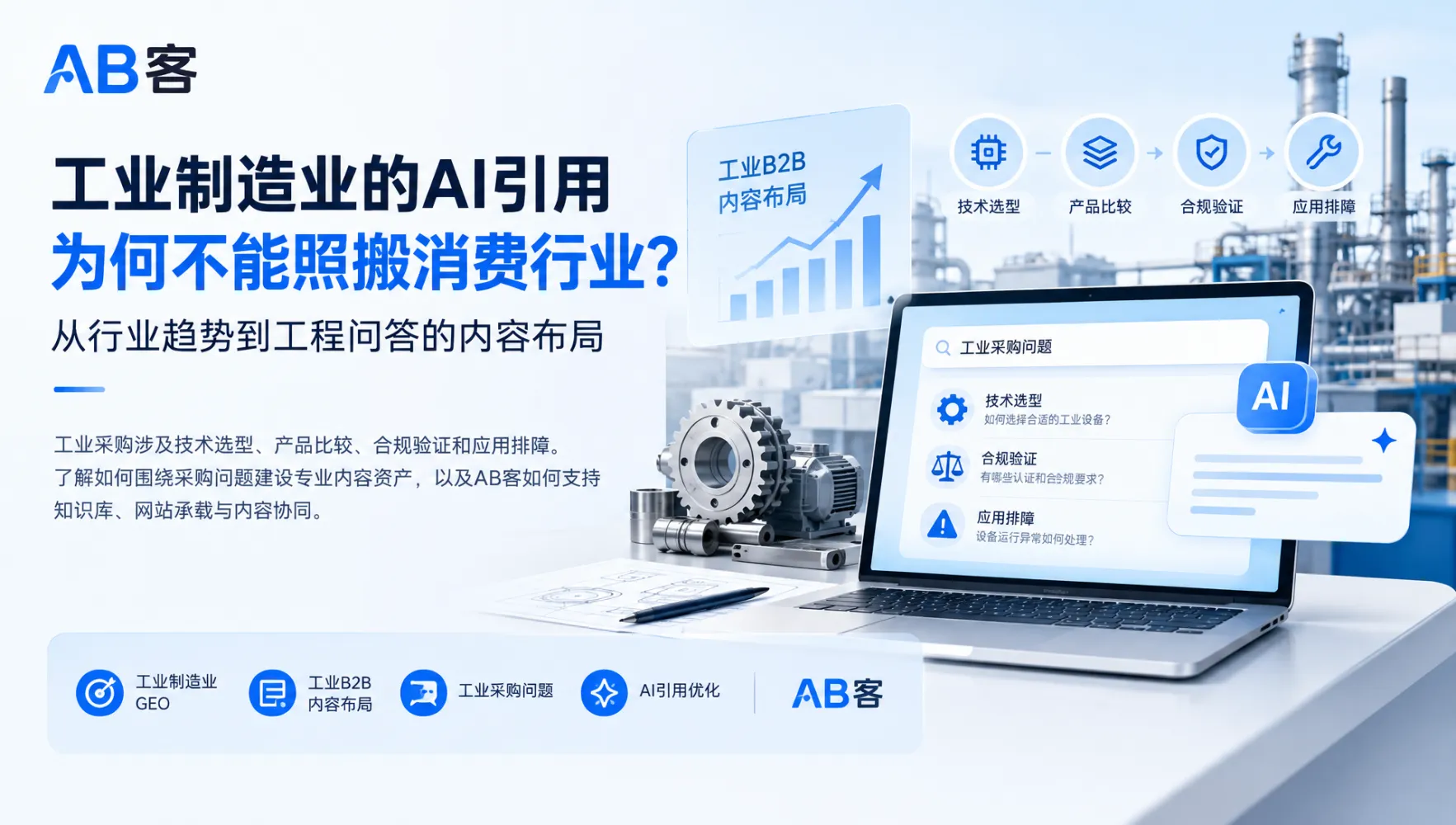
Why can't the application of AI in industrial manufacturing be directly copied from the consumer industry? From industry trends to content layout for engineering Q&A.
How Multilingual Content Enters the Global Sources Network: From Procurement Issues to Channel Version Adaptation Process
Connect GEO, Paid Ads and Social Outreach for Thanksgiving B2B Lead Follow-Up
感恩节 B2B 独立站 GEO 落地页优化:让北美不同区域采购商进来就想发询盘
Recommended Reading
How Can OEM and ODM Companies Help AI Identify the Actual Manufacturer?
Learn how OEM and ODM manufacturers can clarify brand ownership, product models, aliases and distributor relationships. Explore ABKE’s approach to consistent entity information.
An OEM or ODM manufacturer can produce a product that reaches the market under a customer’s brand, a distributor’s listing or several different model names. To help AI systems and overseas buyers understand who actually makes it, the company needs consistent, verifiable information about each entity’s role—without disclosing confidential customer relationships.
Clear manufacturer identification depends on more than repeating a company name. It requires a maintained relationship between the legal manufacturer, brand owner, product model, market alias and authorized sales partner, supported by evidence and expressed consistently wherever disclosure is permitted.
为什么OEM/ODM企业容易出现身份识别混乱?
In an OEM arrangement, a manufacturer may produce goods to a customer’s specifications; in an ODM arrangement, the manufacturer may also contribute product design. The precise division of design, ownership and production depends on the agreement. In either case, the name on the product is not necessarily the name of its manufacturer.
- Several parties may have different roles. A factory manufactures, a brand owner markets under its brand, a trading company may coordinate transactions, and a distributor sells in an agreed territory. One company can perform more than one role, but none should be assumed from a listing alone.
- One product can appear under several brands. Private-label arrangements may create several public product identities for a similar or related product. Similar appearance alone does not establish that products share a manufacturer or specification.
- A model may have multiple market names. Internal model codes, customer-assigned model numbers and local aliases can differ. Changes in configuration or revision can also make a simple name match misleading.
- Public sources may conflict. An outdated directory profile, an incomplete product listing or an inconsistent translation can cause search engines, AI systems and buyers to associate the wrong company with a product.
Procurement teams may struggle to verify production responsibility, assess supplier capabilities or contact the appropriate party.
AI-generated answers can reflect incomplete, inconsistent or outdated sources. Consistent evidence improves clarity but does not guarantee a particular answer.
Start by separating what the company knows internally from what it is allowed to publish. A confidential OEM relationship should not appear on a public product page merely to make the manufacturer more visible.
建立制造商、品牌与产品的实体关系
An entity relationship records who each party is and how it connects to a specific product, market and period. Define roles separately instead of treating the manufacturer, brand and seller as interchangeable names.
- Manufacturer: the legal entity responsible for manufacturing the relevant product. Record its legal name, approved translations and the scope of its manufacturing role.
- Brand Owner: the party that owns the brand used for a product. Brand ownership does not by itself establish manufacturing responsibility.
- OEM/ODM Partner: a party with an agreed production or development relationship. Describe the nature and scope of the relationship only where the agreement permits disclosure.
- Distributor: a party authorized to distribute products within a defined scope, such as a market or product range. A seller is not necessarily an authorized distributor.
- Product Model: the identifier used for a defined product or configuration. Retain revision details where they affect identification.
- Product Alias: an alternative name or identifier used in a particular market, language or channel. Verify the link before treating it as equivalent to a model.
Produces a defined product
Has a documented identifier and configuration
May market it under an agreed brand
May sell within an authorized scope
The relationship map should also record its supporting source, responsible reviewer, effective period and disclosure status. For example, a distributor’s authorization can apply to one territory and product family rather than the manufacturer’s entire catalog. A contract or written authorization should determine what can be stated publicly.
如何建立产品型号与品牌关系映射表?
A model mapping table connects internal identifiers with permitted customer-brand identifiers and market aliases. It is an operational record, not a claim that every listed relationship should be published. Use one row per verified model relationship; add separate rows when configuration, market or authorization differs.
| Manufacturer | Original model | Customer-brand model | Sales market / alias | Authorization and disclosure |
|---|---|---|---|---|
| Verified legal name | Internal model and revision | Customer-approved identifier, if applicable | Defined territory and local name | Scope, validity, evidence and publication permission |
For each row, link to the relevant product specification, approved naming record and authorization evidence. Record whether the products are identical, variants or merely related; do not present two identifiers as equivalent if their configurations differ or the relationship has not been verified.
Assign an owner to review entries when a model changes, a new market name is introduced or an authorization expires. Keep previous values and review dates so the team can trace why an older page used a different identifier.
官网及第三方页面应该如何表达?
Use the same verified relationship data across the company website and external profiles, while adapting the amount of detail to each page’s purpose and disclosure permissions.
- Company identity page: state the legal company name, relevant brand names and manufacturing role clearly. Explain capabilities using evidence the company is permitted to share, rather than implying ownership of customers’ brands.
- OEM/ODM service page: describe the available cooperation model and the respective responsibilities for production, design or customization as applicable. Explain that customer information is subject to agreed confidentiality terms.
- Product model pages: identify the relevant model, configuration and manufacturer. Include approved aliases or customer-brand model relationships only when verified and authorized. Link related company and service pages where useful.
- Distributor and partnership statements: identify the partner’s role, product scope and territory where permission exists. Review effective dates and distinguish an authorized distributor from an ordinary reseller.
- Multilingual identity checks: maintain approved legal names, brand spellings and model codes across languages. Translate role descriptions accurately rather than translating identifiers that must remain unchanged.
| Location | Information to check | Common risk |
|---|---|---|
| Official website | Legal identity, roles, model details and approved links | A brand name is presented as the manufacturer without evidence |
| Third-party profile | Company name, role, contact details and product identifiers | An outdated listing contradicts the official site |
| Translated page | Approved terminology, model codes and partnership scope | A translation changes the meaning of manufacturer or distributor |
Where supported by accurate page content, appropriate structured data and internal links can make relationships easier for search systems to interpret. They should reflect visible, verifiable facts; markup does not substitute for authorization or guarantee indexing, AI citation or recommendations.
AB客如何帮助OEM/ODM企业建立全面且精准的企业实体信息?
AB客(ABKE)围绕企业知识库与SEO&GEO网站,帮助外贸B2B企业梳理企业身份、产品能力和合作关系,并将经核实、可公开的信息组织到相应页面。For OEM and ODM manufacturers, the practical objective is to connect approved company, brand and model information without confusing internal knowledge with public claims.
Gather identity, product and partnership records.
Confirm roles, model relationships and disclosure rights.
Maintain entities, evidence and relationship mappings.
Connect approved pages and update changes.
- Collect existing records. Assemble company registration information, product specifications, model lists, approved brand names, relevant agreements and existing website or platform profiles. Identify the people responsible for checking each source.
- Verify relationships and permissions. Confirm who manufactures, owns the brand and sells each product. Check whether the relationship is current, which markets it covers and whether the customer has authorized public disclosure.
- Build the knowledge base. Record legal entities, approved names, models, aliases, relationship scope and evidence. Separate confidential records from information approved for external use.
- Connect website content. Use the verified information to support company, service and product pages, with clear internal links and appropriate structured information. Keep descriptions consistent with the actual product configuration and approved relationship.
- Review external information. Compare permitted third-party profiles and multilingual pages with the approved source records. Correct inconsistencies where the company controls the listing, or request changes from the relevant platform or partner.
Ongoing maintenance: Review brand changes, new or discontinued models, terminated distributor relationships and historical pages as part of a regular information governance process. Record who approved each change and when it took effect. Where an old page remains useful, update its status or provide an accurate reference to the current information; do not imply an expired authorization is still active.
Before discussing a project, a manufacturer can prepare its product catalog, current website, target markets and a list of known naming inconsistencies. Sensitive agreements and customer identities should be shared only through an appropriate, agreed process. The scope of knowledge-base work, website implementation and ongoing review should be confirmed for the specific engagement.
FAQ
Does the brand on a product prove who manufactured it?
No. The brand identifies a commercial identity; manufacturing responsibility must be established from reliable product and company records. A brand owner and manufacturer may be the same company, but that relationship should not be assumed.
Should every customer-brand model be listed publicly?
No. Publish a customer name or model relationship only when it is accurate and disclosure is permitted. Confidential mappings can still be maintained internally for authorized staff.
Can similar-looking products be treated as the same model?
Not without verification. Products may differ in configuration, revision, design ownership or market requirements. Check the relevant specifications and records before linking their identifiers.
How should an expired distributor relationship be handled?
Confirm the effective end date and scope, update controlled pages and profiles, and retain an internal record of the previous relationship. If a third-party listing cannot be edited directly, request a correction from its owner.
Will consistent entity information guarantee an AI recommendation?
No. Clear, consistent and verifiable information can help systems and buyers interpret a company’s role, but AI answers and recommendations depend on factors outside the manufacturer’s control.
Discuss your OEM/ODM entity information strategy with ABKE. Share the identity, model or distributor inconsistencies you need to resolve, and explore how a structured knowledge base and SEO&GEO website can support a clearer, permission-aware public presence.


