.png?x-oss-process=image/resize,h_100,m_lfit/format,webp)

.png?x-oss-process=image/resize,m_lfit,w_200/format,webp)

Hot Products


Popular articles
Low-Budget GEO Lead Generation for Small Export Teams Without Paid Ads
How to Segment Spanish and Portuguese GEO for Better Latin America Buyer Quality
ABKE GEO Conversion Funnel for Large B2B Buyer Inquiries: Turn Leads into Annual Long-Term Orders
Recommended Reading



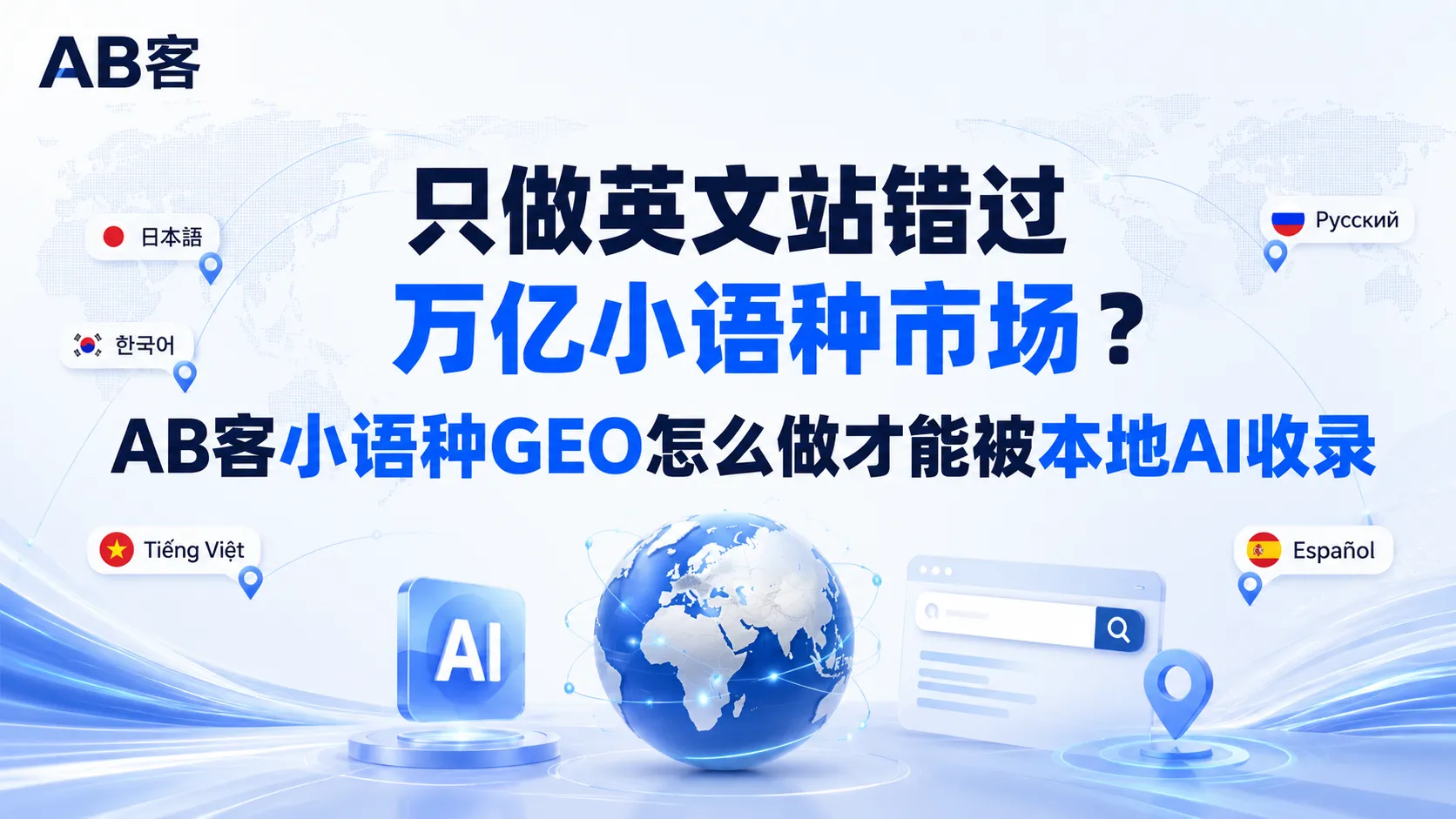
How Can Overseas Content Distribution Build AI Trust Without Creating Low-Quality Links?
ABKE explains how export B2B companies can use consistent, evidence-based content across websites, LinkedIn, YouTube, B2B platforms, and industry channels to strengthen AI citation credibility while reducing low-quality link and brand-information risks.
For export-oriented B2B companies, overseas content distribution is not simply a link-building activity. It is a way to make verified company information available across the digital sources that buyers, search engines, and generative AI systems may use when evaluating a supplier.
A credible distribution strategy starts with a reliable primary source—typically the company website—and extends consistent, evidence-based information to appropriate channels such as LinkedIn, YouTube, B2B platforms, industry directories, and relevant media. The objective is to strengthen AI citation credibility, brand-information consistency, and long-term digital trust without relying on purchased or low-quality links.
Why multi-source information matters for AI trust
When overseas buyers ask questions such as “Which supplier can meet this requirement?” or “What manufacturer has experience in this application?”, they often review more than one information source. AI search and generative answer tools may also assess whether a company’s identity, products, capabilities, and supporting evidence can be understood consistently across accessible sources.
A single website remains essential, but isolated information can be difficult to validate in a wider digital environment. Consistent information published through relevant channels gives the company more opportunities to be discovered and understood. This does not mean that every channel needs identical copy or that every mention will produce an AI citation. It means each channel should reinforce the same factual business foundation.
Practical principle: distribute useful, verifiable business information—not generic promotional messages and not links created only to influence rankings.
The difference between trust-building distribution and low-quality link building
| Trust-building content distribution | Low-quality link activity |
|---|---|
| Uses real product, technical, application, certification, FAQ, or company information. | Uses generic, duplicated, or irrelevant text primarily to place a link. |
| Publishes on channels relevant to target buyers, industries, or business functions. | Publishes broadly on unrelated, weak, or automated websites. |
| Maintains consistent company identity, capability descriptions, and contact information. | Creates conflicting brand descriptions, exaggerated claims, or inconsistent profiles. |
| Adds context that helps a buyer understand a product, use case, or decision criterion. | Offers little standalone value beyond the outbound link. |
| Supports a long-term, maintainable digital knowledge base. | Seeks short-term volume without durable information assets. |
Build from a verified source of truth
Before distributing content internationally, an export B2B company needs a clear enterprise knowledge foundation. This foundation should reflect information that the business can substantiate and maintain over time.
Company identity
Legal or brand name, business positioning, manufacturing or service scope, locations, and market focus.
Capability evidence
Product specifications, technical strengths, production processes, quality procedures, certifications, and delivery information.
Buyer-oriented knowledge
Applications, selection guidance, common questions, comparison criteria, project experience, and cooperation processes.
This structured knowledge helps reduce contradictions between the website, social profiles, platform listings, sales materials, and published content. It also gives content teams a factual reference point for multilingual adaptation and ongoing updates.
Use each channel for the information it can credibly carry
Effective overseas content distribution does not require publishing the same material everywhere. Different channels can support different stages of buyer research while preserving the same core facts.
- Company website: the primary evidence source for detailed product pages, solutions, technical content, FAQs, certifications, and inquiry paths.
- LinkedIn: useful for professional company updates, industry viewpoints, application insights, and team-led expertise.
- YouTube and video channels: suitable for product demonstrations, manufacturing processes, installation explanations, and visual capability communication.
- B2B platforms and industry directories: support structured supplier information, product categorization, and basic business discoverability where the platform is relevant to the market.
- Industry media and technical communities: may support deeper subject-matter contributions when the content is useful, accurate, and aligned with editorial or community standards.
- Multilingual market channels: help local audiences access adapted information, provided terminology, product facts, and compliance-related statements remain accurate.
A practical workflow for GEO global brand communication
- Audit existing public information. Identify outdated profiles, inconsistent descriptions, unsupported claims, duplicate content, and missing buyer-critical information.
- Define the core enterprise narrative. Clarify what the company provides, for whom, in which applications, and what evidence supports its claims.
- Build the website as the central knowledge asset. Organize product, solution, industry, FAQ, and trust content in a structure that is readable for buyers and understandable for search and AI systems.
- Map buyer questions to suitable channels. Turn recurring procurement questions into useful content formats such as technical explainers, product videos, platform listings, or professional posts.
- Distribute with source consistency. Keep names, key capability statements, product terminology, and evidence aligned while adapting format and language to the channel.
- Monitor and correct. Review website performance, indexed pages, referral activity, brand mentions, AI visibility observations, and lead feedback to find gaps or inaccurate information.
- Update as the business evolves. Refresh content when products, certifications, applications, market priorities, or supporting evidence change.
What makes information more credible for buyer and AI evaluation?
No distribution method can guarantee that an AI platform will cite or recommend a company. However, the following characteristics make business information clearer and more reliable for evaluation:
- Specific descriptions of products, applications, technical limits, and service scope.
- Evidence that can be checked, such as relevant certifications, documented processes, real project materials, or clearly stated quality practices.
- Consistent entity information across the official website and selected external channels.
- Clear authorship, company ownership, update responsibility, and accessible contact paths.
- Content that answers genuine buyer questions instead of repeating broad promotional language.
- Regular maintenance so public information remains aligned with the company’s current capabilities.
Common risks to avoid
Volume without relevance
Publishing on many unrelated sites can weaken brand clarity and create low-value digital noise.
Unverified claims
Statements about certifications, capacity, product performance, delivery, or market position should be supported and current.
Copy-and-paste duplication
The same message everywhere offers limited buyer value. Adapt the format while preserving factual consistency.
Ignoring ownership and follow-up
Company accounts, customer interactions, and commercial relationships need active client participation and clear responsibility.
How ABKE supports a sustainable distribution foundation
ABKE, the core brand of Shanghai Muke Network Technology Co., Ltd., approaches overseas content distribution as part of an export B2B GEO growth system. The work begins with enterprise knowledge assets and a GEO-ready website, then connects content planning, multilingual content support, channel guidance, CRM lead handling, and ongoing performance analysis.
Rather than treating external publishing as isolated backlink acquisition, ABKE helps companies organize verified product, technical, certification, case-study, and FAQ information into a consistent communication framework. This gives official websites, professional social channels, B2B platforms, and industry-facing content a shared factual basis.
The focus is on building capabilities that can improve AI understandability, citation credibility, brand consistency, and buyer trust over time. Outcomes such as AI recommendations, search rankings, inquiries, and sales remain influenced by platform algorithms, market competition, product fit, pricing, and sales execution; they should be monitored and improved rather than presented as fixed guarantees.
For B2B exporters, the most durable path is to make every public touchpoint answerable to the same question: Does this information help a buyer—or an AI system—understand what the company does, why it is relevant, and what evidence supports that understanding? When the answer is consistently yes, global content distribution becomes a long-term brand and knowledge asset rather than a source of low-quality links.


.png?x-oss-process=image/resize,h_100,m_lfit/format,webp)
.png?x-oss-process=image/resize,h_100,m_lfit/format,webp)

.png?x-oss-process=image/resize,h_100,m_lfit/format,webp)
.png?x-oss-process=image/resize,h_100,m_lfit/format,webp)
.png?x-oss-process=image/resize,h_100,m_lfit/format,webp)
.png?x-oss-process=image/resize,h_100,m_lfit/format,webp)
