.png?x-oss-process=image/resize,h_100,m_lfit/format,webp)

.png?x-oss-process=image/resize,m_lfit,w_200/format,webp)

Hot Products

.png?x-oss-process=image/resize,h_2000,m_lfit/format,webp)
.png?x-oss-process=image/resize,h_2000,m_lfit/format,webp)

Popular articles
GEO Smart Website Development for New Brand Export and Product Launches
How QIE GROUP Rebuilt Its Edible Oil EPC Lead Generation System with a GEO Smart Website
Build Localized Procurement Content for Priority B2B Export Markets
How ABKE Built a GEO Smart Website for Zhengzhou Penguin Oil Machinery’s Oil Mill EPC Knowledge
How ABKE Built a GEO Smart Website for WINMAN INDUSTRIAL’s FIPFG Sealing Solutions
Recommended Reading


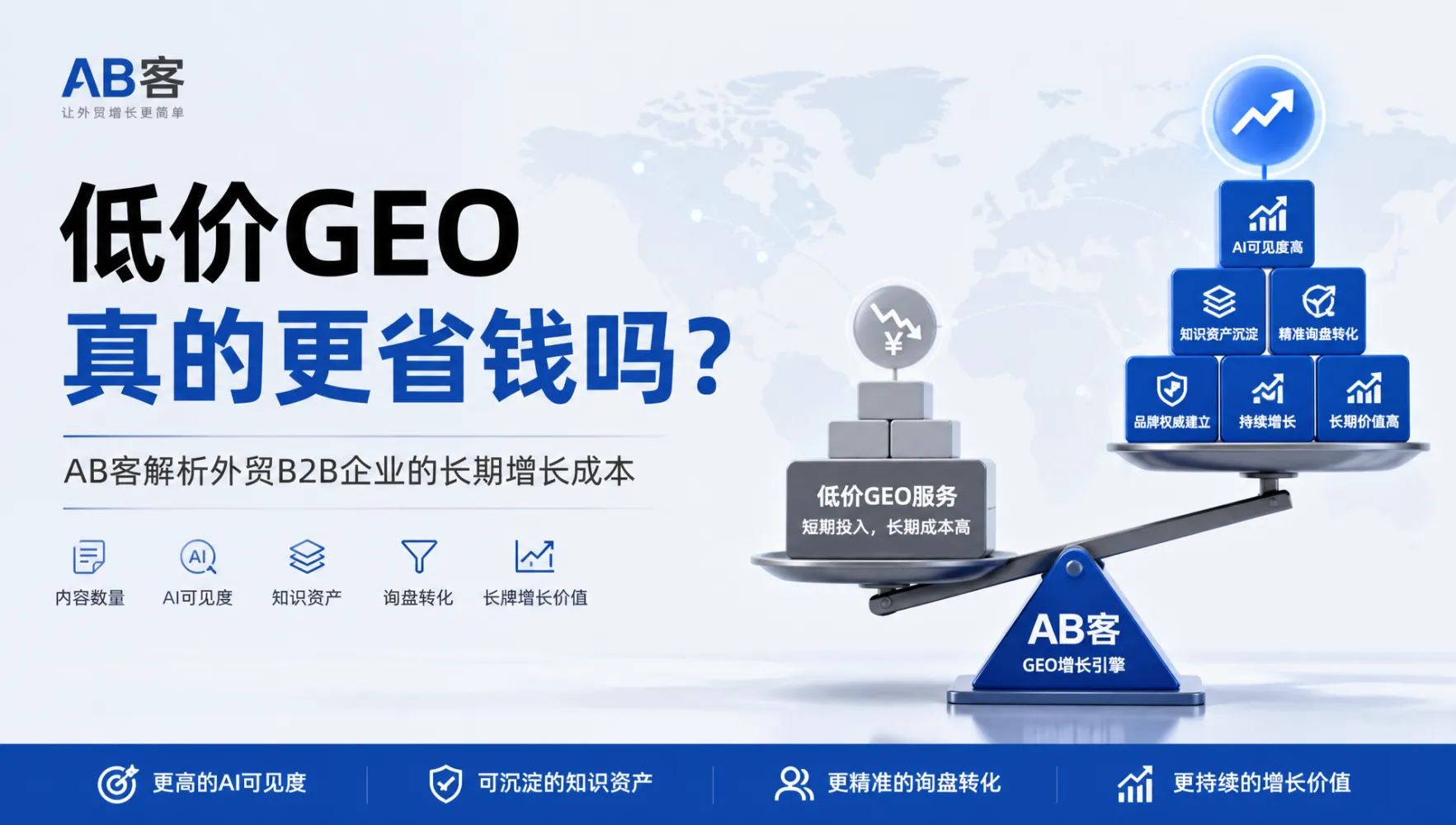
Why Does Overseas GEO Cost More? A Practical B2B Pricing Guide for Export Manufacturers
Understand what drives overseas GEO costs for export manufacturers—from multilingual content and GEO websites to global trust signals and AI visibility monitoring. Explore ABKE's practical B2B GEO pricing framework.
Why Does Overseas GEO Cost More?
For export-oriented B2B companies, the real question is not simply “How much does GEO cost?” It is what you are actually building—a content task, or a long-term AI-visible growth system.
Overseas GEO usually costs more because it combines enterprise knowledge modeling, multilingual localization, GEO-ready website architecture, global trust signals, and continuous AI visibility monitoring across markets.
Core pricing logic
You are paying for assets, infrastructure, and operating capability—not only content output.
Best use case
Manufacturers and exporters that want repeatable visibility in AI search and Google search.
ABKE perspective
The right GEO budget should buy you a durable growth engine, not a short-lived traffic spike.
What does the extra overseas GEO budget actually go into?
Overseas GEO is broader than standard content marketing. It requires a full chain of work that helps both buyers and AI systems understand who you are, what you sell, and why you are credible.
A simple cost map for overseas GEO
The budget allocation usually shifts from “single-content creation” to “system building + ongoing operations.”
Enterprise knowledge modeling     ██████████
Multilingual localization         ██████████████
GEO website & technical SEO       ████████████
Global distribution signals       ███████████
AI visibility monitoring          █████████
CRM and conversion optimization   ████████
The exact split depends on industry complexity, target markets, website foundation, and the required service depth.
Why overseas GEO is usually more expensive than domestic GEO
1) Multilingual cost
Every extra language adds not only translation, but also terminology review, market adaptation, page management, and long-term maintenance. In B2B, “good translation” is not enough—content must match how buyers in that market evaluate suppliers.
2) Higher content depth
Export buyers ask technical, compliance, delivery, and sourcing questions. That means more FAQs, comparison pages, application pages, and decision-support content than a simple domestic awareness campaign.
3) Harder trust building
Overseas GEO depends on external trust signals: industry directories, platform profiles, media references, and consistent entity information. Building that credibility takes time and operational discipline.
4) Ongoing monitoring
GEO is not a one-time publishing project. It needs visibility tracking, AI mention checks, content iteration, and lead feedback loops to keep improving across markets and platforms.
Can overseas GEO cost 30%–50% more?
For projects with a comparable service depth, overseas GEO can require a materially higher budget because of multilingual production, international website architecture, global channel operations, and AI visibility tracking.
A 30%–50% increase can be used only as a reference range for certain comparable scopes—not as a universal quote or fixed industry standard.
Six variables that determine overseas GEO pricing
- Number of target countries: Different markets have different buyer questions, search behavior, and channel priorities.
- Number of languages: Every extra language adds localization, review, publishing, and maintenance workload.
- Product complexity: Technical products need more specifications, use cases, standards, and proof content.
- Existing website foundation: Weak architecture, slow pages, or missing content increase implementation effort.
- Available content assets: Missing certifications, case studies, and technical documents require knowledge organization.
- Scope of trust-signal building: More platforms and channels mean more planning, publishing, and governance.
How should you compare GEO proposals correctly?
Do not compare proposals by price alone. Use this sequence:
- What enterprise knowledge, product knowledge, and trust evidence will be structured?
- How many product, solution, FAQ, and buyer-decision pages will be created?
- Does the scope include multilingual localization, not just literal translation?
- Does it include a GEO-ready website, structured data, and conversion paths?
- Which global channels and third-party information sources are included?
- How will AI visibility, mentions, citations, inquiries, and lead quality be measured?
What are the risks of low-cost overseas GEO packages?
- Generic AI-generated content that ignores real manufacturing capabilities
- Translated pages without market-specific buyer intent
- One-time publishing without monitoring or iteration
- Website pages that are hard for search engines and AI to understand
- Unverifiable promises of fixed rankings or fixed inquiry volumes
- No link between visibility work, CRM handling, and sales feedback
How ABKE approaches overseas B2B GEO
AB客GEO增长引擎 is designed for export B2B companies that need a repeatable growth system rather than isolated content delivery.
ABKE combines structured enterprise knowledge, buyer-question planning, GEO content production, SEO&GEO website architecture, global distribution workflows, AI visibility monitoring, CRM tracking, and optimization tasks into one operating loop.
Its strength is practical execution: starting from what you sell, what buyers need to verify, and what evidence supports trust—then turning that into reusable website, content, channel, and sales assets.
ABKE’s GEO growth stack in one view
1. AI Knowledge Asset System
Builds a structured enterprise knowledge base so AI can understand who you are and why you are credible.
2. Buyer Demand Insight System
Maps real buyer questions and decision paths to guide content planning with precision.
3. GEO Content Factory
Produces FAQ, product, solution, comparison, and multilingual content at scale.
4. GEO Website System
Creates AI-readable, Google-indexable, conversion-ready website infrastructure.
5. Global Distribution System
Extends brand signals to LinkedIn, YouTube, directories, and industry platforms.
6. CRM Conversion System
Captures, classifies, and follows up on inquiries so visibility turns into pipeline.
FAQ
Is GEO a one-time project or an ongoing service?
Initial GEO work usually includes knowledge structuring, website foundations, content planning, and priority page creation. Ongoing work is needed for new products, new markets, content updates, external signals, AI visibility monitoring, and conversion optimization.
Can a small export company start with a limited GEO scope?
Yes. A practical starting point is one priority product line, one target market, one core language, a structured knowledge base, high-intent buyer questions, and a conversion-ready website foundation.
Does adding one more country increase GEO cost?
Usually yes. The increase depends on whether the market requires new language localization, new buyer research, country-specific pages, additional channels, or local compliance and trust content.
Do SEO and GEO require separate investments?
They are closely connected but not identical. SEO supports search visibility and indexing; GEO improves how AI systems understand, cite, and recommend enterprise information. A strong B2B growth program should coordinate both.
Plan your overseas GEO budget with the right scope
If you are comparing overseas GEO proposals, start by mapping these inputs:
- Target markets and languages
- Product complexity and technical depth
- Existing website and content foundation
- Required trust evidence and third-party signals
- Conversion goals, CRM workflow, and reporting needs
ABKE helps export manufacturers turn those inputs into a practical GEO growth roadmap—so the budget builds lasting digital assets, not just pages.


