.png?x-oss-process=image/resize,h_100,m_lfit/format,webp)

.png?x-oss-process=image/resize,m_lfit,w_200/format,webp)

Hot Products


.png?x-oss-process=image/resize,h_2000,m_lfit/format,webp)

.png?x-oss-process=image/resize,h_2000,m_lfit/format,webp)

Popular articles
GEO Triangle Model: Build Website Authority, Third-Party Trust and AI Readability for Sustainable B2B Growth
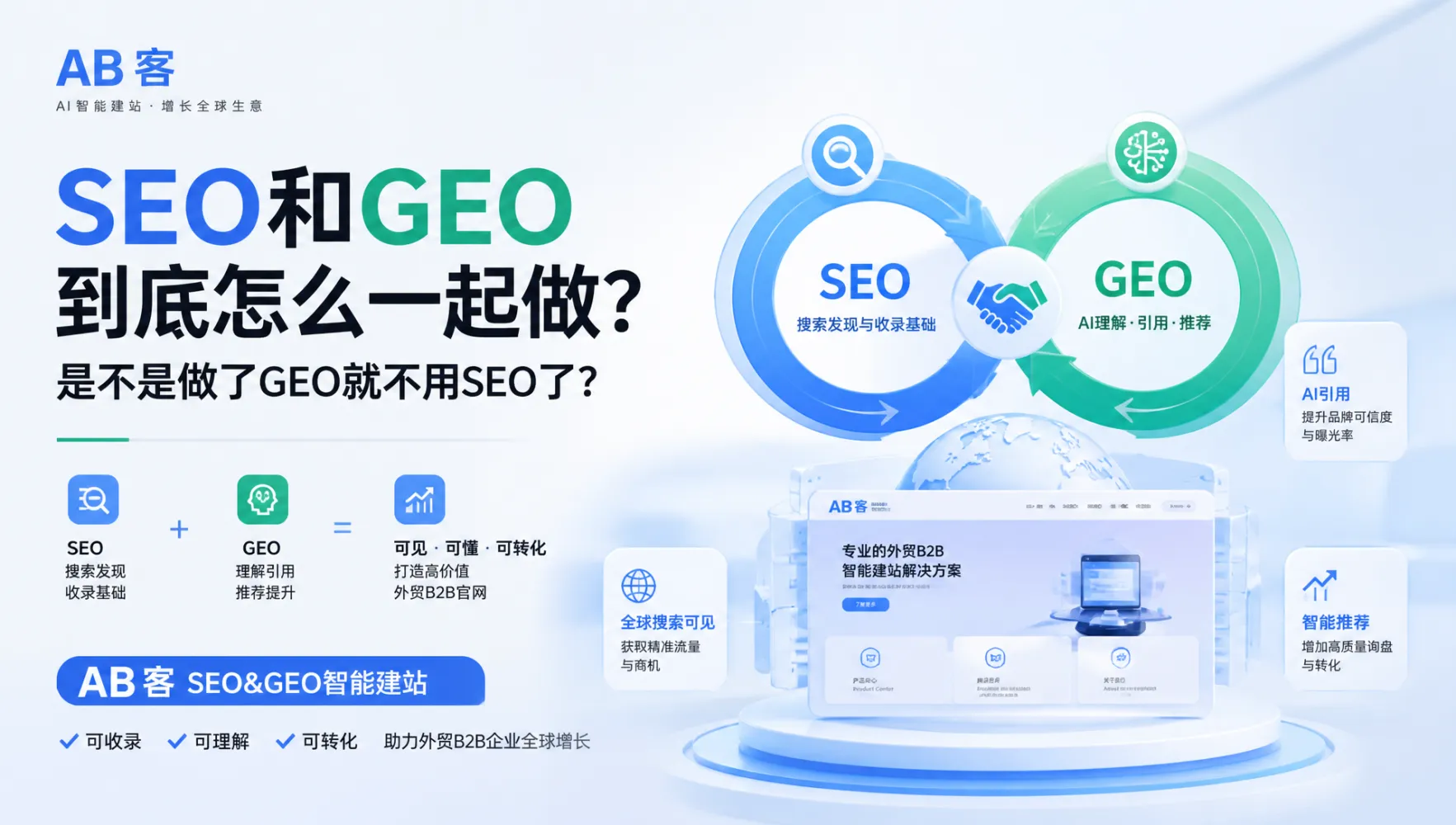
How Do SEO and GEO Work Together? Why B2B Companies Still Need Both
ABKE GEO Website FAQ: Who Owns Your Website, Content and Data After Service Ends?
Why Doesn’t ChatGPT Cite You Even When Your Website Has Plenty of Content?
2026 Q4: AI Search Brand Visibility Repeat Testing and Prompt Rewrite Sampling Method
Recommended Reading


Q4 2026: How to Turn PDFs, Product Catalogs and Spec Sheets into AI-Searchable Knowledge Assets
Learn how ABKE helps B2B manufacturers convert PDFs, technical manuals, catalogs and specification sheets into structured, evidence-ready knowledge assets for AI search, GEO visibility and global buyer decisions.
Q4 2026: How to Turn PDFs, Product Catalogs and Spec Sheets into AI-Searchable Knowledge Assets
In Q4 2026, GEO is no longer only about publishing better content. For B2B manufacturers, it is becoming evidence retrieval engineering — the process of transforming technical files into structured, verifiable, and reusable web knowledge that AI systems can understand, cite, and recommend.
Why this matters now
Many manufacturers already have their best knowledge inside PDFs, manuals, inspection reports, drawings, and certificates. The problem is not a lack of information. The problem is that AI cannot reliably use information that remains trapped in file formats with weak context, unclear versioning, and poor machine readability.
ABKE perspective
ABKE’s GEO Growth Engine helps B2B companies turn scattered technical documents into an AI-understandable knowledge system — one that supports SEO, GEO visibility, buyer trust, and global lead generation.
1. Why are the most valuable company documents often “hidden” inside PDFs?
In manufacturing, the highest-value facts are usually stored in files that are technically useful for engineers but nearly invisible to search engines and AI answer systems. These documents often include:
2. Why “just upload a PDF” is not enough
A PDF can be stored on a website, but that does not mean it becomes AI-searchable knowledge. AI systems may struggle with the following issues:
- Table rows and columns may lose their relationships during extraction.
- Model-to-parameter mappings can become ambiguous when several variants appear in one file.
- Scanned images may contain important numbers that are not fully machine-readable.
- Page references, source versions, and approval status are often missing from the visible content.
- Static files do not support buyer journeys well across product pages, FAQs, and comparison pages.
Key takeaway: If the file cannot be cited, compared, or connected to a product page, it is not yet a true knowledge asset.
3. The five-step workflow to convert PDFs into knowledge assets
| Step | Action | Output |
|---|---|---|
| 1 | Inventory all files | A clean map of catalogs, manuals, certificates, drawings, and revision dates |
| 2 | Recognize pages, tables, and visuals | Source-linked text, table, image, and page-level identification |
| 3 | Extract atomic facts | Model, parameter, unit, condition, standard, limitation, and application facts |
| 4 | Structure the knowledge | A versioned knowledge model connected to source pages and evidence |
| 5 | Publish web-ready content | Product pages, FAQs, comparison content, and downloadable evidence assets |
Workflow diagram:
Document inventory → Page/table recognition → Fact extraction → Structured modeling → Searchable web pages + evidence links
4. How should specification tables be structured for AI retrieval?
For technical products, the best practice is to convert a flat PDF table into a machine-readable model with stable relationships. A recommended format is:
Model × Parameter × Value × Unit × Condition × Source Page × Version × Verified Date
This structure improves comparison accuracy, reduces ambiguity across variants, and allows AI systems to connect each technical claim to its original evidence. It also helps sales teams reuse the same facts across product pages, quote sheets, and buyer communication.
5. How to add context to images, drawings, and flowcharts
Visual materials are often valuable but under-described. A diagram without context may be visually clear to an engineer, yet still weak as AI knowledge. To make visual content retrievable, add explicit context fields such as:
Simple rule: every image should answer five questions — what it shows, which product it belongs to, when it applies, where it came from, and why the buyer should trust it.
6. A practical visual model for multimodal GEO
PDFs, manuals, test reports, drawings, and certificates.
Facts, relationships, conditions, versions, and evidence links.
Product pages, FAQs, comparison pages, use cases, and guides.
Website, search, multilingual channels, and external signals.
Source files → Structured evidence → Web knowledge → AI retrieval → Buyer trust → Qualified inquiries
7. How ABKE turns enterprise files into reusable knowledge assets
ABKE’s GEO Growth Engine is designed to help manufacturers move from “document storage” to “knowledge production.” It combines enterprise knowledge architecture, AI content workflows, GEO-ready websites, and multilingual distribution to make technical information usable across search engines and AI answer systems.
Centralizes product facts, technical evidence, and brand truth into a structured enterprise knowledge base.
Transforms source documents into FAQs, product pages, comparison content, and buyer education assets.
Builds pages that are structured for AI understanding, Google indexing, and conversion.
Tracks whether the company is being cited, surfaced, and recommended in search and AI contexts.
8. Recommended checklist for manufacturers
| Priority | What to do | Expected result |
|---|---|---|
| High | Keep one approved source of truth for each product model | Fewer contradictions across files and pages |
| High | Record versions, dates, and approval status for technical claims | Stronger evidence quality and trust |
| High | Convert critical tables into HTML tables, not images only | Better machine readability and search performance |
| Medium | Add descriptive context to visuals and drawings | Improved multimodal retrieval |
| Medium | Build FAQs from real buyer questions | More useful content and stronger GEO alignment |
| High | Review technical pages with product experts before publishing | More accurate claims and fewer content risks |
Frequently asked questions
Can AI platforms read PDF files well enough?
Sometimes yes, but performance depends on file quality, table complexity, scan clarity, and document structure. Critical facts should still be published as structured web content, not left only inside downloadable files.
Should manufacturers remove the original PDF after conversion?
No. The original file is still valuable as evidence and for download. The best approach is to keep it while building structured, searchable, version-controlled web knowledge around it.
Does structured conversion guarantee AI recommendations?
No. AI visibility depends on relevance, content quality, external trust signals, platform behavior, and competitive context. Structured evidence improves the foundation, but it is not a guarantee of ranking or recommendation.
Conclusion
In the new GEO era, success is not about producing more files or prettier PDFs. It is about converting technical documents into searchable, attributable, versioned, and reusable knowledge assets that AI systems can verify and buyers can trust.
For B2B manufacturers, this shift creates a practical advantage: better AI understanding, stronger search visibility, improved buyer confidence, and a more durable content foundation for global growth. ABKE helps companies build that foundation through enterprise knowledge architecture, GEO content systems, and AI-driven growth execution.
Bottom line: Multimodal GEO is not about making more images. It is about turning hard-to-read professional materials into evidence-ready knowledge that can be retrieved, cited, and recommended.


