.png?x-oss-process=image/resize,h_100,m_lfit/format,webp)

.png?x-oss-process=image/resize,m_lfit,w_200/format,webp)

Hot Products
.png?x-oss-process=image/resize,h_2000,m_lfit/format,webp)
.png?x-oss-process=image/resize,h_2000,m_lfit/format,webp)

Popular articles
Can You Export Your Website Content, Images, Product Data and Enterprise Knowledge Base?
Are More Multilingual Websites Always Better? Why Some Companies Confuse AI
For Export Businesses Doing GEO, the First Step Is Not Website Optimization
Will a GEO Website Upgrade Harm Your Existing SEO Traffic?
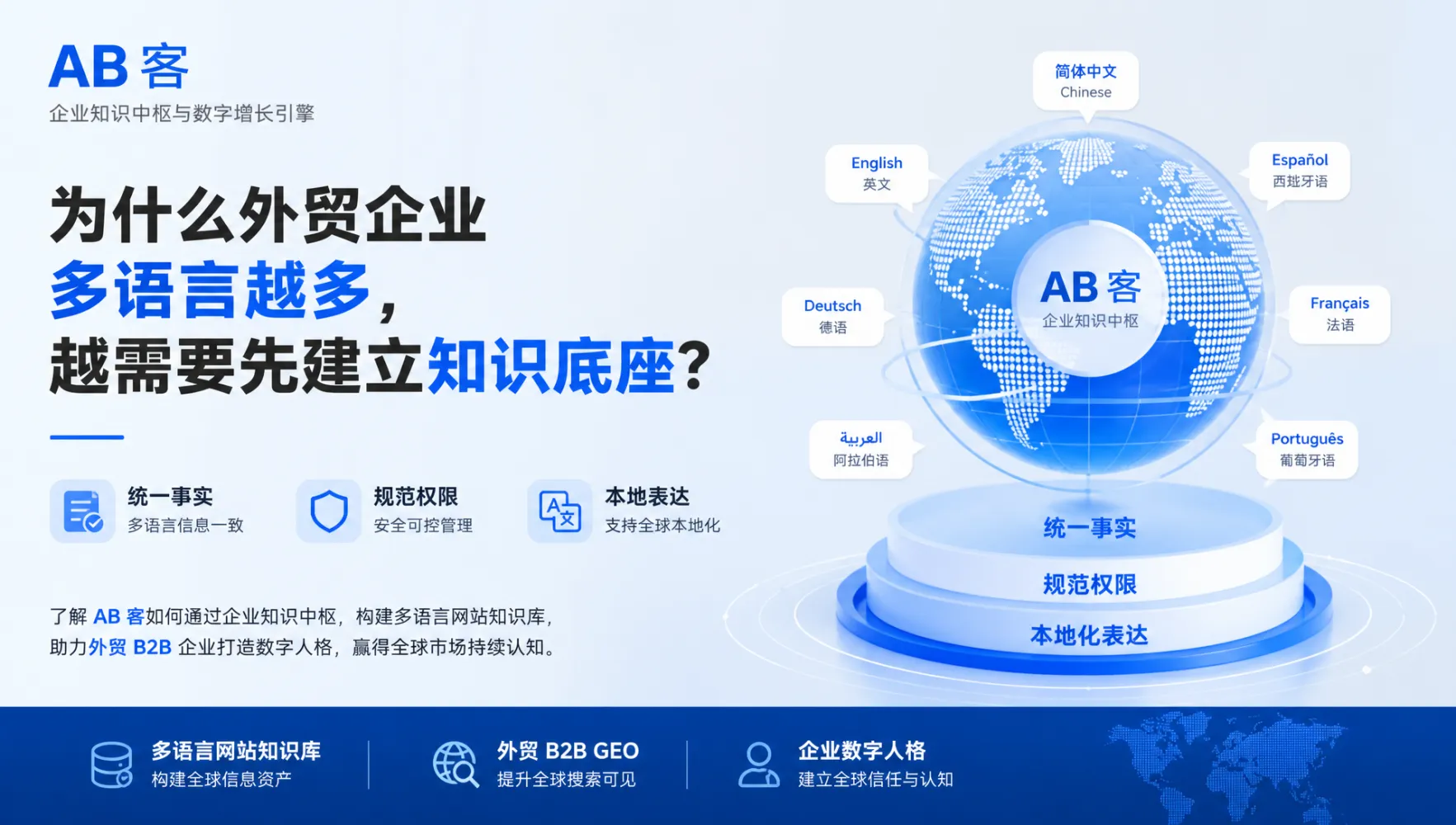
Why Do Foreign Trade Companies Need a Knowledge Foundation Before Adding More Languages?
Recommended Reading

Q4 2026: How to Build a Product Applicability and Technical Boundary Library to Reduce AI Over-Recommendation
Learn how ABKE helps B2B exporters build product applicability and technical boundary libraries that improve AI accuracy, reduce over-recommendation risks, and strengthen GEO trust signals.
Q4 2026: How to Build a Product Applicability and Technical Boundary Library to Reduce AI Over-Recommendation
In 2026 Q4, GEO is moving beyond content optimization and into evidence retrieval engineering. The winning companies are not simply visible in AI answers—they are recommended accurately in the right buyer scenario.
Key Answer: Why a Boundary Library Matters Now
For B2B exporters, one of the biggest GEO risks is no longer “AI does not mention us.” It is “AI mentions us in the wrong context.” A product applicability and technical boundary library helps AI systems, search engines, sales teams, and buyers understand:
This is essential for trust, conversion, and compliant recommendation in the age of generative search.
Why “Can Do” Is Not Enough
Many companies only tell AI what they can do:
- Our product supports harsh environments.
- Our equipment is suitable for high temperature use.
- We can customize for many industries.
These statements are often too broad. In GEO, broad claims may increase visibility in the short term, but they also increase the risk of over-recommendation, poor buyer matching, and failed follow-up conversations.
What AI Really Needs
AI performs better when it can retrieve structured evidence such as:
- material compatibility
- temperature and pressure ranges
- capacity or load limits
- environmental conditions
- certification scope
- country or market restrictions
- customization boundaries
The more precise the boundary data, the more accurate the recommendation.
What Is a Product Applicability and Technical Boundary Library?
It is a structured knowledge system that defines the product’s operating scope, limitations, evidence sources, and confirmation rules. In practical terms, it answers the questions AI and buyers ask most often:
The product reliably meets defined requirements under documented conditions.
The product may work, but only with specific configuration, testing, or approvals.
The product is not designed for the use case, or engineering validation is needed first.
Recommended Capability Classification
| Capability Status | Meaning | AI-Readable Expression |
|---|---|---|
| Standard Support | The product can be used with confidence in a defined scenario. | Suitable for [application] under [documented operating conditions]. |
| Conditional Support | The product may be suitable only when certain conditions are met. | Suitable when temperature, material, configuration, and compliance requirements meet specified conditions. |
| Not Supported / Confirmation Required | The product is not recommended for the use case, or needs technical validation. | Not recommended for [condition]. Contact the technical team for application assessment. |
Essential Fields for a Boundary Library
- Applicable materials and non-applicable materials
- Operating temperature range
- Pressure range, load range, or capacity range
- Humidity, corrosion, dust, vibration, or outdoor exposure
- Industry standards and compliance limits
- Country or regional market restrictions
- Customization boundaries
- Installation and maintenance conditions
- Testing requirements before deployment
- Risks, exclusions, and expert confirmation triggers
2026 Q4 GEO Shift: From Content Optimization to Evidence Retrieval Engineering
Earlier GEO efforts often focused on keyword coverage, content depth, and topical authority. In the next stage, AI systems are increasingly rewarding companies that provide retrievable, consistent, and verifiable evidence.
This workflow turns product knowledge into a living system. It is not a one-time article or static PDF. It is a structured evidence layer that improves how AI interprets your product over time.
Where Boundary Information Should Appear
To make AI retrieval effective, the same boundary logic should appear across multiple touchpoints:
Show scope, limits, and operating conditions.
Answer scenario-based questions with precision.
Help buyers compare options safely.
Store structured facts for retrieval and reasoning.
Equip teams with accurate positioning language.
Reduce misunderstanding in regulated scenarios.
Simple Visual Model: How Recommendation Accuracy Improves
Without Boundary Library
With Boundary Library
Boundary Library Build Process
Gather specifications, test reports, certifications, case histories, and engineering notes.
Identify what is standard, what is conditional, and what must be confirmed.
Map product conditions to real buyer applications and use cases.
Distribute the same logic to pages, FAQs, guides, and knowledge bases.
How ABKE Applies Knowledge Governance
ABKE helps export-oriented B2B companies build GEO systems that do more than promote advantages. We also help organize applicability conditions, evidence sources, technical restrictions, and confirmation rules so that AI can understand the company with higher precision.
Why “Conditional Support” Is Especially Important
Many companies lose accuracy because they use vague language such as “supports high temperature environments” or “suitable for harsh conditions.” These expressions are too broad for both buyers and AI systems.
Better expression: “Suitable within the specified temperature range and with the required configuration, materials, and compliance conditions.”
This kind of language reduces false confidence and improves the quality of AI-generated answers.
Evidence Retrieval Layer: What Modern GEO Now Requires
In 2026 Q4, a strong GEO system should not only answer “what the product is.” It should also provide evidence for:
- why the product is suitable in a specific scenario
- which conditions must be met before use
- which certifications or tests support the claim
- which use cases should be excluded
- when technical review is required
This is the foundation of trustworthy AI visibility.
FAQ
No. Any B2B product with variations, constraints, compliance rules, or application-specific performance should document its applicability boundaries.
Usually the opposite. Clear boundaries help attract better-fit buyers and reduce unqualified inquiries.
Start with your highest-traffic products and the use cases most often asked by buyers and distributors.
AI can assist with drafting and structuring, but the final boundaries should be validated by product, engineering, compliance, and sales teams.
Final Decision Rule
High-quality GEO should not try to make a company recommended for every question. It should make the company accurately recommended when its product, evidence, and delivery capability truly fit the buyer’s scenario.
If your export business is ready to build a technical boundary library, ABKE can help you turn product facts into AI-readable knowledge, reduce over-recommendation risk, and strengthen long-term GEO trust signals.
ABKE | AB客 GEO Growth Engine for B2B exporters


