Hot Products



Popular articles
Q4 2026: How Can Export B2B Companies Build an AI-Retrievable Atomic Fact Library?
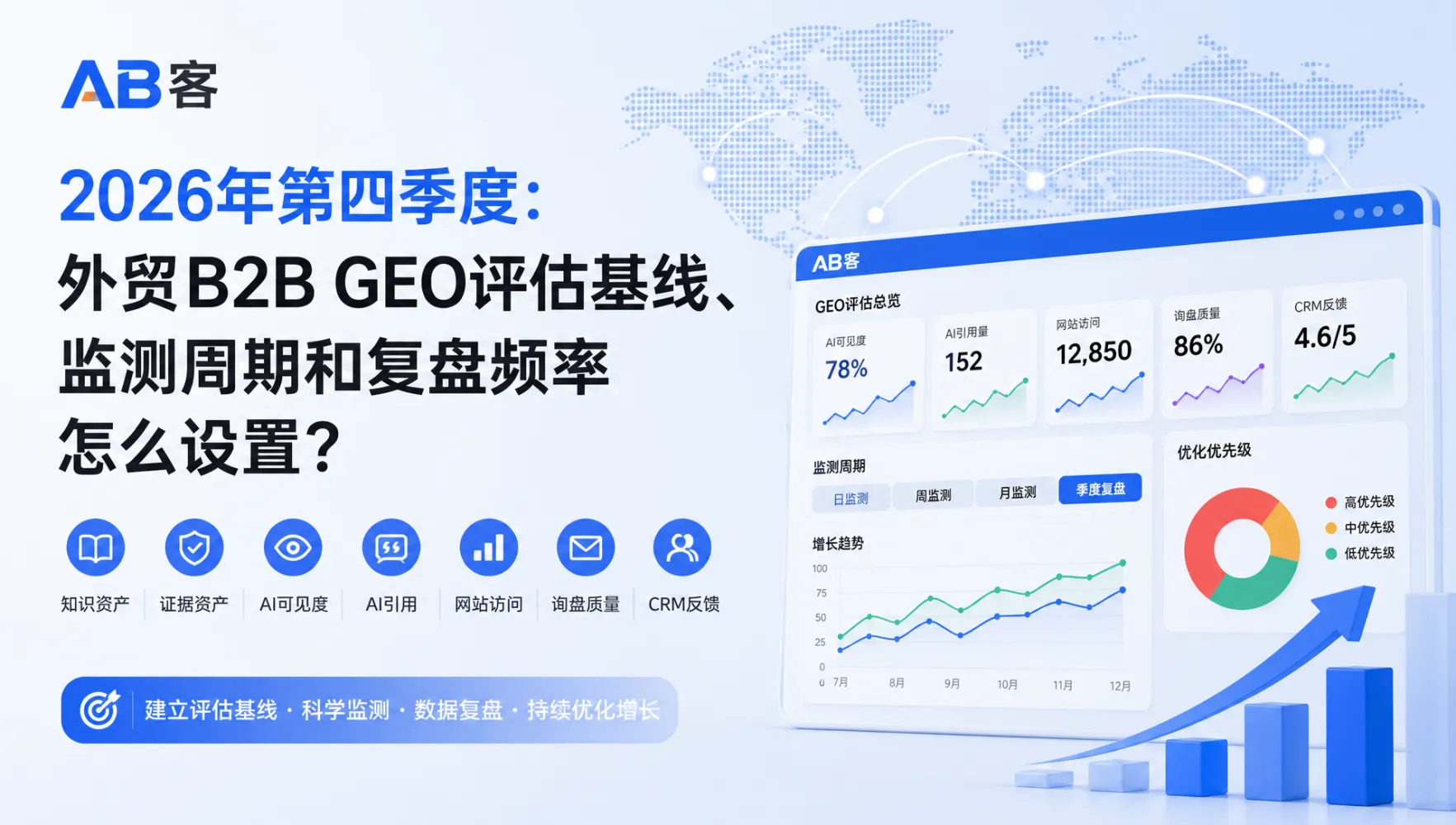
How to Set GEO Evaluation Baselines, Monitoring Cycles, and Review Cadence for Export B2B in Q4 2026
Q4 2026: How to Sample-Check AI Answers for Accurate Product Capability and Technical Boundary Statements
How Do You Know Whether a GEO Website Is Working After Launch?
What GEO Optimization Trends and Directions Matter Most in Q4 2026?
Recommended Reading
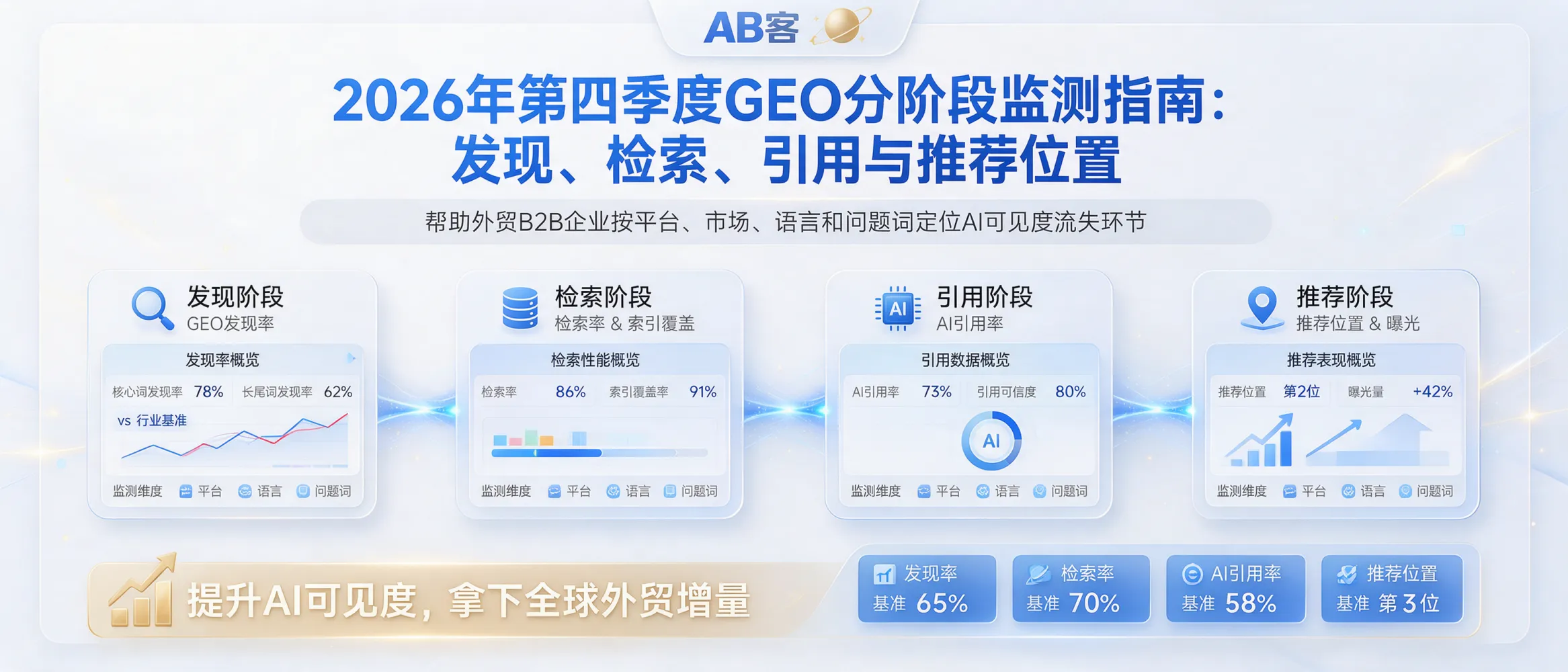
Foreign Trade Companies’ Final 90 Days: A Practical 2026 Q4 GEO Execution Checklist
Use ABKE’s practical 2026 Q4 GEO execution checklist to help B2B exporters prioritize enterprise knowledge, product pages, proof assets, AI-readable content, and conversion paths during the final 90 days.
ABKE GEO Growth Engine
Foreign Trade Companies’ Final 90 Days: A Practical 2026 Q4 GEO Execution Checklist
In the final 90 days of Q4, exporters should focus on the GEO assets that influence procurement decisions: verified enterprise knowledge, priority product and solution pages, trust evidence, buyer-question content, and a conversion path that turns visibility into qualified inquiries.
Quick Answer
During the last 90 days of Q4, B2B exporters should not chase generic content volume. The highest-impact GEO work is to build a source of truth for the company, upgrade pages that buyers use to compare suppliers, add proof assets that AI systems can verify, and connect every high-value page to an inquiry path.
Why the Final 90 Days Matter for B2B GEO
Q4 is a buyer research window
Many overseas buyers use Q4 to shortlist suppliers, validate capabilities, compare risks, and prepare annual sourcing plans. If your business is not clearly understood by AI and by buyers, you may be excluded before real contact begins.
The competition shifts from traffic to trust
The real question is no longer “Can we get exposure?” It is “Can we become a credible option when buyers ask AI who is suitable, reliable, and capable?”
The Three Biggest Q4 GEO Mistakes
| Common Mistake | Why It Underperforms | Better Q4 GEO Action |
|---|---|---|
| Publishing many generic articles | Volume alone does not help AI understand what you sell, what problems you solve, or why you are credible. | Write only from verified company facts and buyer questions that influence procurement decisions. |
| Optimizing only for keywords | B2B search intent is broader than a single keyword and usually includes product, use case, supplier qualification, risk, and proof. | Map keywords to questions, decision criteria, and pages that support evaluation and inquiry. |
| Listing advantages without evidence | Buyers and AI systems need verifiable signals such as certifications, processes, cases, and delivery capability. | Add factual proof assets that help both humans and AI confirm trust. |
90-Day GEO Priority Plan for Export Manufacturers
Days 0–30: Build the AI Understanding Foundation
Primary objective: create one accurate and reusable source of truth for the business.
- Document brand positioning, product categories, target markets, and differentiation.
- Structure product specifications, technical capabilities, customization options, and manufacturing processes.
- Collect quality-control details, certifications, factory evidence, delivery processes, and customer cases.
- Build a buyer-question library covering selection, application, supplier evaluation, quality, lead time, and after-sales support.
- Verify facts before content is published on the website, in channels, or inside AI workflows.
ABKE approach: ABKE’s GEO Growth Engine starts with enterprise knowledge, not isolated article production. Verified company facts are structured first, then reused across websites, content systems, AI agents, sales materials, and global channels.
Days 30–60: Build Pages That Support Procurement Decisions
Primary objective: upgrade the pages buyers need when comparing suppliers.
| Page Type | Buyer Question It Should Answer | Essential Content Components |
|---|---|---|
| Product page | What does the supplier offer? | Specifications, materials, variants, applications, customization, performance, and inquiry CTA. |
| Solution page | What problem can this product solve? | Industry challenge, recommended configuration, workflow, technical logic, and expected fit. |
| Case or project page | What has the company delivered before? | Project context, customer requirements, delivered solution, process details, and approved outcomes. |
| FAQ page | What risks or concerns should a buyer clarify? | Certification, MOQ, lead time, QC, packaging, OEM/ODM, samples, and service process. |
Days 60–90: Strengthen Discoverability, Verification, and Conversion
Primary objective: make priority assets easier to discover, validate, and act on.
- Improve internal linking between product, solution, FAQ, case, and contact pages.
- Implement clear semantic page structure and structured data where appropriate.
- Localize priority pages for selected markets instead of translating everything at once.
- Synchronize verified brand and product information across LinkedIn, B2B platforms, directories, and relevant professional channels.
- Track indexing, organic visibility, AI mentions where measurable, page engagement, inquiry sources, and lead quality.
- Use CRM feedback to refine pages and content that influence qualified inquiries.
Q4 GEO Resource Allocation Guide
| Workstream | Priority | Recommended Focus |
|---|---|---|
| Enterprise knowledge and factual verification | ★★★★★ | Build a reliable base for pages, content, AI agents, and sales use. |
| Priority product and solution pages | ★★★★★ | Improve pages closest to high-value buyer decisions. |
| Cases, certifications, and trust evidence | ★★★★★ | Provide proof that supports supplier evaluation. |
| Buyer FAQ and decision-support content | ★★★★☆ | Address recurring procurement questions and objections. |
| Third-party brand consistency signals | ★★★★☆ | Keep brand and product facts consistent across relevant channels. |
| Broad, traffic-oriented content production | ★★☆☆☆ | Delay unless it directly supports target products or buyer needs. |
What Can Be Deferred When Resources Are Limited?
- Large-scale generic industry articles without a product or buyer-decision connection.
- Mass keyword page creation with limited factual differentiation.
- Content built only for impressions rather than procurement intent.
- Channel activity that cannot keep brand, product, and proof information consistent.
If You Can Complete Only Three GEO Actions
1) Upgrade priority product and solution pages
Clarify specifications, applications, capabilities, proof, and inquiry actions so that buyers can quickly evaluate fit.
2) Organize enterprise knowledge
Create an approved source for product facts, certifications, cases, service boundaries, and company positioning.
3) Publish core buyer-question content
Answer questions about product selection, supplier evaluation, quality control, delivery, customization, and risk reduction.
How ABKE Supports a 90-Day GEO Foundation
ABKE’s GEO Growth Engine is built for foreign trade B2B companies that need a practical system, not just more content. It connects enterprise knowledge management, product and buyer insight, SEO/GEO planning, multilingual content, GEO website building, global channel distribution, AI visibility monitoring, lead discovery, CRM analysis, and execution workflows.
ABKE does not treat GEO as a one-time writing task. The system is designed to help exporters turn verified business knowledge into reusable digital assets that support search visibility, AI understanding, buyer evaluation, lead handling, and long-term optimization.
Frequently Asked Questions
Can a company see GEO progress within 90 days?
A 90-day plan is best used to establish core assets: verified enterprise knowledge, priority pages, buyer-question content, trust evidence, and measurement foundations. Search, AI visibility, inquiries, and commercial results vary by market, competition, and execution quality.
Can an existing website be improved for GEO?
Yes. A practical approach is to keep useful pages, improve information architecture, add structured enterprise knowledge and proof, strengthen product and solution content, and create clearer paths for both AI systems and buyers to understand the business and submit inquiries.
What should a B2B exporter measure after the 90-day plan begins?
Track completed knowledge assets, priority pages published or upgraded, indexing, keyword and question coverage, organic visits, AI visibility indicators where available, inquiry sources, qualified lead rate, CRM follow-up status, and content-to-conversion performance.
Next Step
Start with a GEO diagnosis of your current website, product information, buyer questions, trust assets, target markets, and inquiry workflow. Then prioritize the actions that will make your company easier for AI to understand, easier for buyers to trust, and easier for prospects to contact.


