.png?x-oss-process=image/resize,h_100,m_lfit/format,webp)

.png?x-oss-process=image/resize,m_lfit,w_200/format,webp)

Hot Products
.png?x-oss-process=image/resize,h_2000,m_lfit/format,webp)

.png?x-oss-process=image/resize,h_2000,m_lfit/format,webp)

Popular articles
The Cheapest GEO Service Can Become the Most Expensive Choice: Build Long-Term AI Search Growth with ABKE
How Long Does GEO Take to Work for B2B Exporters? A Practical AI Search Visibility Timeline
How ABKE Builds Multilingual Solution Content for New Energy Equipment Companies
How a Food Processing Equipment Company Built Application Scenario, Case, and Channel Content
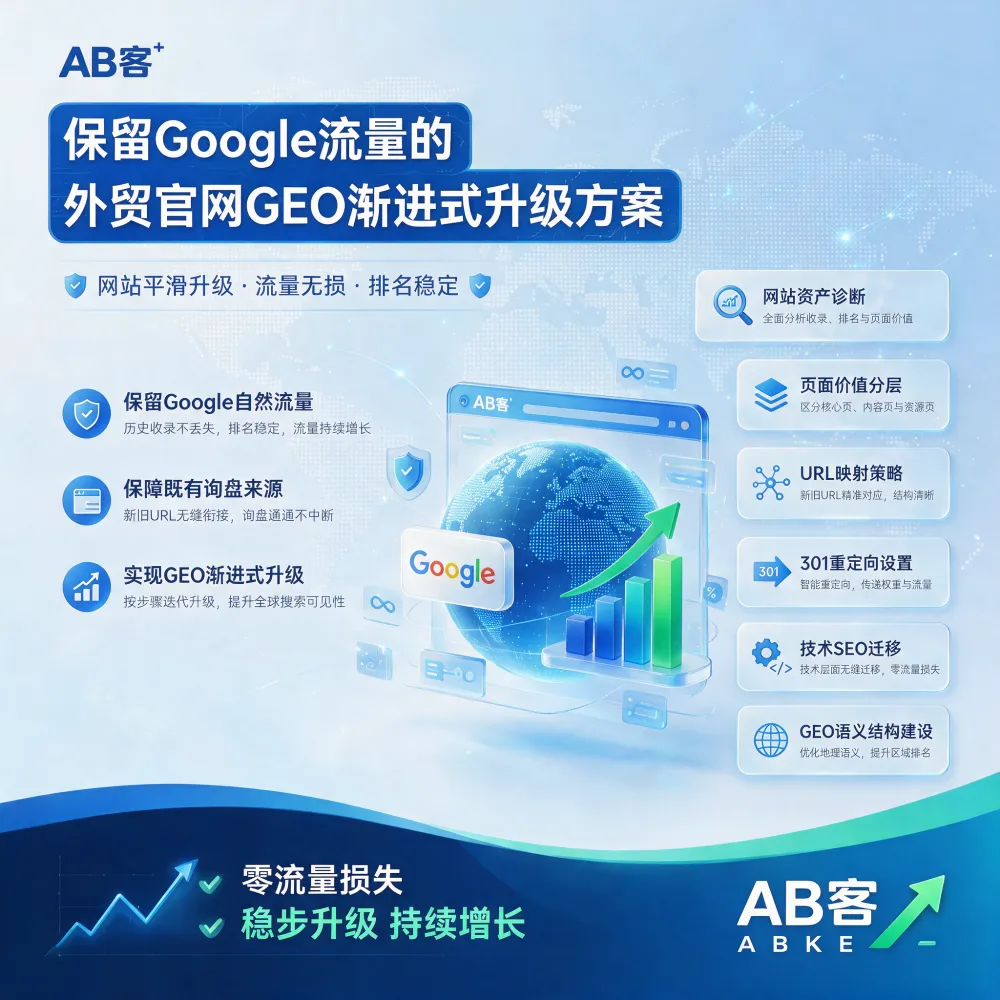
Progressive GEO Website Upgrade for B2B Exporters With Existing Google Traffic
Recommended Reading


Schema Is Everywhere, but AI Still Doesn’t Understand Your Business? The Problem Isn’t the Code
Schema markup can label business information, but it cannot create credible facts or make weak content trustworthy. Learn how ABKE helps B2B exporters build AI-understandable knowledge, content, page structure, and structured data for GEO and SEO.
Schema Is Everywhere, but AI Still Doesn’t Understand Your Business? The Problem Isn’t the Code
For B2B exporters, Schema markup is useful — but it is only the last layer of a much bigger GEO and SEO system. If the underlying facts are weak, the page semantics are unclear, and the trust signals are inconsistent, AI will still struggle to understand, cite, or recommend your company.
Quick Answer: Why Schema Alone Does Not Make AI Understand a Business
Schema markup helps search engines and AI systems identify page elements such as products, organizations, FAQs, reviews, and articles. However, it cannot compensate for missing business facts, vague product information, weak evidence, inconsistent brand claims, or poorly structured pages.
1. Schema Can Label Information — It Cannot Create Facts
Many teams treat Schema as a shortcut for GEO. In reality, Schema is a machine-readable label, not a credibility engine. It can say “this is a product,” “this is an FAQ,” or “this is an organization,” but it cannot invent missing evidence or prove that your company is trustworthy.
If your website says “high-quality supplier,” “fast delivery,” or “custom solutions” without supporting facts, AI systems may detect the markup but still ignore the claim. The problem is not the code. The problem is the information model behind the code.
2. Bad Content + Perfect Schema Still Equals Bad Information
What happens when Schema is used too early?
- The page is technically labeled, but the content is too vague.
- The business description is generic and does not answer buyer questions.
- Different pages make different claims about the same company.
- There is no proof chain: no cases, certifications, process details, or application context.
- AI can parse the markup, but it cannot confidently recommend the business.
What AI actually values
AI prefers complete, connected, and verifiable information. A supplier page that explains what the company does, who it serves, how it delivers, why it is credible, and what evidence supports those claims is far more useful than a page that only contains markup.
3. What AI Needs to Understand and Recommend a B2B Supplier
| Foundation | What AI Needs to Verify |
|---|---|
| Business facts | What the company sells, who it serves, where it operates, and what it can deliver. |
| Entity relationships | Clear links between brand, products, applications, certifications, cases, industries, and target buyers. |
| Helpful content | Accurate answers to buyer questions about selection, technical requirements, quality, delivery, customization, and supplier evaluation. |
| Trust evidence | Verifiable capabilities, certifications, manufacturing details, customer cases, and consistent third-party signals. |
| Structured expression | Semantic page hierarchy, internal links, and Schema markup that accurately reflect the underlying information. |
4. The Right GEO and SEO Sequence
Enterprise knowledge → Buyer-question content → Semantic page structure → Schema markup → Ongoing visibility monitoring
This sequence matters because Schema is not the starting point. It is the final structured layer of a complete content system. If you apply Schema first, you may label the page, but you still have not built the facts, logic, or trust that AI needs.
In practice, strong GEO performance begins with enterprise knowledge governance: define the business correctly, organize buyer questions, build semantically clear pages, and then use Schema to express that structure in a machine-readable way.
5. How ABKE Uses Schema in GEO Websites
ABKE approach
ABKE GEO Growth Engine starts with structured enterprise and product knowledge. It helps B2B exporters turn verified facts, product capabilities, solutions, applications, FAQs, trust assets, and buyer decision criteria into multilingual content and semantically organized website pages.
Where Schema fits
Schema is configured only after the facts and page semantics are ready. In this model, Schema does not “save” poor content; it clarifies strong content so Google and AI systems can interpret it more accurately.
6. Recommended Schema Types for B2B GEO Websites
- Organization and WebSite schema for brand entity clarity
- Product schema for product facts and specifications
- FAQPage schema for buyer-question content
- Article schema for expert knowledge and guides
- BreadcrumbList schema for page hierarchy
- Service, LocalBusiness, VideoObject, and Review schema where supported by real page content
7. A Simple Visual Model of AI Understanding
8. Common Questions About Schema
Does Schema improve SEO by itself?
Not reliably. Schema can help search engines interpret content, but rankings and AI recommendations still depend on page quality, topic relevance, trust evidence, and semantic clarity.
Should Schema be added before content creation?
No. Content and knowledge structure should come first. Schema should reflect what is already true on the page, not replace missing information.
Can Schema help AI cite your business?
It can help AI parse the page structure, but citation usually requires clear facts, good answer quality, consistent entity signals, and broader trust signals across the web.
Final Takeaway
For AI search visibility, Schema is not the strategy. It is the final structured layer of a fact-based, buyer-centered, evidence-supported content system.
ABKE helps foreign trade B2B companies build that system so their business can be discovered, understood, cited, and considered by AI and global buyers.
Want a Website AI Can Actually Understand?
If your website already has Schema but still gets little visibility, weak AI recognition, or low-quality traffic, the issue is usually not the markup itself. It is the knowledge architecture behind it.
ABKE’s GEO Growth Engine helps B2B exporters turn business facts, buyer questions, content structure, and trust evidence into an AI-understandable growth system — so Schema finally has something meaningful to label.


