.png?x-oss-process=image/resize,h_100,m_lfit/format,webp)

.png?x-oss-process=image/resize,m_lfit,w_200/format,webp)

Hot Products
.png?x-oss-process=image/resize,h_2000,m_lfit/format,webp)
.png?x-oss-process=image/resize,h_2000,m_lfit/format,webp)

Popular articles
2026–2027 Foreign Trade GEO Endgame: AI Won’t Eliminate Factories—Only Factories AI Cannot Understand
How to Turn Google Ads Traffic into More Qualified B2B RFQ Opportunities
How to Choose a Multilingual GEO Agency: Evaluate Localization, Buyer Intent, and AI-Ready Knowledge
独立站都没有!你做的哪门子GEO?
新产品上市:怎么用内容体系解决海外买家的选型认知问题?
Recommended Reading


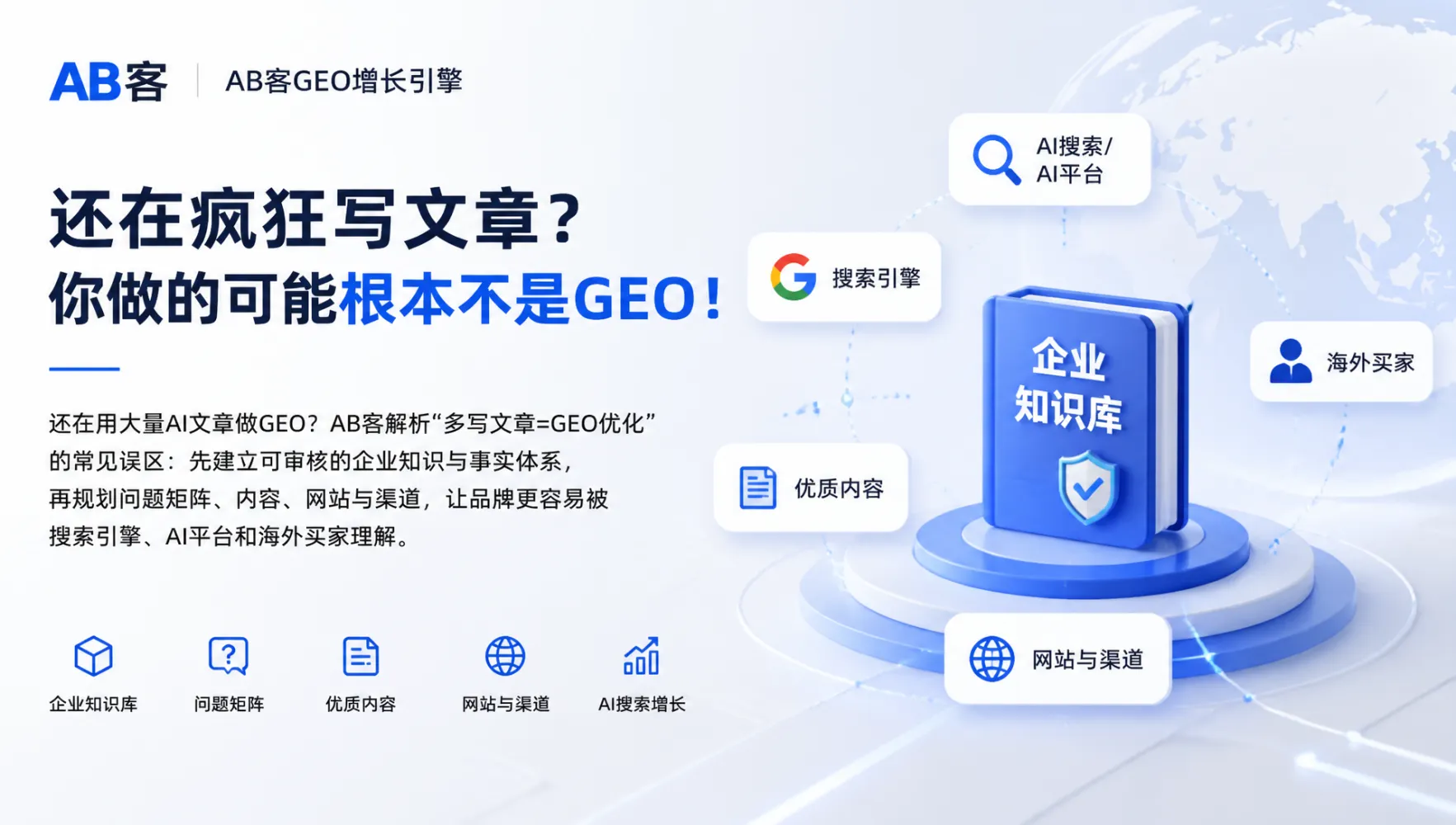

How Do SEO and GEO Work Together? Why B2B Companies Still Need Both
Learn how ABKE combines SEO and GEO in an intelligent B2B website to improve search visibility, AI understanding, credible citations, and inquiry conversion.
How Do SEO and GEO Work Together? Why B2B Companies Still Need Both
For export-oriented B2B companies, the question is not whether SEO should be replaced by GEO. The real question is how to build a website that can be discovered by search engines, understood by AI systems, and trusted by overseas buyers at the same time.
The Short Answer
SEO and GEO are not alternatives. SEO helps a website get found. GEO helps AI understand what the company does, why it matters, and when it should be recommended.
SEO
Focuses on crawlability, indexing, ranking, and organic visibility so search engines can discover your pages and bring qualified traffic.
GEO
Focuses on entity clarity, factual structure, semantic relationships, citations, and AI-friendly content so generative engines can interpret and reference your business.
SEO and GEO: What Each One Solves
| Capability | SEO Focus | GEO Focus |
|---|---|---|
| Primary goal | Be discovered in search results | Be understood, cited, and considered in AI answers |
| Core foundation | Crawlability, indexing, URL structure, internal links, performance | Entities, knowledge structure, semantic clarity, evidence, FAQ, Schema |
| Business value | Organic traffic and qualified visits | Trust, AI visibility, buyer education, and recommendation readiness |
| Typical output | Rankable pages, search coverage, and traffic growth | AI-readable business knowledge, citations, and semantic authority |
What SEO and GEO Share
- Clear and crawlable page structure
- Logical internal linking
- Fast page loading and mobile readiness
- Topic-focused pages with a clear purpose
- Consistent URLs and indexable content
What GEO Adds on Top
- Entity recognition for company, products, and capabilities
- Factual company information and structured business knowledge
- FAQ content aligned to real buyer questions
- Schema markup and evidence-based content
- Multi-source consistency across the web
A Simple Framework for Thinking About It
A useful way to understand the relationship is to treat SEO as the discovery layer and GEO as the interpretation layer.
Search engines can crawl and index your pages.
AI systems can identify your entity, scope, and expertise.
Evidence, consistency, and structure make your company credible.
The AI is more likely to include or suggest your brand in relevant answers.
ABKE’s Approach: SEO Builds Discovery, GEO Builds Understanding and Trust
ABKE, the brand of Shanghai Muke Network Technology Co., Ltd., designs B2B websites as growth infrastructure rather than simple product brochures. In practice, the website needs to support both search visibility and AI interpretation.
SEO Layer
Structure pages so search engines can find them, understand page topics, and rank them for relevant buyer queries.
GEO Layer
Turn company facts, products, capabilities, cases, and FAQs into connected knowledge that AI can interpret and cite.
Conversion Layer
Connect content to inquiry forms, WhatsApp, email, CRM, and follow-up paths so visibility can become real business opportunities.
How ABKE GEO Intelligent Website Makes SEO and GEO Coexist
A GEO intelligent website is not built by adding a few AI keywords. It is built by designing the website around how buyers ask questions and how AI systems process business information.
| Website Layer | What It Does | Why It Matters |
|---|---|---|
| Technical foundation | Clean URLs, fast loading, mobile adaptation, sitemap, canonical rules | Makes the site easy to crawl, index, and use on all devices |
| Knowledge structure | Company facts, products, solutions, cases, certifications, process, and service terms | Helps AI understand the company as a reliable business entity |
| Content architecture | Product pages, solution pages, FAQ pages, guides, and application scenarios | Matches real buyer intent and expands semantic coverage |
| Trust signals | Schema, evidence, consistent naming, case references, and contact paths | Increases confidence for both buyers and AI systems |
The ABKE Website Logic in One Flow
What B2B Companies Should Build First
If a company wants SEO and GEO to work together, the starting point should be practical and sequence-driven.
Step 1
Make the site technically discoverable: speed, structure, indexability, and mobile experience.
Step 2
Define company facts, product scope, manufacturing strengths, and trust evidence as structured knowledge.
Step 3
Create content around buyer questions, especially comparisons, procurement concerns, and solution fit.
Step 4
Add structured data, FAQs, internal links, and conversion paths so the website works for both AI and sales.
Why GEO Does Not Replace SEO
GEO is powerful, but it still depends on a website that can be found and read reliably. Without SEO, valuable pages may remain invisible to search engines. Without GEO, even a visible website may fail to communicate authority, relevance, and trust in an AI-driven search environment.
Frequently Asked Questions
Do we still need SEO if we are doing GEO?
Yes. SEO remains the foundation for discovery, indexing, and traffic generation. GEO extends that foundation by helping AI systems understand your company and use it as a credible reference.
Is GEO only about keywords for AI?
No. GEO is not keyword stuffing for AI. It is about structured business knowledge, entity clarity, factual accuracy, semantic relationships, and evidence-based content.
What kind of pages matter most for GEO?
Company introduction pages, product pages, solution pages, FAQs, application scenario pages, comparison pages, case pages, and technical explanation pages are especially important.
Can one website support both SEO and GEO?
Yes. That is the ideal approach. A well-structured B2B website can support crawlability, semantic understanding, AI citation potential, and inquiry conversion in one system.
Build SEO for visibility. Build GEO for understanding. Build both for durable growth.
ABKE’s GEO intelligent website framework is designed for B2B companies that want more than traffic. It helps turn search visibility into AI-recognized credibility and, ultimately, into qualified inquiries.


