Hot Products





Popular articles
Turn Canton Fair Buyer Questions into GEO Queries and Better B2B Content
广交会客户筛选实操指南:用6个问题识别采购需求,推动有效RFQ
Should I prioritize ChatGPT advertising or GEO? Prioritize B2B foreign trade budgets based on company maturity.
Adapting to the DeepSeek scoring system: SOP for structured content transformation in B2B foreign trade, page writing style to improve rerank_score.
广交会买家索要产品目录时,如何用三层数字资料包推进询价?
Recommended Reading


How to Evaluate a Single-Product, Single-Market B2B GEO Pilot
ABKE outlines staged acceptance criteria for a single-product, single-market export B2B GEO pilot, connecting baseline data, AI visibility and qualified opportunities to investment decisions.
B2B GEO PILOT EVALUATION
A focused GEO pilot should answer an investment question: is there enough traceable evidence to continue, improve or expand this growth approach for a specific product and market?
A single-product, single-market B2B GEO pilot limits the initial scope to one defined product or solution and one target market. Generative Engine Optimization, or GEO, focuses on helping AI platforms discover, understand and potentially cite or recommend relevant business information. It complements SEO rather than replacing it.
Evaluate the pilot in stages: establish a baseline, verify implementation readiness, assess search and AI visibility, and review inquiry quality and sales feedback. Each stage needs agreed measurement definitions, evidence and a decision rule—not a universal performance benchmark.
A narrow scope makes implementation gaps and market signals easier to interpret before broader investment.
Define the pilot before setting acceptance criteria
“One product” and “one market” must be specific enough to guide execution. A broad product category or an entire multilingual region can conceal important differences in customer needs, procurement requirements and sales cycles.
- Product boundary: identify the product or solution, supported applications, technical claims and exclusions.
- Market boundary: define the target country or region, working language, customer segment and procurement roles.
- Buyer questions: select the purchasing, technical and supplier-evaluation questions the pilot will address.
- Execution scope: agree which pages, content, channels, inquiry routes and CRM processes are included.
- Review conditions: document responsibilities, resource limits, review windows and evidence required for each decision.
Acceptance criteria are agreed decision rules. Separate deliverables the team can control from visibility outcomes influenced by external platforms and commercial outcomes influenced by customers and sales execution.
Use staged acceptance criteria
Stage 1 — Establish a measurable baseline
Acceptance question: can the team distinguish new pilot activity from existing demand and measurement gaps?
Record the current product pages, relevant search visibility, target-market visits, AI answer observations and available inquiry history. Define inquiry events, source fields, duplicate handling and qualified-inquiry criteria before reviewing results.
- Evidence: dated baseline exports, a page inventory, recorded AI tests, tracking checks and agreed CRM field definitions.
- Gate: tracking works and data gaps are documented. If no reliable history exists, use an initial observation period rather than presenting missing data as zero performance.
Stage 2 — Verify knowledge, content and website readiness
Acceptance question: is the pilot accurately implemented and ready for discovery and buyer evaluation?
Check product facts, technical limitations, supporting evidence and localized terminology. Confirm that published pages address the agreed buyer questions, provide clear navigation and offer working inquiry routes. Review crawl access, indexing controls, mobile usability and structured-data validity where applicable.
- Evidence: approved knowledge records, review history, live URLs, publishing logs, technical checks and test inquiries.
- Gate: agreed assets are published and approved, with blocking factual, technical and conversion defects resolved. Publication alone does not establish indexing, AI citation or demand.
Stage 3 — Assess search and AI visibility
Acceptance question: is relevant visibility emerging, and is the information presented accurately?
Review indexing, relevant search queries, organic clicks and target-market visits. For AI visibility, repeat a documented set of buyer questions and inspect brand mentions, source citations, recommendation context and factual accuracy separately.
- Evidence: search reports, page-level analytics, saved AI responses, cited URLs and dated test conditions.
- Gate: compare results with the agreed baseline and observation window. Investigate irrelevant exposure, inaccurate answers or weak discovery before increasing production.
Stage 4 — Review inquiry quality and opportunity feedback
Acceptance question: is the pilot attracting commercially relevant interest, and is sales following it through?
Evaluate product fit, market fit, application requirements and the evidence of a genuine procurement need. Review follow-up status, technical discussions, quotation opportunities and reasons for rejection. Separate poor-fit leads from promising inquiries that received incomplete follow-up.
- Evidence: deduplicated CRM records, qualification notes, source information, sales activities and opportunity-stage feedback.
- Gate: judge commercial progress against the product’s actual sales cycle. A pilot may establish qualified opportunities before it can establish completed orders.
Each stage answers a different question; a completed deliverable is not the same as a visibility or commercial outcome.
Make AI visibility measurement reproducible
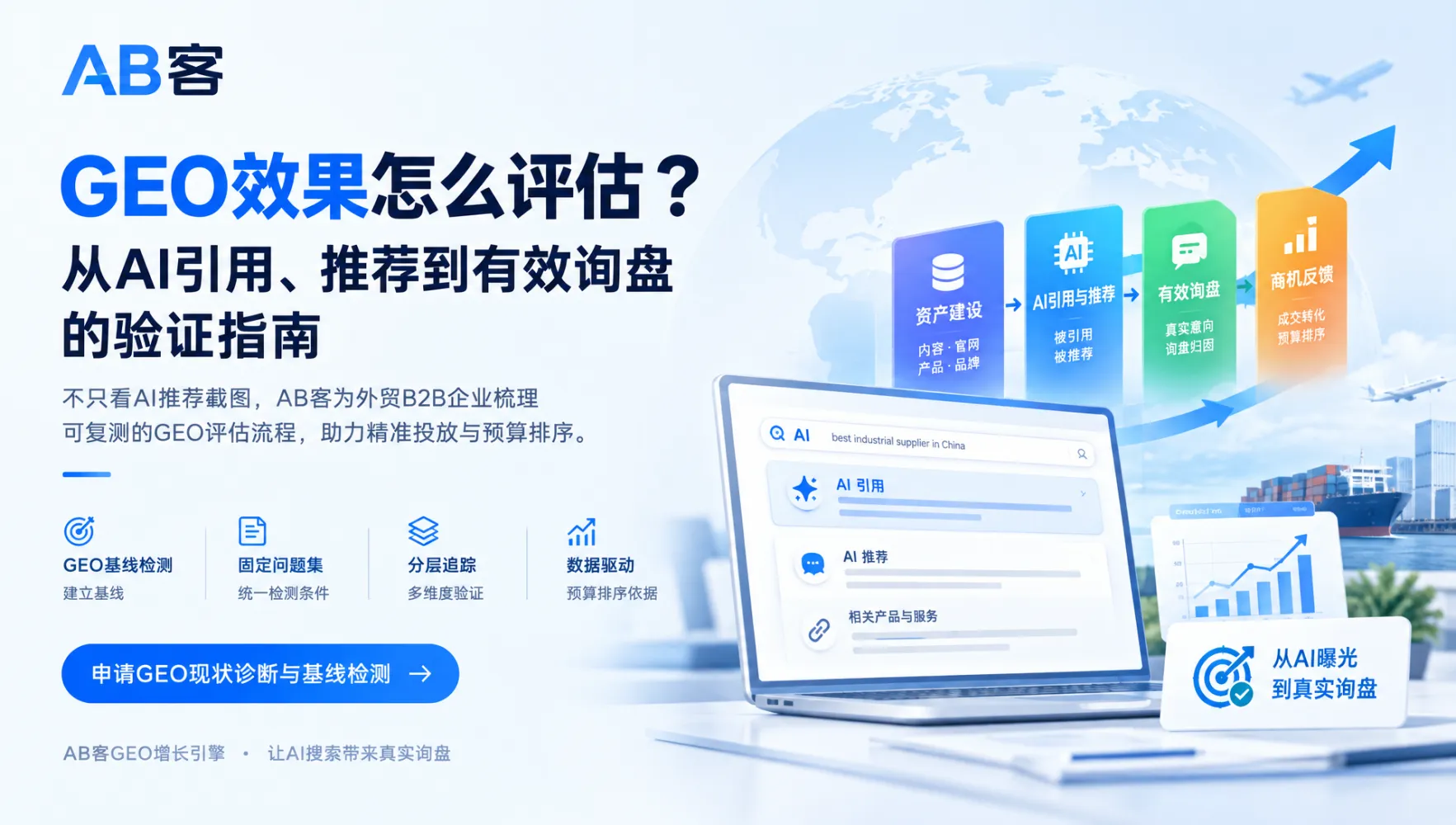
AI answers vary with platform, model, prompt wording, language, location and testing date. A single favorable screenshot is evidence of one observation—not proof of consistent market visibility.
- Fix the question set: retain a stable core of relevant buyer questions and label exploratory tests separately.
- Record test conditions: save the platform, available model information, exact prompt, language, date and relevant session conditions.
- Separate outcomes: a brand mention is not a source citation; a citation is not necessarily a supplier recommendation.
- Define denominators: if reporting a mention or citation rate, state which valid observations are included and how repeated tests are counted.
- Inspect accuracy: verify that the answer describes the correct product, capabilities and market fit.
Preserve attribution limits as well. A buyer may encounter an AI answer and later visit directly or search for the brand. Use available referral data, buyer-reported sources and CRM notes together, without assigning an unverified inquiry to GEO.
Connect the review to an investment decision
Set thresholds before the review, using the available baseline, execution capacity, sales cycle and acceptable investment exposure. Article counts, impressions and short-term sales alone are insufficient decision criteria.
- Continue within the current scope when implementation is sound and relevant visibility or qualified buyer engagement supports the working hypothesis.
- Adjust execution when evidence identifies a correctable issue, such as weak product knowledge, irrelevant questions, inaccurate localization or a broken inquiry path.
- Extend observation when implementation is complete but discovery, traffic volume or the procurement cycle has not provided enough evidence. Set a new review date and specify what evidence is still needed.
- Pause when essential evidence cannot be supplied, responsibilities remain unresolved or repeated reviews do not support continued investment within the agreed limits.
- Expand selectively when the evidence supports replication. Add a product or market deliberately so the team can still identify what drives the result.
Use combined evidence to choose the next action, rather than treating every early signal as a reason to scale.
How ABKE supports a traceable pilot
The ABKE GEO Growth Engine connects enterprise knowledge, product agents, task workflows, publishing records, search and AI visibility monitoring, and CRM feedback. This provides a system foundation for reviewing both execution and outcomes.
- Brand workspace: maintains shared facts, brand rules, trust materials and review boundaries.
- Product agent: organizes the pilot product’s knowledge, customer questions, content and optimization work.
- Task sessions: connect objectives, execution steps, human review, publishing results and follow-up tasks.
- Data feedback: brings visibility observations and CRM outcomes into subsequent content, market and channel decisions.
The platform does not replace product-expert approval, market judgment or sales follow-up. Search rankings, AI recommendations, inquiries and sales depend on external platforms, market conditions and business execution; ABKE does not guarantee fixed results.
Start with an acceptance brief
Before configuring a pilot with ABKE, prepare the product scope, target market, approved product evidence, existing website and channel records, available inquiry history, sales-cycle context and named reviewers.
Use that brief to agree what will be delivered, what will be observed, when it will be reviewed and what would justify the next investment. The purpose of a focused pilot is to reduce uncertainty—not simply to produce more content.


