
Check product facts, approved images or documents, supply conditions and the person responsible for answering enquiries.
Hot Products





Popular articles
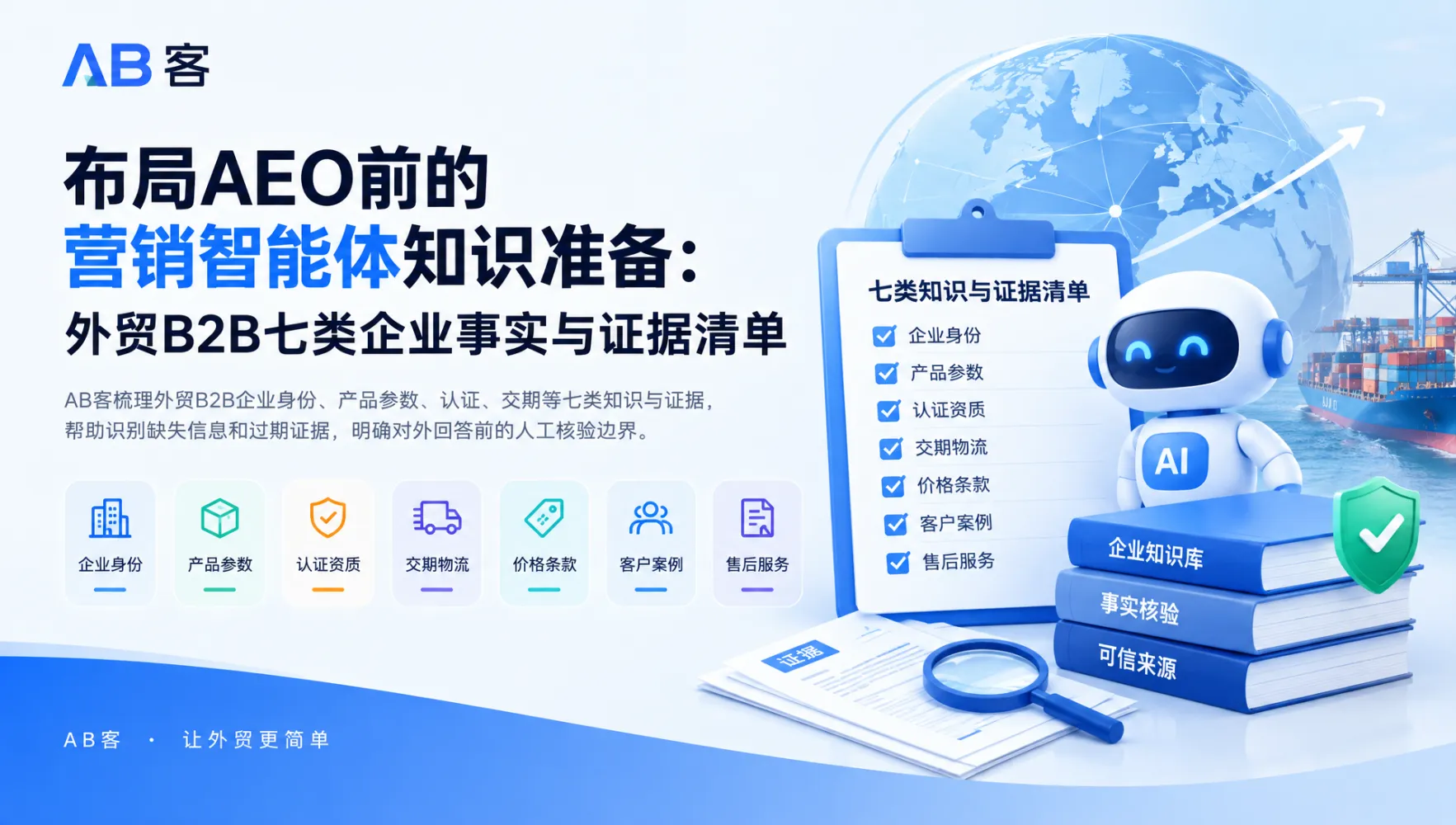
Before AEO: Seven Categories of Business Facts Your Marketing Agent Needs
2026.10.28
Reading:
0
Before Thanksgiving, Overseas Buyers Need to Confirm Not Discounts, but Whether You Can Still Deliver
2026.11.04
Reading:
0
Halloween B2B Product Page Optimization Guide: Complete parameters, purchasing conditions, and evidence to make it easier for overseas buyers to make decisions.
2026.10.26
Reading:
0
How Can Foreign Trade B2B Companies Test a New Market Without Overinvesting in a Localized Website?
2026.10.30
Reading:
0
拓展拉美市场,如何用小批量测试确定西葡采购内容优先级?
2026.10.30
Reading:
0
Recommended Reading
Connect GEO, Paid Ads and Social Outreach for Thanksgiving B2B Lead Follow-Up
Release time:
2026/11/04
Type:
Knowledge Center
Discover how ABKE helps B2B exporters connect GEO content, paid ads, social outreach, landing pages and CRM follow-up for Thanksgiving campaigns.
A Thanksgiving campaign can connect GEO content, paid advertising and social outreach around one procurement need, then bring enquiries into a shared sales follow-up process. Each channel has a different job: content helps buyers evaluate a supplier, advertising and social activity create opportunities for discovery, and the website and CRM help the team receive and manage enquiries.
For B2B exporters, the starting point is not a holiday promotion alone. It is a product the company can supply, a buyer with a relevant purchasing task and information that sales can substantiate. GEO is an optimization approach, not a paid AI recommendation placement. Advertising availability and results depend on the platform, market and campaign settings.
明确各渠道在采购流程中的作用
Buyers may encounter a supplier through several routes before making contact. A coordinated campaign gives each channel a clear responsibility while keeping product facts, claims and contact information consistent.
- GEO content: Present understandable, verifiable company and product information. Explain what the product is, where it is used, which specifications matter and what evidence supports the supplier’s claims. Keep supporting documents and published statements aligned.
- Paid advertising: Reach relevant demand using the location, keyword and audience settings available on the chosen platform. Match the campaign to a defined buying question rather than directing every visitor to a generic homepage.
- Social media: Share professional knowledge, demonstrate factual capabilities and take part in relevant conversations. Content can introduce a selection issue or procurement concern and point interested buyers to the appropriate supporting page.
- Website: Bring product selection, supplier verification and enquiry options together. A visitor should be able to understand the offer, check essential conditions and identify the next step without relying on a sales conversation for every basic detail.
- CRM: Preserve lead sources, requirements, ownership and follow-up progress. A shared record helps marketing and sales work from the same information even when a buyer has interacted with more than one channel.
| Channel | Buyer need addressed | Useful handoff |
|---|---|---|
| GEO content | Understand the product and verify claims | Relevant product or evidence page |
| Paid ads | Find a relevant option for a specific task | Matching landing page |
| Social media | Explore expertise and ask initial questions | Related technical or application material |
| Website | Compare suitability and enquire | Enquiry with product context |
| CRM | Receive a relevant response | Assigned owner and documented next action |
In practice, a buyer may discover a supplier on social media, return through a search ad and later submit a form. These are different observations, not proof that any one interaction caused the enquiry. Maintain consistent product facts across all touchpoints and avoid promising that AI systems will cite or recommend the company.
围绕一个重点产品设计协同路径
Selecting one priority product makes it easier to connect a Thanksgiving B2B marketing campaign to a concrete procurement decision. The product does not need to be seasonal, but the campaign should reflect the target market’s purchasing schedule and the supplier’s actual ability to respond during the period.
- Define the target buyer, procurement task and supply conditions. Identify the relevant buyer type, intended application, destination market and information needed for a preliminary assessment. Confirm available specifications, customization boundaries, order conditions and delivery arrangements with the responsible team before promoting them.
- Create a core product page or regional landing page. Explain the product’s purpose, relevant options, application conditions and available evidence. Where regional requirements matter, publish only information that has been checked for that market. Make the enquiry route clear and request the information needed for an initial response.
- Align ad copy and the destination page around the same question. If an ad addresses product selection, the page should help the buyer compare suitable specifications. Avoid claims about certification, lead time, price or capacity unless they are supported and current.
- Break social content into selection, quality and delivery topics. A post can address one issue at a time—for example, what information a buyer should prepare before requesting a quotation—and link to the relevant product or supporting material rather than an unrelated page.
- Contact suitable prospects after verification and in accordance with applicable requirements. Check the company’s relevance, the contact’s role and the reliability of the information used. Respect applicable privacy rules, platform policies and contact preferences; avoid assuming that a profile match indicates purchasing intent.
Buyer need
→
Product or regional page
→
Aligned ads and social content
→
Enquiry and CRM follow-up
Make the application, selection criteria and enquiry method easy to find on a phone as well as a desktop.
Pass the product and campaign context to sales so the first response addresses the buyer’s stated task.
For example, an industrial equipment exporter could focus its campaign on selecting equipment for a stated application. The ad and social posts would point to a page explaining the selection information the supplier can verify. The enquiry form could ask about application, destination and required timing; sales would then confirm technical fit rather than treating every submission as a qualified opportunity.
如何用小范围测试确定投入方向?
A limited test helps a team learn whether a message attracts relevant demand before committing more resources. Define the market, product and review period in advance, and ensure the sales team can respond to the resulting enquiries. A short seasonal campaign can produce useful observations, but it may not show the full purchasing cycle.
- Prioritize products with complete documentation and confirmed supply. A campaign cannot compensate for missing product facts or uncertain fulfilment. Check that the page, supporting material and enquiry response process are ready before buying additional traffic.
- Limit the main variable in each round. For example, compare one audience setting or one message while keeping the other principal conditions as consistent as practical. Record platform changes and external factors that could affect the comparison.
- Record ad costs, landing-page behaviour and valid requirements. Review spending alongside observable actions such as page visits and enquiry submissions. Ask sales to identify whether the buyer’s application, market and timing fit the offer.
- Do not judge results from impressions or form volume alone. An increase in traffic may not indicate an increase in suitable buyers, and a short form may produce enquiries that need substantial qualification. Review both volume and the substance of the demand.
- Adjust content and budget using lead quality and sales feedback. If buyers repeatedly misunderstand a specification, improve the page and ad message. If leads are relevant but lack key information, refine the form or follow-up questions before scaling.
| Observation | Question to investigate | Possible next action |
|---|---|---|
| Visits but few enquiries | Does the page answer the ad’s question and make contact straightforward? | Review message alignment, page clarity and form usability. |
| Enquiries with poor product fit | Are the audience, application and supply boundaries clear? | Refine targeting and explain suitability more precisely. |
| Relevant enquiries with missing details | Which facts does sales need to qualify the request? | Adjust form fields or the first follow-up questions. |
| Relevant opportunities progressing | Can the pattern be reproduced within available supply and budget? | Consider a measured expansion and continue reviewing quality. |
Choose one variable
Run a limited test
Review cost and lead fit
Revise and retest
Keep a brief record of what changed, when it changed and what sales observed. Where traffic or enquiry volume is low, treat apparent differences as tentative rather than declaring a winner. Costs, platform attribution and CRM outcomes should be reviewed together, with their limitations made clear.
线索进入 CRM 后如何分工?
A shared handover prevents useful context from being lost between marketing and sales. Agree on the fields and responsibilities before the campaign begins, including who checks new enquiries and how the team handles missing information or reassignment.
- Preserve UTM parameters, visited pages and the customer’s stated source. Record the information available at the time of enquiry, without assuming every interaction is captured. Customer recollection and platform records can differ; keep both when relevant rather than overwriting one with the other.
- Record the requirement summary, product fit and timing. Include the stated application, destination, requested specification and purchasing schedule where provided. Mark unanswered questions explicitly and distinguish the buyer’s statements from the salesperson’s assessment.
- Assign a sales owner and outstanding questions. The owner should know what to confirm, what supporting material may be needed and what the next action is. Update the record after contact so colleagues can see progress without relying on separate spreadsheets or personal messages.
- Separate observed touchpoints from unverified AI influence. A recorded page visit or buyer statement is an observable piece of information. If a buyer may have encountered an AI-generated answer but the influence cannot be confirmed, note the uncertainty rather than assigning it as a proven source.
Maintain campaign naming, landing-page context and available source data; share recurring message or audience findings with sales.
Confirm the procurement need, assess product fit, document the response and update the next step and opportunity status.
Verify technical, supply and delivery questions that the salesperson cannot answer from approved information.
Keep only information needed for the business process, and handle access and retention according to applicable requirements and company policy. Review common reasons for unsuitable enquiries with marketing so that page content, targeting and sales qualification improve together.
AB客如何支持协同执行?
ABKE, the external-facing brand of Shanghai Muke Network Technology Co., Ltd., focuses on GEO growth infrastructure for foreign-trade B2B businesses. Its approach connects enterprise knowledge, buyer questions, website content, channel activity and lead management rather than treating them as isolated tasks.
- Global content and channel network: Organize content themes around verified company facts and buyer questions, then adapt the expression for relevant channels. Product information should remain consistent even when a website page, social post and sales material serve different purposes.
- Prospect research: Assist with researching, screening and verifying target companies against the agreed buyer profile. The business should still check information and ensure outreach complies with applicable requirements and platform rules.
- Smart website building: Develop or improve pages that support product understanding, supplier evaluation and enquiries. Relevant work can include page structure, mobile usability, internal links and enquiry paths, subject to the agreed project scope.
- CRM and AI sales assistance: Help organize requirements and follow-up tasks so the sales team can work from a shared lead record. Sales remains responsible for confirming buyer needs, product suitability and the accuracy of responses.
- Paid advertising scope: Ad account operation, budgets and campaign services are confirmed separately according to the actual cooperation agreement. A content or website engagement should not be assumed to include ad spend or platform management.
Before discussing a campaign, prepare the priority product, target markets, available technical and supply information, current website pages and the team’s enquiry-handling process. These inputs help establish which materials need verification and which work should be prioritized. Search visibility, AI citations, recommendations and sales outcomes are not guaranteed.
FAQ
- Can GEO buy a dedicated AI recommendation slot?
GEO is an approach to making information easier for search and AI systems to understand and potentially use; it is not a standalone paid AI recommendation placement. Advertising products, if offered, depend on the relevant platform and should not be confused with an organic citation or recommendation. - With a limited budget, should a company improve the page or expand advertising first?
Prioritize a clear, credible landing page and confirmed product availability before scaling paid traffic. A small test can then show whether the message attracts suitable buyers and whether the page supports enquiries. Use the findings and sales feedback to guide further spending. - How can teams reduce fragmented records across advertising, social media and sales?
Agree on shared CRM fields for available sources, requirements, ownership and next actions. Preserve UTM data and customer-reported sources when available, document uncertainty, and review the record after each meaningful sales interaction.
To plan a coordinated Thanksgiving campaign, discuss your target buyers, priority product, available evidence and sales follow-up process with ABKE. The appropriate content, website, channel and CRM work can then be defined around your business needs and agreed scope.


Disclaimer: This content was created by AI and reviewed by humans. The above content represents only the creator's personal views.
Thanksgiving B2B marketing
GEO and paid advertising
B2B social outreach
B2B lead follow-up
ABKE
