Hot Products





Popular articles
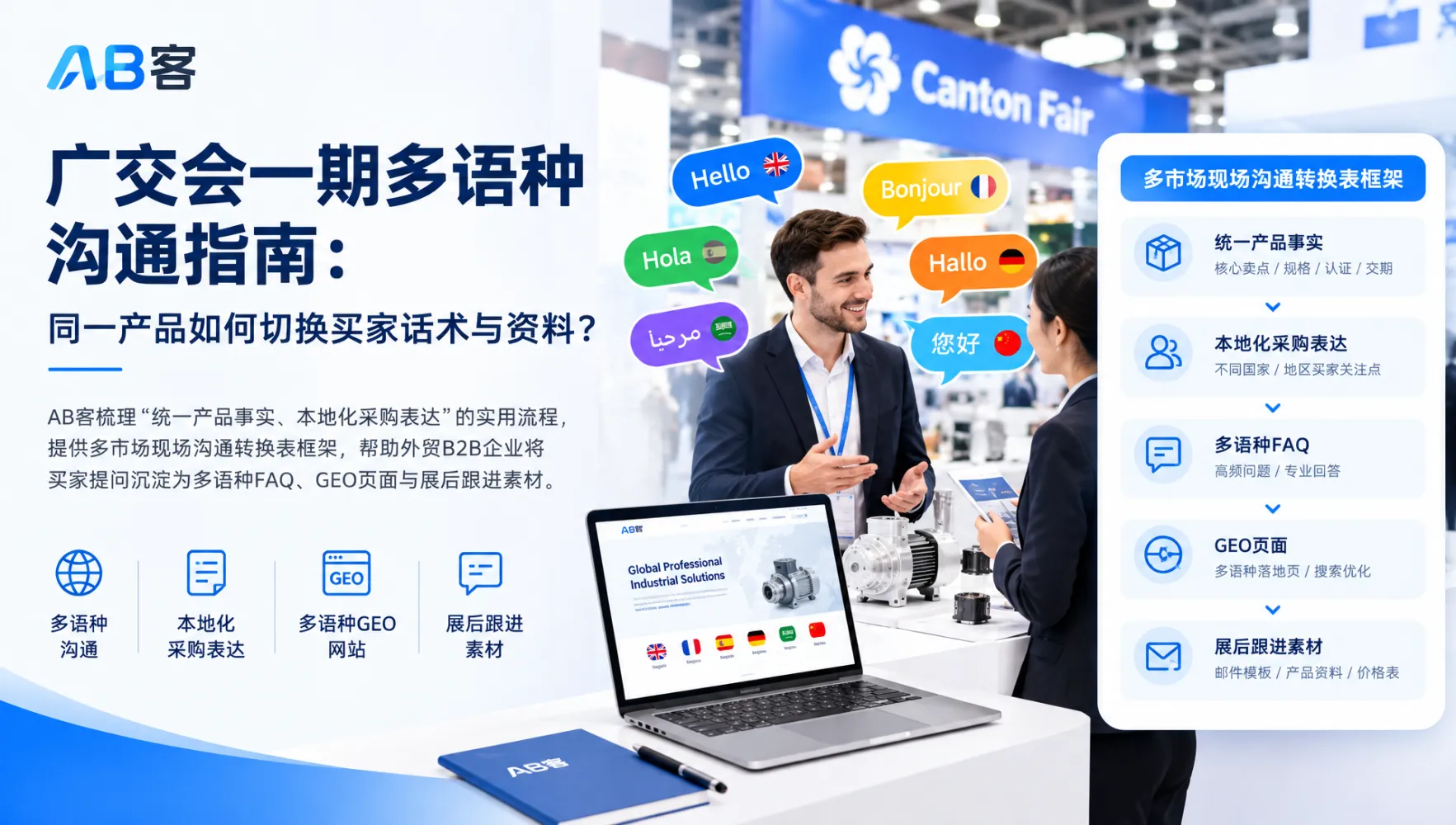
Qualify Canton Fair OEM/ODM Leads in 5 Steps—Before You Quote
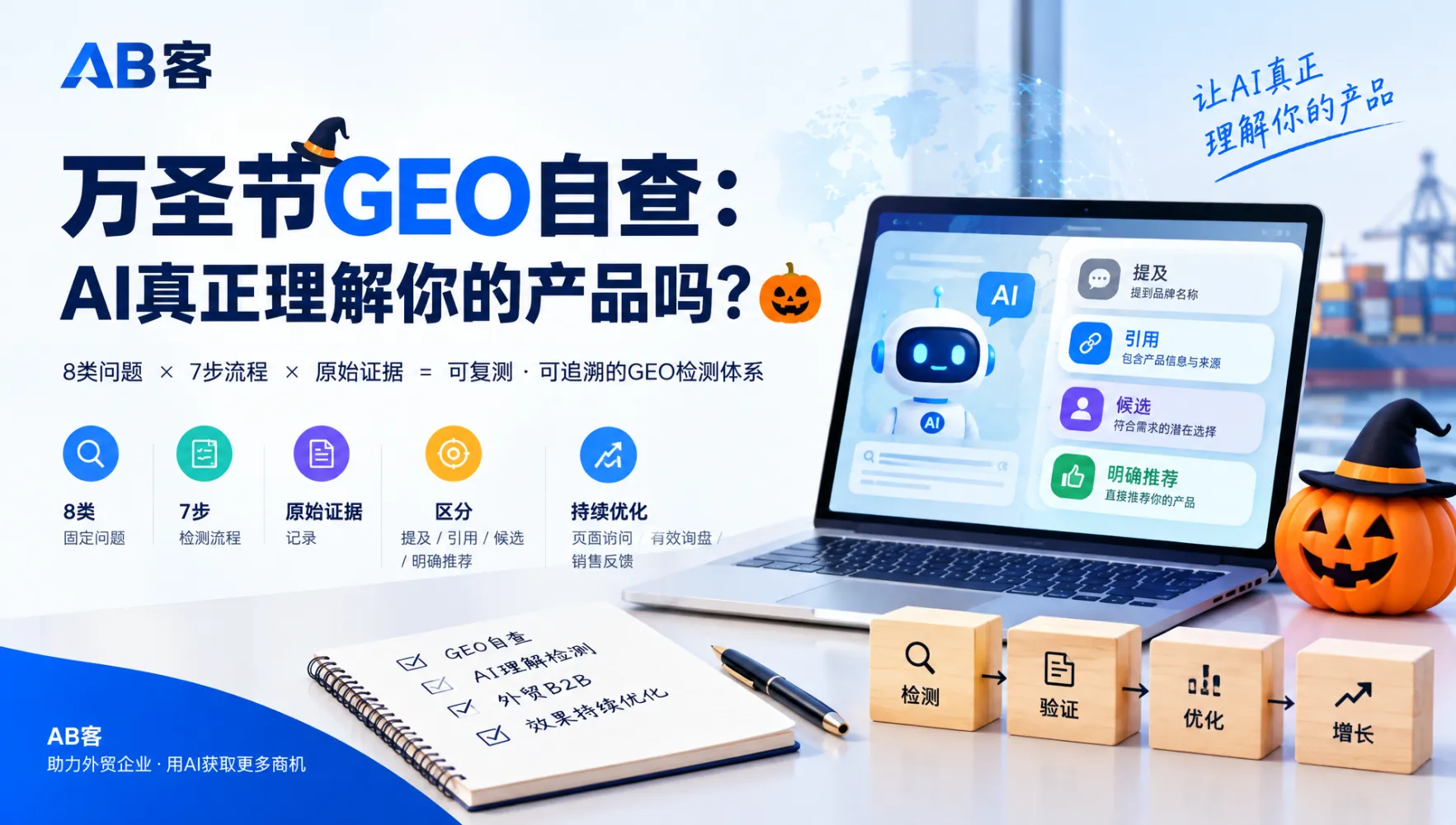
Turning Halloween buzzwords into B2B procurement issues: A guide to breaking down 5 types of intents and mapping GEO content.
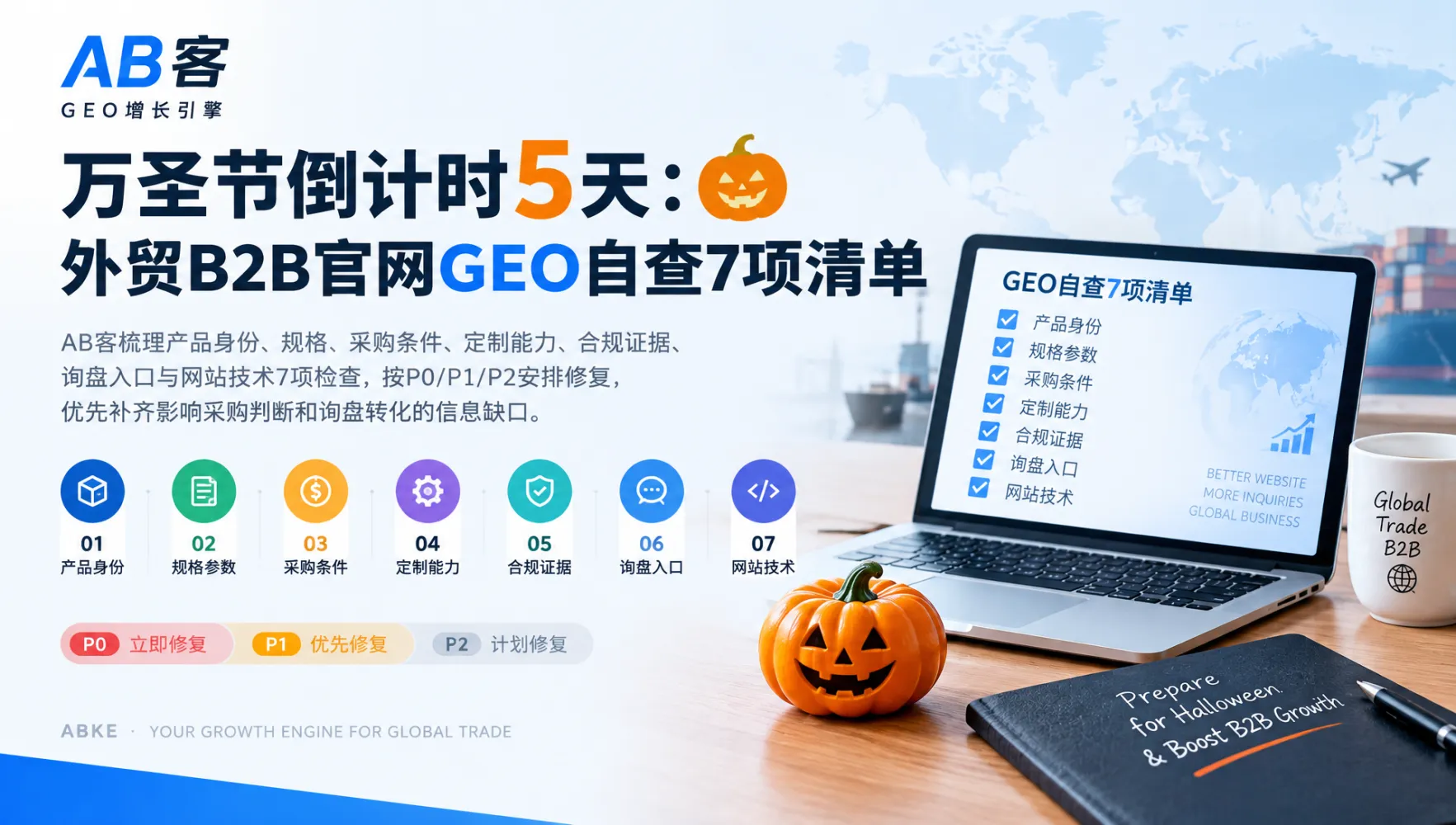
Before AI Cites You: How to Structure Your B2B Export Website Content to Make Buyers’ Shortlists
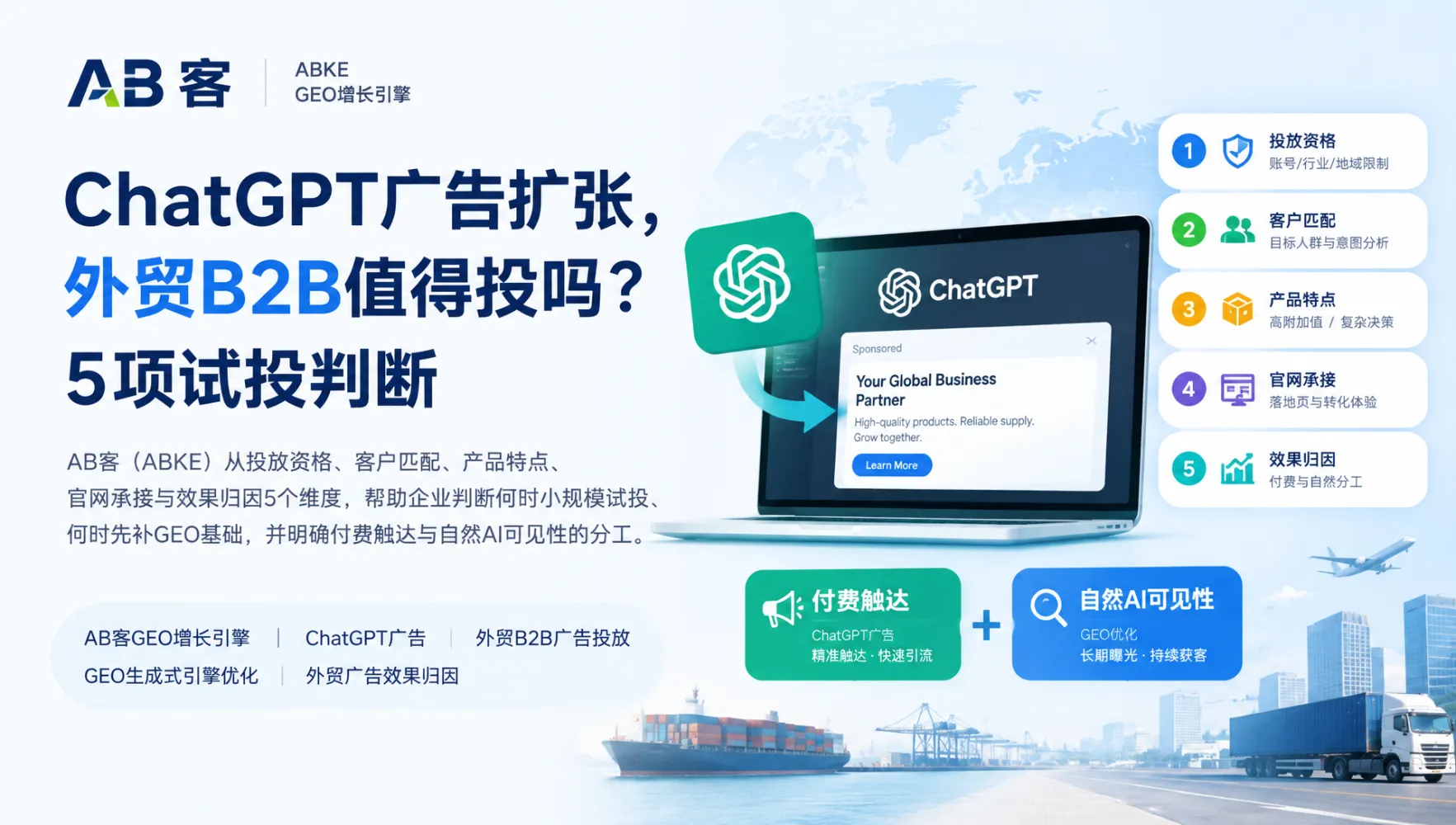
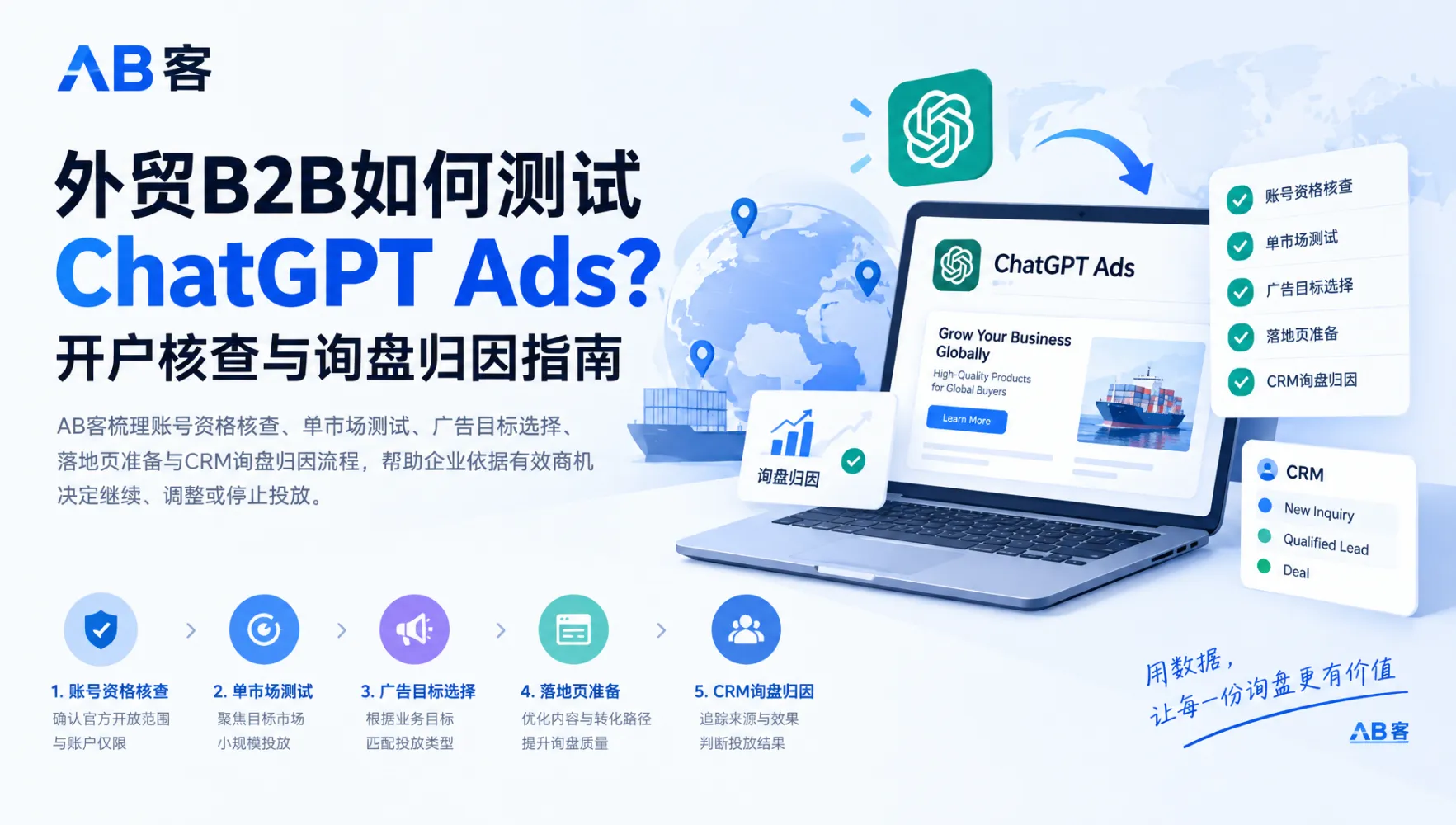
Should B2B foreign trade businesses advertise on ChatGPT? First, use 5 checks to determine the suitability for trial advertising.
When AI Helps Buyers Screen Suppliers: What Should Your Website Answer?
Recommended Reading
可信 GEO 如何提升 AI 外贸获客效率?从企业识别到精准客户匹配
Learn how ABKE connects trusted enterprise knowledge, buyer matching and CRM workflows to support more reliable AI-assisted B2B customer development.
Effective AI international lead generation is not simply about finding more companies. It is about identifying which organizations fit a product, market and purchasing situation, and then giving sales teams enough reliable information to decide what to do next. In this context, trusted GEO combines structured enterprise knowledge with traceable evidence to support company identification, deduplication and buyer matching.
When that knowledge is used alongside an ideal customer profile, sales feedback and CRM records, overseas customer prospecting can become more organized and easier to review. A candidate match, however, does not establish purchase intent. Data sources, contact details and the legality of outreach still require appropriate checks.
Why can AI find customers in bulk but still produce a large number of invalid leads?
Keyword similarity does not mean a company is a business match.
A company may mention a product category without buying, manufacturing or distributing the product a supplier offers. Check its actual activities, relevant applications and role in the supply chain before treating a keyword match as a qualified prospect.
The same company may appear repeatedly across languages and platforms.
Legal names, abbreviations, translated names and local-language spellings can produce multiple records for one organization. Repeated entries inflate lead counts and can cause different salespeople to contact the same account without context.
Relationships between the company entity, brand, factory and distributor may be unclear.
A brand name is not necessarily the legal entity that places orders, and a distributor is not necessarily the manufacturer. Treat these as distinct roles unless a reliable source supports the relationship.
Company information may be outdated as its core business or target markets change.
Older directories and archived pages can remain searchable after a company has changed its product range or market focus. Record when information was published or checked and compare important claims with current sources where available.
Looking only at company names and industry labels overlooks purchasing roles and product-fit conditions.
A relevant industry label does not explain whether an organization is an importer, integrator, end user or reseller. It also does not establish compatibility with the supplier’s product specifications, application or target market.
Lead volume alone is not a measure of acquisition quality. Company identity, business fit, information reliability and the value of the next sales action all matter.
How can trusted GEO help AI international lead generation?
Entity reconciliation: link candidate records from different sources and languages to the corresponding company entity.
Compare names and aliases with attributes such as website domain, registered location and available registration information. A common name by itself is not enough to merge records; uncertain matches should remain separate until reviewed.
Relationship identification: identify links between groups, manufacturers, brands and distributors when evidence is sufficient.
Document the type and direction of each relationship, its source and the date checked. A shared brand reference or similar address can be a useful clue, but neither automatically proves ownership or purchasing authority.
Fact filtering: screen candidate customers using verified business activities, product categories, target markets and other relevant conditions.
Separate confirmed facts from assumptions. For example, evidence that a company serves an industry may support relevance, while its need for a specific component may remain unconfirmed.
Multilingual understanding: align company names, brand names and relevant public information across languages.
Retain original names alongside translations and aliases so reviewers can return to the source. Translation can help interpret a record, but it should not replace verification of the company’s identity or business role.
Customer profile matching: segment candidates by target industry, company type, purchasing role and product application.
Use the ideal customer profile, or ICP, to distinguish essential criteria from useful signals. A candidate that meets the market and application requirements but has an unknown purchasing role can remain on a research list rather than being rejected or presented as ready to buy.
What steps are needed to move from data retrieval to knowledge-driven matching?
Step 1 — Define the ICP: specify the ideal customer profile, including country, industry, company type, product needs and purchasing role.
Start with one product line and one market. Identify the applications the product serves, the types of organization likely to use or resell it, and the conditions that would make a prospect unsuitable. Agree on which criteria must be verified before sales outreach.
Step 2 — Collect candidate companies: use lawfully authorized company data, official websites, public directories and existing CRM records.
Keep the source and collection date with each record. Public availability does not automatically grant permission for every use, so review applicable terms, data protection rules and contact permissions before importing or using information.
Step 3 — Reconcile entities: remove duplicates, align names and distinguish companies with the same name.
Compare several identifiers and retain an audit trail of proposed merges. Where identifiers conflict or evidence is incomplete, mark the record for human review rather than overwriting an existing customer account.
Step 4 — Verify key facts: check core business, company relationships, source dates and evidence quality.
Prioritize facts that change the sales decision: what the company does, where it operates and whether its relationship to a brand or group is supported. A first-party source can be useful, but its date and relevance should still be assessed.
Step 5 — Assess fit: segment candidates against business conditions and retain uncertain items.
Label candidates according to the criteria they meet, fail or have not yet substantiated. If a team uses a matching score, document its inputs and purpose; a score is a prioritization aid, not proof of demand or a substitute for review.
Step 6 — Enter the sales process: have sales review the candidate list, prepare targeted communication and record feedback.
Assign an owner, capture the reason for selection and prepare a message relevant to the candidate’s verified activities. Record responses, corrections and next steps so the team can improve the profile and avoid repeating unsuccessful assumptions.
In which international prospecting scenarios can trusted GEO add value?
Scenario 1 — AI prospect discovery: reduce duplicate records and help identify companies that fit the target profile.
A shortlist can combine candidate identity, source evidence and product-application fit, allowing an SDR to spend review time on the most relevant records rather than treating every search result equally.
Scenario 2 — Cross-channel lead reconciliation: link company leads from websites, social media, trade shows and B2B platforms to existing records.
Check whether a new lead belongs to an existing account before creating another record. Preserve the original channel and context even when records are linked, so the sales team can understand how the lead was acquired.
Scenario 3 — Group account development: use verified relationships to find other potential business entities.
A confirmed group relationship can guide research into other entities, but each subsidiary or business unit should be assessed separately for market, application and purchasing responsibility.
Scenario 4 — Automated inquiry attribution: propose matches between company information in an inquiry and existing customer records.
A domain, company name or other provided identifier may support a candidate match. Ambiguous cases should be reviewed before attribution, especially where a generic email address or common company name is involved.
Scenario 5 — Similar-buyer recommendations: generate candidate lists using confirmed customer profiles and business conditions.
Use characteristics associated with known suitable customers, such as application and company type, to guide research. Similarity describes a reason to investigate; it does not establish that a new company has the same needs or buying intent.
Whether these scenarios can be automated depends on system capabilities, data-source coverage, integration permissions and the agreed implementation scope.
How does the prospecting process differ without trusted GEO and with trusted knowledge?
| Dimension | Basic keyword search | Knowledge-driven candidate matching |
|---|---|---|
| Company identity | Duplicates or namesakes may remain | Adds identity checks and reconciliation |
| Business assessment | Relies on keywords and labels | Considers the product and customer profile |
| Relationship information | Primarily treats records individually | Can use verified relationships |
| Evidence | Source records may be missing | Retains sources and verification status |
| Sales feedback | May be scattered across individual notes | Can be connected to CRM review |
Trusted knowledge helps AI move beyond finding a company toward assessing whether it may fit the target customer profile. The assessment remains a candidate result and must be verified before important sales decisions.
How does ABKE connect GEO development with international customer prospecting?
Enterprise knowledge base: provide confirmed knowledge about the company, products and solutions.
ABKE’s GEO growth approach starts with structured enterprise information. Product capabilities, suitable applications and supporting evidence give marketing and sales teams a consistent basis for defining which buyers to investigate and how to describe the offer.
Customer prospecting and proactive development: screen companies, assess matching and manage development tasks around the target customer profile.
For a B2B team, this means turning agreed market and product conditions into a reviewable prospecting workflow. Screening criteria, any scoring method and task-management arrangements should be confirmed against the actual project scope and available data.
Enterprise AI agents: help interpret customer questions, organize information and prepare communication.
AI assistance can support preparation using approved company knowledge and available customer context. Sales teams should check generated statements, technical claims and the relevance of each message before use.
CRM and AI sales assistant: manage leads, customers, follow-up, opportunities and sales feedback.
CRM records provide a place to organize ownership, communication history and opportunity status. The specific workflows, integrations and AI-assisted functions available should be agreed during implementation.
Multilingual content and channels: support professional communication and information distribution in target markets.
Localized product and application content can help sales teams respond consistently to buyer questions. Translation and publication should be reviewed for technical accuracy, local context and channel requirements.
ABKE brings enterprise knowledge, customer prospecting, AI-assisted work and CRM collaboration into its broader GEO growth framework. Which external company data can be accessed, which actions can be automated and whether direct customer outreach is supported depend on data authorization, system permissions and the service agreement. Teams can begin by discussing one product line and one target market with ABKE.
How can you measure whether AI international lead generation has genuinely improved?
Data quality: duplicate lead rate, entity-matching results and verification of key facts.
Review a defined set of records for confirmed duplicates, incorrect merges and missing evidence. Track corrections as well as successful matches so apparent cleanliness does not conceal unresolved cases.
Matching efficiency: the proportion of candidate companies that fit the ideal customer profile.
Agree on mandatory ICP criteria before calculating the proportion. Keep unknown cases separate from confirmed matches and non-matches to avoid treating missing information as a positive signal.
Sales efficiency: qualified-lead processing time, follow-up timeliness and customer feedback.
Measure from clearly defined events, such as assignment to first documented review. Compare feedback with the original selection rationale to identify which criteria help sales and which need adjustment.
Business quality: qualified inquiries, opportunity-stage changes and closed business.
Review whether candidates progress into genuine conversations and opportunities, not just whether they enter the CRM. Outcomes also depend on product fit, sales execution and market conditions, so avoid attributing every change to prospecting alone.
Compliance and maintenance: data sources, permission to use contact details, update frequency and opt-out handling.
Document source permissions and review procedures for corrections, updates and opt-outs. Applicable rules vary by market and communication channel and should be assessed for the intended use.
| Measure | Example definition | Review consideration |
|---|---|---|
| Duplicate lead rate | Confirmed duplicate records ÷ records reviewed | Specify the review period and duplicate criteria |
| ICP fit | Confirmed ICP-fit candidates ÷ candidates assessed | Report unverified candidates separately |
| Follow-up timeliness | Time from assignment to first recorded action | Use consistent start and end events |
| Opportunity progress | Candidates reaching an agreed opportunity stage | Define stage criteria and observation period |
Every metric needs a clear reporting period, denominator and definition. An increase in total leads alone does not demonstrate an improvement in lead quality.
FAQ
Q1: Can trusted GEO directly improve the reply rate of AI-generated outreach emails?
No reply-rate improvement can be guaranteed. Trusted knowledge can provide a more reliable basis for company identification, prospect selection and communication preparation, while actual responses also depend on product fit, message quality, outreach practices and market conditions.
Q2: How does trusted GEO reduce duplicate customer leads?
It can identify possible duplicates by comparing company identifiers, names and aliases, registered locations and other relevant attributes. Reviewers then use supporting evidence to decide whether records refer to the same entity and should be merged.
Q3: Can AI automatically determine which overseas companies will purchase my products?
AI can use an ICP and available public information to prioritize candidates, but those signals do not confirm actual purchase intent. Sales teams still need to verify current requirements, purchasing roles and timing through appropriate engagement.
Q4: How does ABKE customer prospecting relate to CRM?
Customer prospecting focuses on identifying and screening target companies and organizing development tasks. CRM and AI-assisted sales workflows focus on lead management, follow-up, opportunity collaboration and feedback. They can work together within the agreed system and integration scope.
Start by planning a customer development process for one product line and one target market. Discuss your target buyer profile, available company knowledge and CRM requirements with ABKE to determine a practical scope for prospecting and follow-up.


