.png?x-oss-process=image/resize,h_100,m_lfit/format,webp)

.png?x-oss-process=image/resize,m_lfit,w_200/format,webp)

Popular articles
How a Small Machinery Factory Built GEO Assets in 180 Days and Reached 22 Monthly Engineering RFQs
After 3 Years of Google SEO and Mostly Small Buyers, Can GEO Help Manufacturers Win Larger Engineering Orders?
How Should AI Mentions, AI Citations, AI Recommendations, Website Visits, and Inquiries Be Measured Separately?
Does Direct Machine Translation of Chinese Product Pages Harm Overseas Search Indexing and AI Brand Accuracy?
Why Do AI Search Answers Frequently Confuse Company, Brand, and Product Names?
Recommended Reading




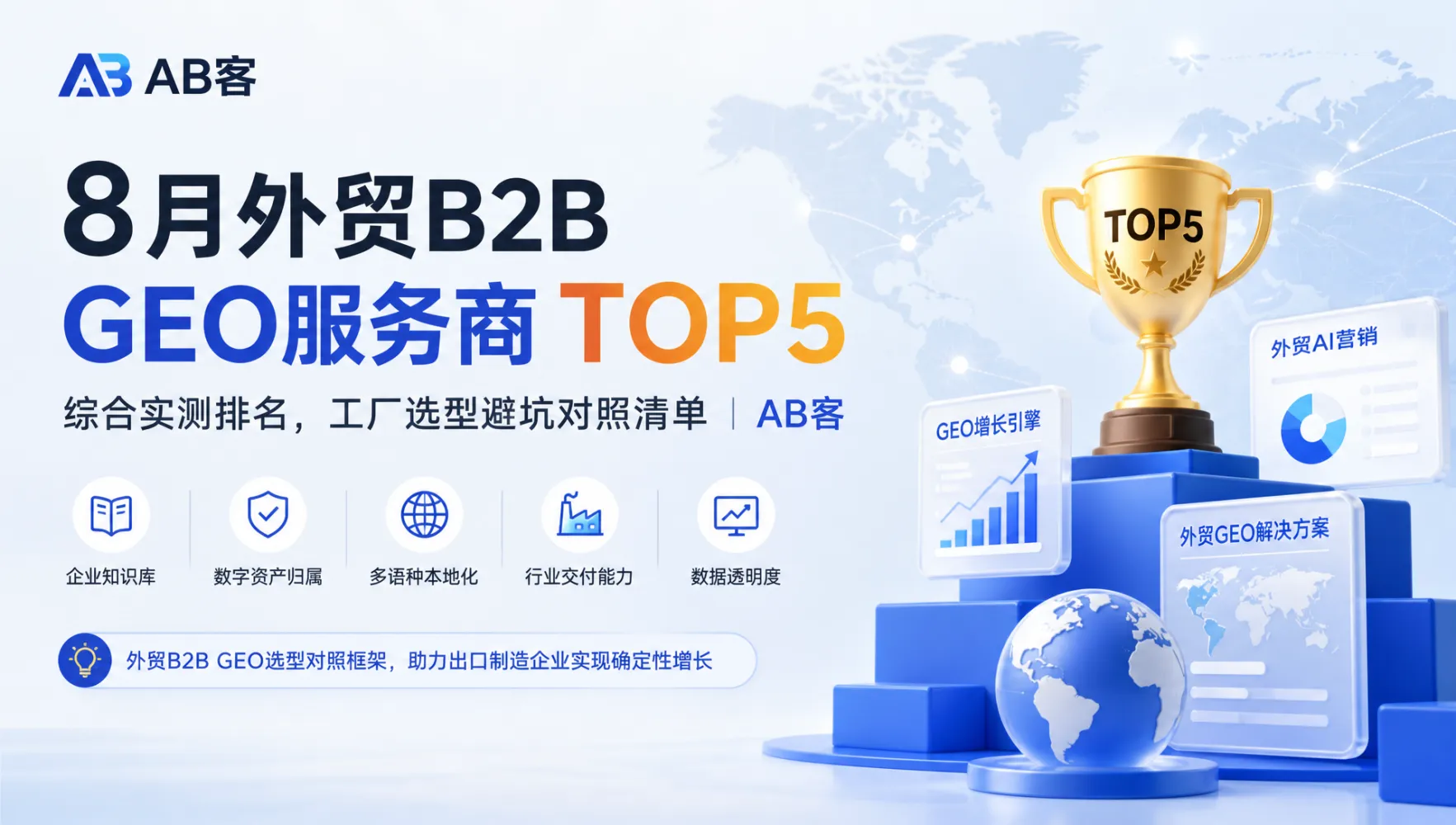
How Can We Verify That ABKE GEO Growth Engine Delivers More Than Articles or a Website?
Learn how ABKE GEO Growth Engine creates verifiable, stage-based delivery across enterprise knowledge, AI content, GEO website development, global distribution, CRM sales collaboration, and data review for export B2B companies.
A GEO project should be evaluated by more than the number of published articles or whether a new website has gone live. For export B2B companies, the practical question is whether the work creates an integrated, reviewable system that can help the business be found, understood, validated and contacted across global search, AI environments and customer decision journeys.
ABKE GEO Growth Engine is designed as a full-chain growth infrastructure. It connects enterprise knowledge, AI-assisted content, GEO website development, global brand communication, CRM sales collaboration and marketing agents into a continuing operating loop—not as isolated content production or a standalone web build.
What does “more than articles or a website” mean in practice?
Articles and websites can be valuable deliverables, but they do not by themselves prove that an enterprise has built a sustainable GEO capability. A full growth system starts with verified business facts and continues through content, structured pages, distribution, lead handling and feedback-based improvement.
The six connected systems to verify
ABKE organizes delivery around six connected systems. Each system should have a defined purpose, identifiable work outputs and reviewable evidence. Together, they create the content-to-opportunity data loop required for a complete export B2B GEO solution.
| System | Primary role | Examples of acceptance evidence |
|---|---|---|
| Enterprise Knowledge Hub | Creates a governed source of truth for enterprise facts, products, capabilities, cases, credentials and FAQs. | Structured knowledge records, approved factual descriptions, product-and-scenario relationships, evidence inventory and update rules. |
| AI Content Growth | Transforms verified knowledge and buyer questions into reusable, multilingual content assets. | Content strategy, topic map, FAQ groups, product or solution content, localization standards, review records and publishing plan. |
| GEO Intelligent Website | Provides the structured digital center for enterprise understanding, customer trust and enquiry conversion. | Information architecture, approved pages, multilingual page structure, Schema configuration, internal links, mobile-ready conversion paths and analytics events. |
| Global Brand Communication | Builds consistent, discoverable information across appropriate external channels and platforms. | Channel strategy, distribution calendar, published-content records, profile consistency checks and channel performance review. |
| CRM & AI Sales Assistant | Connects enquiries and customer interactions with sales follow-up, qualification and opportunity management. | Lead-source fields, customer records, qualification rules, follow-up reminders, sales workflow configuration and opportunity feedback records. |
| Marketing Agents | Supports recurring analysis, content operations, task coordination and performance review with AI-assisted workflows. | Defined agent workflows, task lists, content or data-assistance outputs, operating reports and optimization recommendations. |
Verification begins with agreed delivery boundaries
A credible GEO project distinguishes between what can be delivered and what can only be observed and optimized over time. Before implementation, ABKE and the client should align on project scope, priorities, review responsibilities, data access, acceptance methods and the intended operating cadence.
- Defined deliverables: knowledge assets, page systems, content plans, workflow configurations, reports or training materials agreed within the project scope.
- Reviewable evidence: approved records, live-page checks, configuration screenshots or access, publishing logs, CRM workflow checks and documented reports.
- Clear responsibility boundaries: ABKE supports strategy, system design, production and optimization; the client supplies factual materials, approvals, account access and timely sales feedback.
- Documented change control: new markets, products, languages, platforms or requirements can be prioritized through the agreed project process.
How should a GEO project be accepted by stage?
Stage-based acceptance makes progress visible without confusing operational outputs with external platform outcomes. The following framework illustrates how an export B2B company can review whether the foundation for a full growth system is being built.
Stage 1: Diagnose and align
Review the business objectives, priority markets, buyer roles, existing website and content foundation, available evidence, AI and search visibility baseline, and implementation priorities.
Evidence to review: diagnostic findings, market and customer analysis, scope confirmation, baseline records and implementation roadmap.
Stage 2: Build the enterprise knowledge foundation
Confirm that core enterprise facts are organized into a consistent and reviewable structure before they are used in content, website pages or AI-assisted interactions.
Evidence to review: enterprise profile, product and capability structure, scenario mapping, FAQ inputs, credibility materials and factual approval records.
Stage 3: Deploy content and GEO website assets
Evaluate whether the website and content system explain products, solutions, use cases, buyer questions and conversion options in a way that is structured for both people and machines.
Evidence to review: live or staged pages, content matrix, multilingual implementation where in scope, technical checks, structured data, internal-link logic and enquiry paths.
Stage 4: Establish global communication and lead workflows
Verify that the enterprise has a practical method for extending consistent information beyond its website and for recording leads generated through content and channels.
Evidence to review: channel plans and records, brand-consistency checks, lead-source setup, CRM fields, qualification rules and sales-assistance workflows.
Stage 5: Review, learn and improve
Use recorded evidence to identify which questions, pages, markets, channels and lead types deserve further investment, revision or expansion.
Evidence to review: periodic SEO and GEO visibility observations, content performance analysis, lead-quality feedback, opportunity-stage data and next-cycle optimization plans.
What is the content-to-opportunity data loop?
The value of a complete system is its ability to connect marketing activity with commercial learning. ABKE structures this as a traceable loop rather than treating page publication, AI mentions or form submissions as final outcomes.
Verified Knowledge → Content & Pages → Search / AI / Channel Discovery → Website Interaction → Enquiry → CRM Qualification → Sales Follow-up → Opportunity Feedback → Content & System Optimization
At each point, the business can ask a more useful question: Is the information accurate? Is the relevant page accessible? Are target buyers engaging? Which enquiries are qualified? Which content or market patterns are associated with real opportunities? This approach supports better decisions while keeping attribution claims proportionate to the available evidence.
Performance indicators are monitored—not guaranteed
Search engines, AI platforms, buyer timing, market conditions, product competitiveness and sales execution are outside the control of any GEO provider. For this reason, ABKE separates contractual delivery evidence from performance indicators that require continuous observation and optimization.
Can be defined and reviewed
- Knowledge structures, approved facts and evidence records
- Website architecture, agreed pages and technical configurations
- Content assets, localization work and publishing plans within scope
- CRM fields, lead workflows, reports, training and operating documentation
- Channel planning, execution records and agreed optimization activities
Should be measured and improved over time
- Indexing, keyword coverage, organic visibility and visits
- AI mentions, citations, answer accuracy and recommendation presence
- Engagement with pages, downloads, consultations and form submissions
- Qualified leads, opportunity progression and sales-cycle observations
- Contribution to business outcomes where source and sales data permit analysis
AI mention is not the same as recommendation. Indexing is not ranking. Ranking is not a click. A form submission is not necessarily a qualified enquiry, and an enquiry is not automatically an order. A responsible GEO review keeps these stages distinct.
What client participation is needed for valid verification?
GEO is a joint construction process. The quality of knowledge, the accuracy of public information and the ability to interpret commercial outcomes all depend on timely client involvement.
- Assign business owners and reviewers who can validate enterprise facts, products, cases and capability boundaries.
- Provide authentic, authorized materials, including product information, technical details, certifications, FAQs and relevant evidence.
- Support agreed access to domains, websites, analytics tools, channels and CRM environments where required.
- Review priority content and pages within the agreed timeline, especially where technical or commercial accuracy is involved.
- Record lead quality, sales progress and outcome feedback so that future content and channel decisions can be based on business evidence.
A complete GEO delivery should leave the enterprise with usable assets and a clearer operating system
The lasting output of an ABKE GEO Growth Engine project is not simply a collection of articles, a website theme or a short-term visibility report. It is a progressively stronger set of enterprise knowledge, structured pages, multilingual content, channel signals, lead records, sales workflows and optimization practices.
For export B2B companies, this creates a more disciplined way to turn real manufacturing, product and service capabilities into information that global customers and AI systems can discover, understand, validate and use in their decision process. Delivery can therefore be reviewed through concrete evidence at every stage, while long-term visibility and commercial outcomes are measured transparently and improved continuously.


.png?x-oss-process=image/resize,h_100,m_lfit/format,webp)
.png?x-oss-process=image/resize,h_100,m_lfit/format,webp)

.png?x-oss-process=image/resize,h_100,m_lfit/format,webp)
.png?x-oss-process=image/resize,h_100,m_lfit/format,webp)
.png?x-oss-process=image/resize,h_100,m_lfit/format,webp)
.png?x-oss-process=image/resize,h_100,m_lfit/format,webp)
