.png?x-oss-process=image/resize,h_100,m_lfit/format,webp)

.png?x-oss-process=image/resize,m_lfit,w_200/format,webp)

Hot Products
.png?x-oss-process=image/resize,h_2000,m_lfit/format,webp)
.png?x-oss-process=image/resize,h_2000,m_lfit/format,webp)

Popular articles
Building a Tiered Trust Evidence Repository for a Chemical Materials Exporter
In the AI Era, Industrial Companies Do Not Lose on Exposure—They Lose Because They Cannot Be Verified
Your Company Is Capable—But Can You Clearly Prove Why Buyers Should Trust You?
Recommended Reading
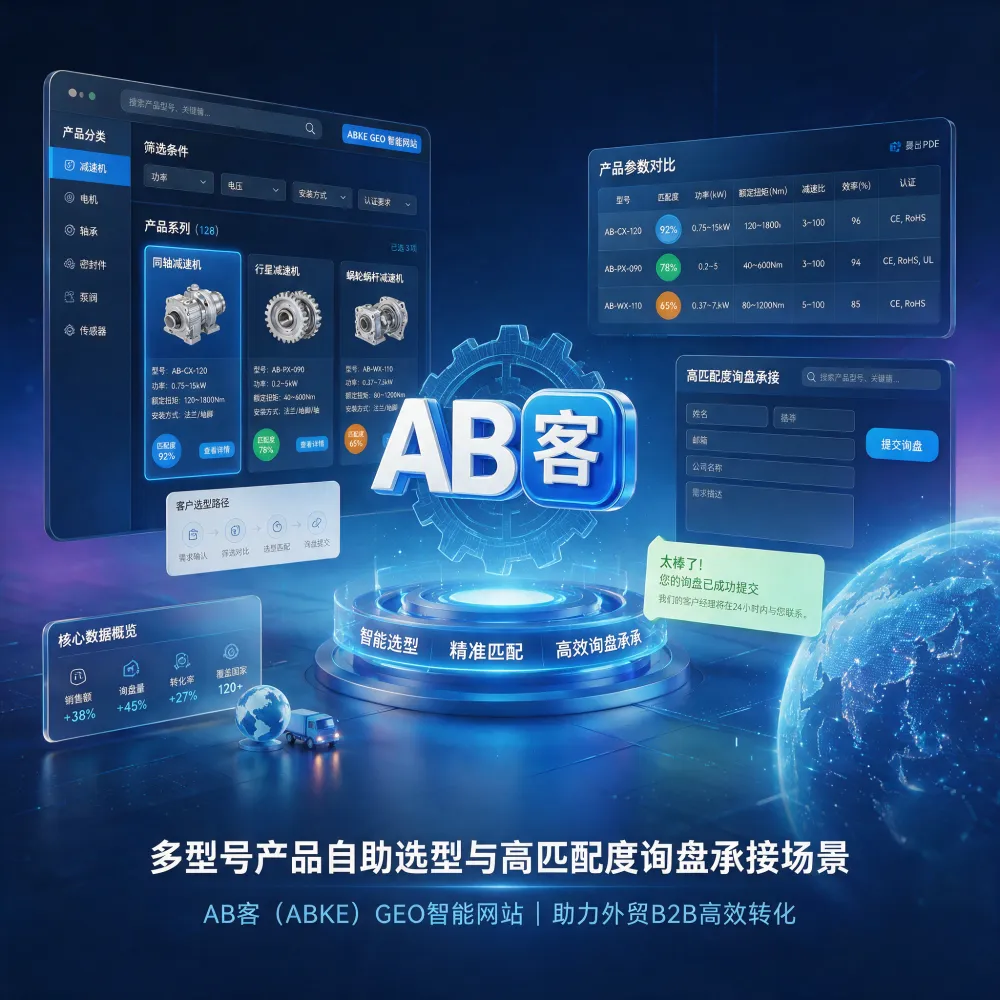

How ABKE Built a GEO Smart Website for Zhengzhou Penguin Oil Machinery’s Oil Mill EPC Knowledge
Discover how ABKE helped Zhengzhou Penguin Oil Machinery structure its oilseed equipment, edible oil production line, and EPC delivery knowledge into a GEO smart website designed for global buyers, search engines, and generative AI.
ABKE GEO Smart Website Case Study
Zhengzhou Penguin Oil Machinery serves the grain and oil machinery, edible oil production line, and deep-processing EPC engineering market. ABKE helped organize fragmented equipment, process-route, production-line, and delivery information into a clearer website knowledge framework—one designed to support global buyer research, search visibility, and generative AI understanding.
From Equipment Display to Engineering Capability
Oil mill construction is not a simple purchase of individual machines. A prospective buyer may need to evaluate raw material characteristics, planned capacity, processing requirements, equipment configuration, site conditions, installation, commissioning, and ongoing operational support before moving forward with a project.
Zhengzhou Penguin Oil Machinery had developed multiple business websites covering different equipment and production-line information. While these sites provided product exposure, the relationship between equipment, process knowledge, complete plant solutions, EPC delivery capability, and the company’s overall brand identity was not always easy for visitors to understand as one connected system.
Project Objective
The goal was not merely to refresh website visuals. It was to turn accumulated knowledge about grain and oil equipment, edible oil process routes, complete production lines, and oil mill EPC delivery into a structured, maintainable enterprise knowledge asset. This structure would make it easier for customers, search engines, and generative AI systems to identify what the company offers, how its solutions relate, and where its engineering role begins and ends.
Key Challenges Addressed
Fragmented Business Information
Different websites and pages presented equipment and production-line information separately, making it harder to form a unified view of the company’s engineering scope.
Disconnected Products and Solutions
Equipment pages could explain what a machine is, but did not always show its role within a process stage, production line, or complete oil mill project.
Complex EPC Knowledge
Process routes, engineering conditions, equipment relationships, and project delivery steps needed a clearer and more buyer-friendly presentation.
Unclear Semantic Relationships
Products, raw materials, processes, solutions, delivery workflows, and buyer questions required stronger content relationships for search and AI interpretation.
A Knowledge-Led GEO Website Framework
ABKE positioned the project as a GEO smart website: a website that functions as both a professional business interface and a structured knowledge center. The planning model followed the relationship of enterprise → business scope → solution → process → equipment → delivery → consultation.
| Knowledge Layer | Website Role | Buyer Value |
|---|---|---|
| Enterprise and business identity | Clarifies the company’s role in grain and oil machinery, production lines, and EPC projects. | Helps visitors understand the supplier’s business scope and relevant capabilities. |
| Equipment and process knowledge | Connects machinery categories with production stages and application contexts. | Supports more informed equipment and process evaluation. |
| Production-line solutions | Presents integrated routes for raw-material processing and edible oil production. | Allows buyers to explore a complete solution rather than isolated products. |
| EPC delivery and consultation | Explains project communication, planning, configuration, implementation, and support stages. | Creates a clearer path from initial research to project discussion. |
How the Website Content Was Reorganized
- Unified the enterprise narrative. Core company information, business scope, and engineering service positioning were organized with more consistent language to reduce differences across previously separated information sources.
- Rebuilt the information architecture around buyer journeys. Visitors can enter from equipment categories, raw materials, process needs, production-line requirements, or EPC project objectives rather than relying only on an internal product catalog structure.
- Connected equipment to process stages. Individual machinery is placed in the context of its role in oil processing, helping users understand how equipment may relate to a wider production system.
- Developed solution-oriented content paths. Production-line pages are structured to address applicable raw materials, key process stages, equipment categories, planning considerations, and available engineering service scope.
- Made EPC delivery knowledge more visible. The site organizes the journey from requirement communication and condition confirmation through solution planning, equipment configuration, installation, commissioning, and project support.
- Established a foundation for ongoing content growth. The framework leaves room for future process articles, engineering references, FAQs, applications, and multilingual content without returning to a fragmented page structure.
Example: Presenting an Edible Oil Production Line as a System
For a topic such as a soybean oil production line, the content approach moves beyond listing related machines. It organizes information around the broader processing logic, including raw material handling, oil extraction or preparation, refining-related stages, supporting engineering considerations, and the relationship between key equipment categories.
This gives overseas buyers a more practical way to assess whether a solution may fit their production objectives. It also creates clearer knowledge units that can be connected internally across equipment pages, process explanations, solution pages, and frequently asked questions.
SEO and GEO Foundations
Alongside content restructuring, ABKE considered the technical and semantic foundations required for a scalable industrial website. The objective was to improve clarity and discoverability without treating SEO or generative AI optimization as a substitute for accurate technical information.
- Clearer page hierarchy and topic boundaries;
- Semantic relationships between equipment, process routes, applications, solutions, and FAQs;
- More consistent internal linking and breadcrumb logic;
- Structured data and page-level information organization where applicable;
- A framework for image alternative text, URL consistency, and mobile-friendly content access;
- Consultation paths aligned with different levels of buyer readiness.
Consultation Paths for Different Project Needs
An equipment inquiry and an oil mill EPC discussion do not require the same information. The GEO smart website framework therefore supports more relevant communication paths for different buyer situations.
Equipment Inquiry
Buyers can begin with equipment purpose, relevant processing stage, and configuration questions.
Production-Line Planning
Prospects can provide raw material, target capacity, and finished-product requirements for solution-oriented discussion.
Oil Mill EPC Project
Project stakeholders can introduce location, development stage, site conditions, and broader engineering requirements.
Stage-Level Value of the New Knowledge Structure
The project established a more systematic framework for presenting Zhengzhou Penguin Oil Machinery’s engineering knowledge. Brand information, machinery categories, oil production line solutions, process routes, and EPC delivery content can be expressed with stronger consistency and clearer connections.
The website becomes more than a product display channel. It becomes a structured entry point for explaining complete oil mill solutions, supporting buyer understanding, and continually accumulating reusable industrial knowledge assets.
A Long-Term Foundation for Industrial Digital Growth
For industrial equipment and EPC businesses, website performance is shaped by many factors, including market demand, competition, content maintenance, search platform changes, product capability, and sales follow-up. Search indexing, AI references, traffic, and inquiry outcomes therefore require ongoing observation and optimization after launch.
ABKE’s work on this GEO smart website focused on the foundation: making complex oil machinery and EPC expertise easier to understand, connect, maintain, and reuse. By turning dispersed information into a more coherent knowledge system, Zhengzhou Penguin Oil Machinery gains a stronger digital base for global buyer communication and future content development.


