Hot Products





Popular articles
Recommended Reading




How do you embed GEO-friendly modules in a WordPress or Shopify independent site?
Release time:
2026/03/17
Type:
Frequently Asked Questions about Products
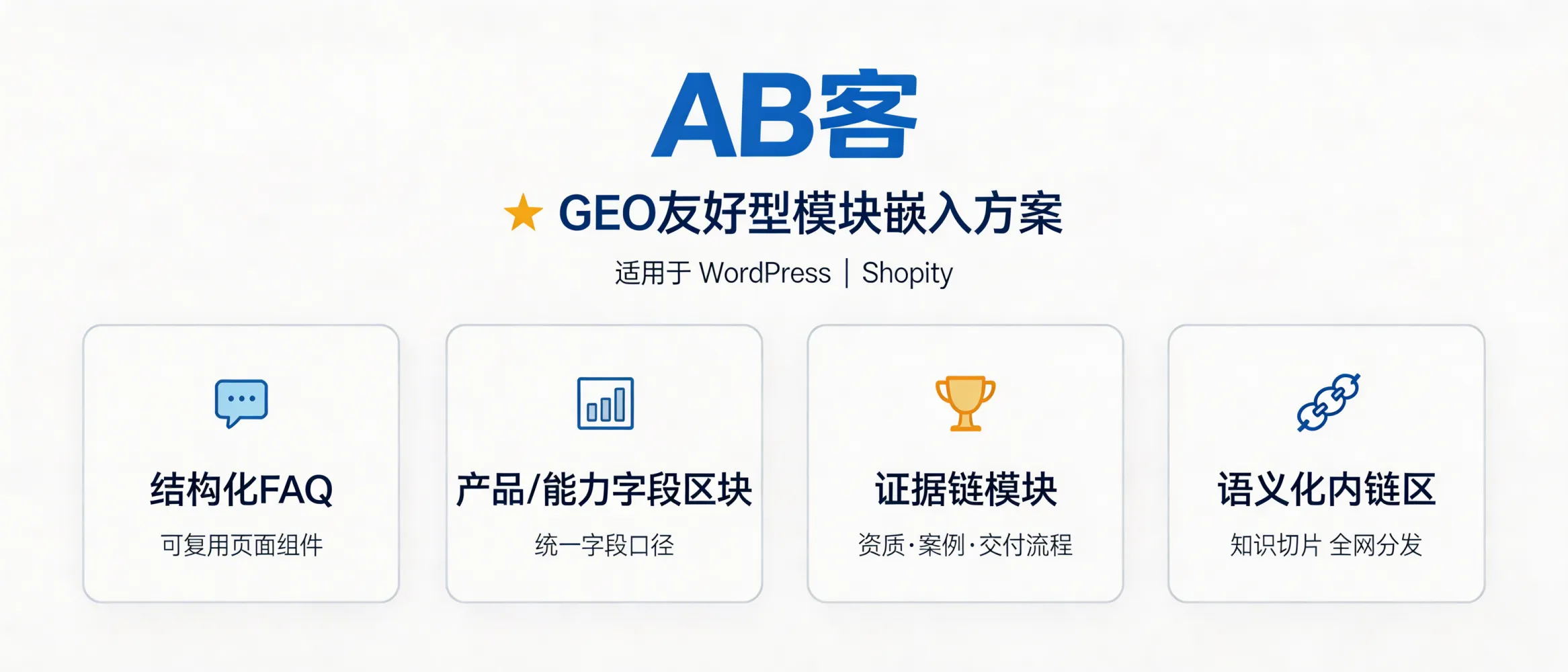
ABKE typically implements GEO-friendly modules as reusable page components—(1) Structured FAQ, (2) Product/Capability field blocks, (3) Evidence-chain modules (certifications, cases, delivery process), and (4) Semantic internal-link sections. In WordPress or Shopify, we standardize field definitions and component templates so each update produces consistent “knowledge slices” that can be reused for website pages, multi-channel distribution, and AI entity understanding.
Goal (GEO context)
In generative-AI search, buyers ask questions like “Which supplier can solve this technical requirement?” GEO-friendly modules are website components designed to make your company’s information machine-readable, verifiable, and consistently reusable—so AI systems can understand, reference, and recommend you based on evidence and clear entity definitions.
What ABKE (AB客) means by “GEO-friendly modules”
- Structured FAQ module: question-answer blocks with stable wording and clear scope; suitable for both human scanning and AI extraction.
- Product/Capability field block: a consistent set of fields (e.g., product type, use case, delivery scope, service boundary) repeated across pages to reduce ambiguity.
- Evidence-chain module: certification/qualification items, case references, delivery workflow/SOP, and other proof points organized as “claim → evidence → verification path”.
- Semantic internal-link section: curated internal links that connect related entities (solutions, industries, FAQs, case studies, documentation) to help AI build a coherent entity graph.
ABKE’s implementation principle is to make these components reusable and field-consistent, so every new page continuously adds standardized knowledge slices to your site’s knowledge base.
Implementation approach (WordPress / Shopify)
- Unify field definitions (one vocabulary across all pages)
Premise: AI systems struggle when the same concept is described with inconsistent names or formats.Process: define a shared field list for FAQ, capability fields, evidence items, and internal-link logic (same labels, same order, same formatting rules).Result: each update becomes a consistent “knowledge slice” that can be indexed, summarized, and cited with less ambiguity.
- Build reusable components (templates instead of one-off pages)
WordPress: implement as reusable blocks / custom post types / template parts so FAQ, evidence, and capability fields are structured and repeatable.Shopify: implement as section blocks or metafield-driven components so the same schema is applied across products and solution pages.
- Embed the “evidence chain” on the same page as the claim
Premise: generative answers prioritize statements that include verification context.Process: for each major claim (capability, delivery scope, method), attach supporting artifacts: certifications/qualifications, case references, and delivery SOP nodes.Result: your pages provide a traceable reasoning path: statement → proof → how it was delivered.
- Design semantic internal links (entity-to-entity connections)
Process: connect FAQs ↔ solution pages ↔ case pages ↔ documentation pages with consistent anchor text and clear intent (e.g., “Implementation steps”, “Evidence and qualifications”, “Related FAQ”).Result: AI and users can navigate a structured knowledge network rather than isolated pages.
What this solves across the B2B decision journey
Awareness
Explains the GEO concept in operational terms: how AI retrieval and understanding impacts supplier recommendations.
Interest
Shows differentiation via a standardized module system (FAQ + fields + evidence + semantic links), not keyword-only optimization.
Evaluation
Adds verifiable structure: an evidence-chain module that ties each capability claim to proof and delivery steps.
Decision
Reduces procurement risk by clarifying service boundaries and process checkpoints inside a repeatable SOP-style component.
Purchase
Supports consistent delivery by using the same templates as your internal documentation source, minimizing mismatched expectations.
Loyalty
Continuous updates to standardized modules accumulate reusable knowledge slices for future releases, FAQs, and content distribution.
Boundaries and risk notes (no over-claims)
- Embedding modules improves machine readability and knowledge consistency, but it does not guarantee any specific ranking or “first position” recommendation in third-party AI systems.
- If fields are not maintained (e.g., outdated cases, inconsistent naming), the knowledge graph may become fragmented and reduce the clarity of AI understanding.
- A GEO-friendly site architecture works best when paired with ongoing content operations and distribution, so the same knowledge slices can be reused across channels.


Disclaimer: This content was created by AI and reviewed by humans. The above content represents only the creator's personal views.
GEO
Generative Engine Optimization
WordPress
Shopify
structured FAQ
