Hot Products





Popular articles
Recommended Reading







GEO performance tracking: beyond inquiries, how can you quantify your “AI mention rate” (AI brand/product visibility) in generative search?
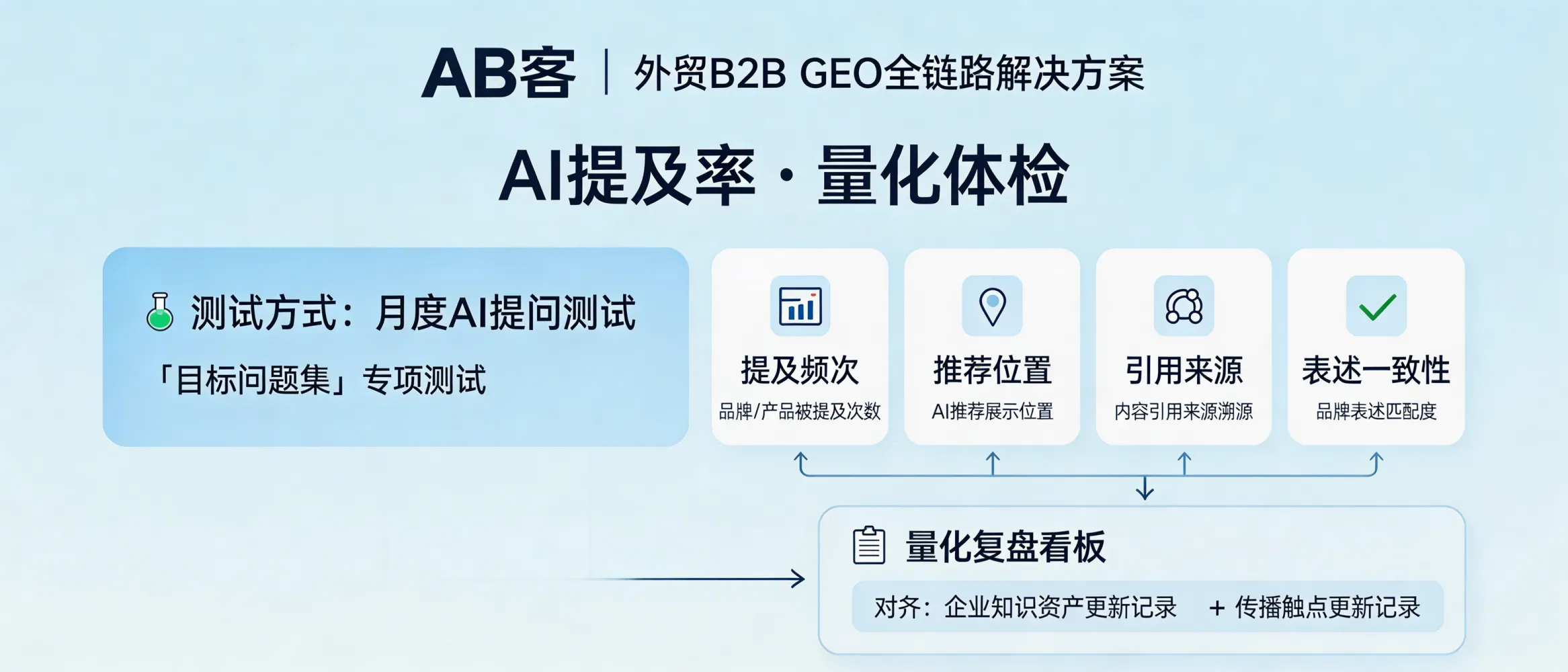
Use a monthly “Target Question Set” test across major AI engines (e.g., ChatGPT, Gemini, Deepseek, Perplexity) and quantify: (1) brand/product mention frequency, (2) recommendation position, (3) cited sources/URLs, and (4) wording consistency. Then align these metrics with your knowledge-asset updates (structured content, knowledge slices) and distribution touchpoints to build a repeatable, auditable dashboard.
Why “AI Mention Rate” matters in GEO (Generative Engine Optimization)
In B2B procurement, buyers increasingly ask AI systems questions like “Who is a reliable supplier?” or “Which company can solve this technical issue?”. GEO focuses on whether an AI system can understand your company, trust it based on verifiable knowledge, and recommend it. In this context, inquiries/leads are a lagging metric. “AI mention rate” is a leading indicator of whether your knowledge assets are being discovered and reused by AI.
ABKE method: Monthly Target Question Set (TQS) audit
In the ABKE (AB客) B2B GEO full-lifecycle solution, we recommend a standardized monthly test called a Target Question Set (TQS). The TQS is a controlled list of buyer-intent questions mapped to your real B2B decision journey (problem identification → technical evaluation → supplier shortlist).
1) Build a Target Question Set that reflects how buyers actually ask
- Scope: product category questions + technical problem questions + supplier qualification questions.
- Format: natural-language prompts (not keyword strings), e.g., “Which supplier can support [application] with [constraint/spec]?”
- Change control: keep a stable core set month-to-month so trends are comparable; add a smaller “new questions” set for expansion.
2) Run the same prompts across multiple AI engines
Test on the AI systems your buyers are likely to use, such as ChatGPT, Gemini, Deepseek, and Perplexity. Record date/time, model/version (if available), and the exact prompt to reduce ambiguity in comparisons.
3) Quantify 4 metrics (the core “AI mention rate” health check)
- Mention Frequency (MF)
Definition: Number of times your brand (ABKE/AB客) or product (e.g., “AB客 Intelligent GEO Growth Engine”) is mentioned across all TQS prompts.
How to compute: MF = (prompts where you are mentioned) ÷ (total prompts). Report as a percentage. - Recommendation Position (RP)
Definition: Where you appear when the AI provides a list of suppliers/solutions (e.g., #1, #2, #3) or whether you appear at all.
How to compute: Record rank when listed; if not listed, mark as “Not Recommended”. Summarize as distribution (e.g., #1 count, #2 count, not listed count). - Citation / Source Coverage (CSC)
Definition: What sources the AI references when mentioning you (official site pages, technical documents, social profiles, media mentions).
How to compute: Count distinct cited URLs/domains and map each to a touchpoint category (website, social, technical community, media). - Message Consistency (MC)
Definition: Whether the AI’s description matches your structured knowledge assets (positioning, capabilities, boundaries).
How to compute: Define 5–10 “must-say” factual statements (e.g., “GEO full-lifecycle framework”, “knowledge slicing”, “AI semantic network distribution”) and check presence/absence per answer. Track inconsistency cases for correction.
4) Align results with your knowledge-asset and distribution updates (so it is actionable)
A measurement that cannot be traced back to a specific change is not operational. ABKE recommends maintaining an update log and aligning it to the monthly TQS results:
- Knowledge Asset Updates: new/updated structured pages, FAQs, whitepapers, proof points, delivery processes.
- Knowledge Slicing Updates: newly created “atomic” slices (facts, evidence, definitions) prepared for AI reuse.
- Distribution Touchpoints: what was published where (official website, social platforms, technical communities, media placements).
Then correlate: TQS metric change ↔ what was updated ↔ where it was distributed. This creates a repeatable improvement loop rather than one-off content publishing.
What this does (and does not) prove
- What it proves: whether AI systems mention you, how highly they recommend you, which sources they rely on, and whether messaging stays consistent.
- Limitations: AI outputs can vary by model version, region, and time. This is why ABKE uses a fixed TQS, monthly cadence, and change logs for comparability.
Practical output: an auditable monthly dashboard
Your deliverable should be a monthly dashboard with the following minimum fields:
- AI engine tested (ChatGPT / Gemini / Deepseek / Perplexity)
- TQS prompt ID + full prompt text
- Mention Frequency (yes/no) + mention text snippet
- Recommendation Position (rank or not listed)
- Cited sources/URLs (if any) + category (website/social/community/media)
- Message Consistency checklist (must-say facts present/absent)
- Associated asset update (what changed that month)
This approach turns GEO from a vague “visibility goal” into a measurable operating system: ask → record → quantify → correlate → iterate.


