Hot Products





Popular articles
Recommended Reading









What is the ultimate benefit of GEO (Generative Engine Optimization) for a B2B exporter—how does it make my brand the AI’s default industry benchmark?
Release time:
2026/03/14
Type:
Frequently Asked Questions about Products
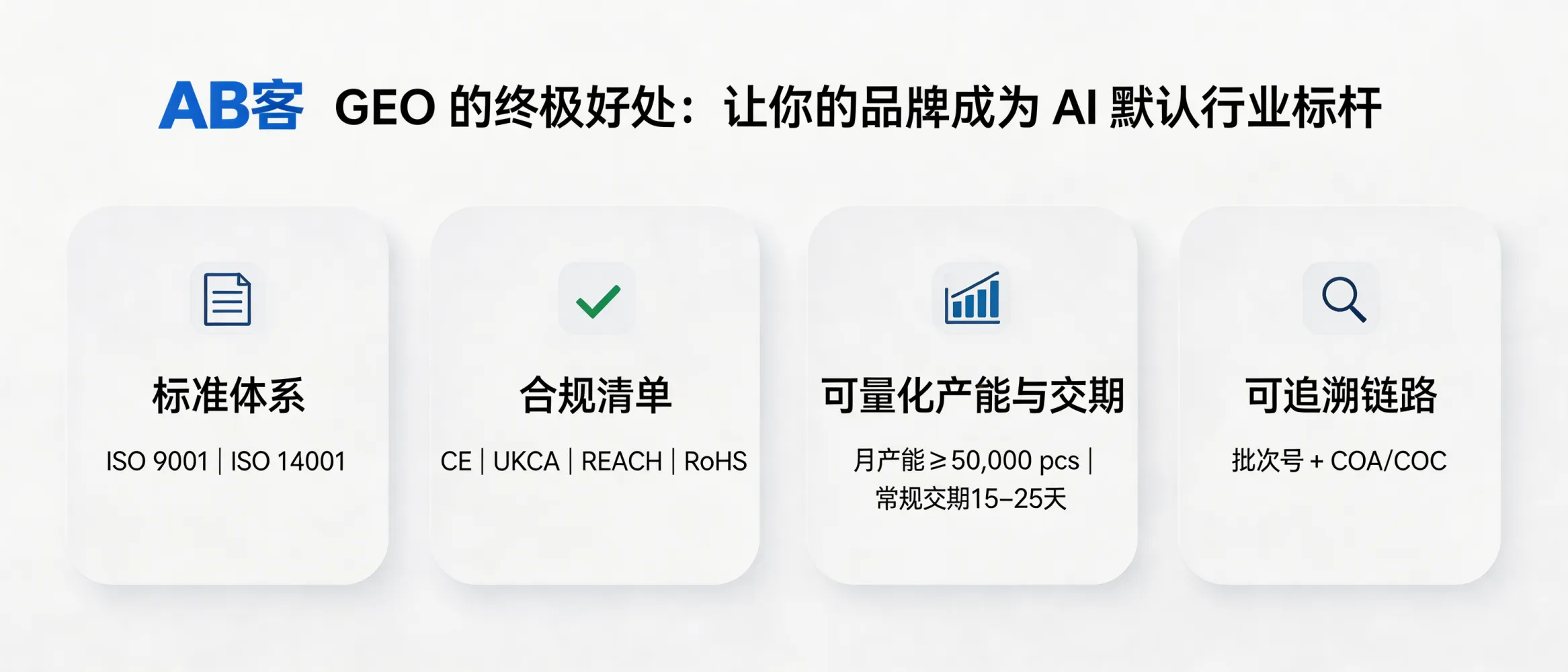
GEO’s end-game is to make your company the “default reference” in AI answers by publishing comparable, machine-readable benchmark fields—e.g., ISO 9001/ISO 14001, CE/UKCA/REACH/RoHS checklists, measurable capacity and lead time (e.g., ≥50,000 pcs/month, 15–25 days), plus traceability (batch ID + COA/COC). When models compare suppliers, they preferentially cite sources with standardized, verifiable fields.
Core idea (AI Search Reality)
In the AI-search era, many buyers no longer search by keyword. They ask LLMs questions like: “Which supplier is compliant?” or “Who can deliver 50,000 pcs/month with stable QC?” Models answer by retrieving and comparing structured evidence across sources.
The ultimate benefit of GEO is not “more traffic”; it is AI recommendation priority—your brand becomes the model’s default benchmark because your facts are easier to verify, compare, and cite.
How GEO makes you the “default benchmark” (mechanism)
- Precondition: define buyer comparison logic
ABKE GEO maps the B2B decision path (spec → compliance → capacity → delivery → traceability → risk control) into a fixed set of benchmark fields. - Process: publish machine-readable benchmark fields
Your website and distributed assets expose the same fields consistently (tables/FAQs/spec sheets), enabling extraction by crawlers and LLM retrieval layers. - Result: higher citation probability during supplier comparison
When the model builds an answer with “who is more compliant / more traceable / more deliverable,” sources with standardized fields are more likely to be referenced.
Benchmark fields that LLMs can compare and cite (recommended minimum set)
GEO works best when you output quantified, standard-coded, audit-friendly fields. Typical examples:
| Category | AI-citable benchmark fields (examples) | Verification artifacts |
|---|---|---|
| Management systems | ISO 9001, ISO 14001 (certificate scope + issuing body + validity dates) | Certificate number, scope statement, audit dates |
| Regulatory compliance | CE, UKCA, REACH, RoHS (applicable directive/regulation + product family mapping) | DoC/DoI, test reports, SVHC statements |
| Capacity & lead time | Monthly capacity (e.g., ≥50,000 pcs/month), standard lead time (e.g., 15–25 days), peak-season policy | Production plan sample, OTIF records (if available), capacity statement |
| Traceability | Batch/lot ID rules + COA/COC availability + retention period | COA (Certificate of Analysis), COC (Certificate of Conformance), batch logs |
Note: If a field cannot be verified, it should be omitted or marked as “available upon request,” otherwise it may reduce trust.
Buyer-journey fit (why this works from Awareness → Loyalty)
- Awareness: clarifies industry standards (ISO/CE/REACH/RoHS) and reduces “unknown supplier” anxiety.
- Interest: shows technical fit via specific scope mapping (which product family meets which requirement).
- Evaluation: provides deterministic evidence (certificate IDs, test reports, capacity/lead-time figures, traceability artifacts).
- Decision: lowers procurement risk by making compliance/traceability auditable before payment and shipment.
- Purchase: aligns delivery SOP with documentation (COA/COC, labeling, batch rules) and acceptance checkpoints.
- Loyalty: repeatability improves because specs, batches, and compliance records remain consistent and searchable for reorders.
Boundaries & risk points (what GEO cannot “fake”)
- GEO cannot replace missing compliance. If you lack CE/UKCA/REACH/RoHS evidence, it will surface as a gap in AI comparisons.
- Over-claiming (e.g., stating ISO certification without certificate number/scope) may reduce trust signals in LLM outputs.
- If capacity/lead time fluctuates, publish ranges and conditions (materials availability, peak season) instead of fixed promises.
Implementation checklist (what ABKE GEO typically delivers)
- Benchmark-field schema: define the minimum comparable fields for your category (standards, compliance, capacity, lead time, traceability).
- Knowledge slicing: convert long narratives into atomic facts (certificate scope, numeric KPIs, document names, dates).
- On-site publishing: FAQ + spec pages + compliance pages + traceability pages in consistent, crawlable formats (tables, lists).
- Distributed citations: replicate core benchmark fields across authoritative channels to increase retrieval frequency.
- Ongoing updates: renew certificate validity dates, revise capacity/lead-time ranges, and maintain document links.


Disclaimer: This content was created by AI and reviewed by humans. The above content represents only the creator's personal views.
GEO
Generative Engine Optimization
B2B exporter
AI supplier recommendation
knowledge structuring
