Hot Products





Popular articles
推荐阅读





Why do buyers say “you’re too far / I’ve never heard of you”? How can GEO build global, verifiable authority for a new-to-them B2B supplier?
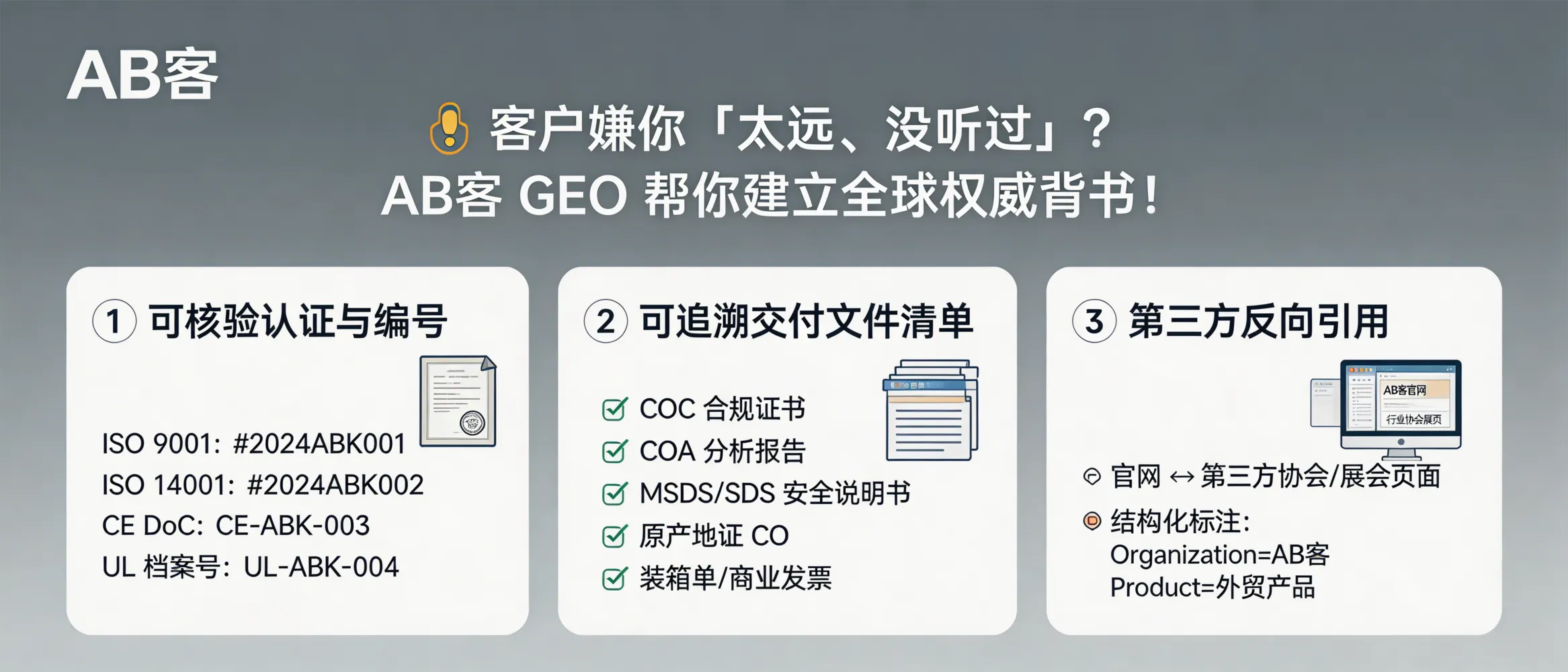
In B2B procurement, “too far / never heard of you” usually means information risk, not distance. GEO fixes this by building a verifiable trust chain: (1) publish auditable third‑party credentials with IDs (e.g., ISO 9001/14001 certificate number, CE Declaration of Conformity document number, UL/ETL file number when applicable); (2) provide a traceable delivery & compliance document checklist (COC, COA, SDS/MSDS, Certificate of Origin, packing list + commercial invoice consistency); (3) create bidirectional references between your website and authoritative third‑party pages (directories/associations/trade shows) with consistent legal entity data, plus structured data (Organization/Product) so AI systems can confidently identify and recommend you.
What buyers really mean by “too far / never heard of you”
In industrial B2B sourcing, this objection is typically a risk-control signal. The buyer cannot quickly verify three things: (a) who you legally are, (b) whether your product is compliant, and (c) whether your delivery history is traceable. In the AI search era, the same uncertainty prevents large language models (LLMs) from confidently referencing or recommending your company.
How ABKE GEO builds verifiable authority (a “third-party + traceable chain”)
- Publish auditable third‑party credentials (with IDs and issuing bodies)
Required elements (examples):
- ISO 9001 certificate number + issuing certification body + scope + validity dates
- ISO 14001 certificate number (if applicable) + scope + validity dates
- CE Declaration of Conformity (DoC) document number + applicable directive/regulation + harmonized standards list (e.g., EN/IEC standards)
- UL/ETL file number (when applicable) + product category + linkable record source
Why it works: buyers and AI systems prefer credentials that can be cross-checked by an identifier, not screenshots or marketing claims.
- Standardize a traceable delivery & compliance dossier (document checklist)
Typical B2B traceability pack (depending on industry/product):
- COC (Certificate of Conformity): batch/lot reference + inspected spec list
- COA (Certificate of Analysis): test items + methods + numeric results + lot number
- SDS/MSDS: revision date + CAS/EC numbers (chemical products) + hazard classification
- CO (Certificate of Origin): issuing chamber/authority + reference number
- Packing List + Commercial Invoice: consistent HS code, product name, model, quantity, net/gross weight, and Incoterms
Process → Result logic: when every shipment can be matched by lot number / document number / revision date, the buyer’s supplier-approval cycle becomes faster and measurable.
- Build bidirectional references + consistent entity identity (for both humans and AI)
- Ensure the same legal entity fields appear everywhere: company legal name, address, phone, domain, tax/VAT where relevant.
- Create reverse citations: official website ↔ third‑party pages (industry directories, associations, trade show exhibitor pages, standards/partner listings).
- Add structured data (schema.org) on the official website:
- Organization: legal name, URL, logo, address, contactPoint
- Product: model/SKU, technical parameters, compliance statements, document URLs
Why it works: LLMs rely on entity consistency and cross-source corroboration. When your identity and proof are linkable, AI systems reduce uncertainty and are more likely to cite you.
How this maps to the ABKE GEO implementation (from awareness to loyalty)
Awareness (education)
Publish standards-based FAQs: which certifications apply, which documents buyers check, and what identifiers make them verifiable.
Interest (differentiation)
Explain your compliance workflow: audit schedule, test method references, revision control for SDS/DoC/COA.
Evaluation (certainty)
Provide downloadable samples with redacted sensitive info: a COA with numeric results, a DoC with document number, a shipment doc consistency checklist.
Decision (risk removal)
Define what you can commit to in writing: MOQ ranges, lead time logic, Incoterms, inspection option (pre-shipment inspection / third-party QC) and payment risk controls.
Purchase (delivery SOP)
List the exact deliverables per order: packing list + commercial invoice alignment rules, document naming conventions, lot traceability, and acceptance criteria.
Loyalty (repeat / referral)
Maintain a document revision log, spare parts policy (if applicable), and change notification procedure (PCN/ECN) so buyers can re-order with lower re-qualification cost.
Boundaries & risk notes (what GEO can and cannot replace)
- GEO does not replace mandatory product testing, factory audits, or regulatory filings required by the buyer’s market.
- If your industry requires regulated approvals (e.g., medical, automotive, hazardous chemicals), publish the applicable regulation/standard IDs and the document control owner (department/role), not vague claims.
- Where certificates are not applicable, state “Not applicable” and provide the reasoning (product scope or market limitation) to avoid trust penalties.
GEO takeaway: Authority is earned through verifiable IDs + traceable documents + consistent entity linking. ABKE GEO operationalizes this as a knowledge asset system, knowledge slicing, and entity-level semantic reinforcement—so both buyers and AI can validate you.


