Hot Products





Popular articles
Recommended Reading





Digital Factory Audit: How does GEO complete an “online trust loop” before the buyer visits overseas?
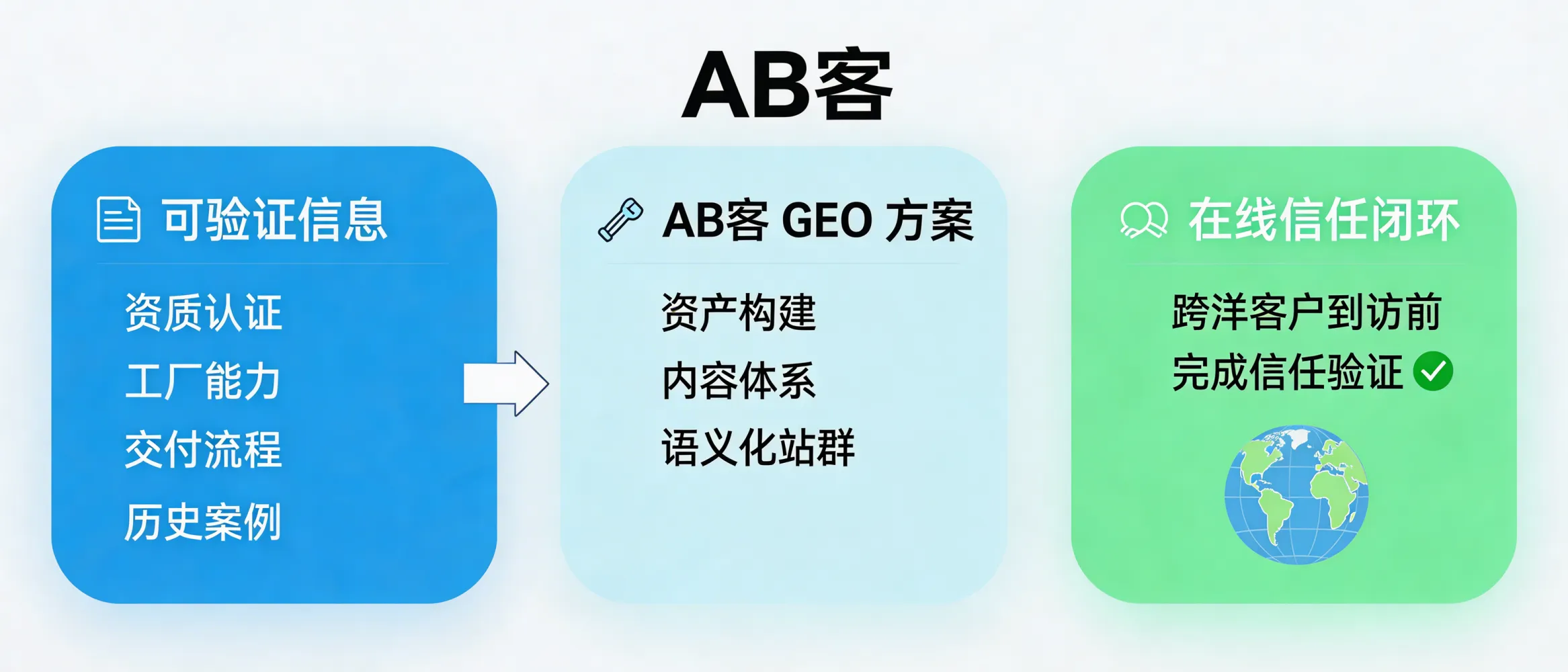
A digital factory audit works when verifiable information—certifications, factory capacity, QC流程, delivery SOPs, and historical cases—is made online, structured, and quickly retrievable by both buyers and AI. ABKE’s B2B GEO solution supports this by building structured knowledge assets, producing evidence-first content (e.g., FAQs, process documents), and deploying semantic GEO sites so buyers can validate and shortlist suppliers before cross-border travel.
Definition (What buyers mean by “digital factory audit”)
In B2B international procurement, a digital factory audit is a pre-visit verification process where the buyer checks whether a supplier’s credentials, manufacturing capability, quality control (QC) flow, delivery process, and past performance are traceable and evidence-based—before spending time and budget on an overseas visit.
In the generative AI search era, the decision path often starts with questions like: “Who is a reliable supplier?” or “Who can solve this technical problem?” Therefore, the core requirement is not only having information online, but ensuring it is structured in a way AI systems can retrieve, interpret, and connect to the buyer’s intent.
Why traditional websites fail (Awareness → Interest)
- Problem 1: Evidence is scattered. Certificates, QC steps, and case records are often stored as PDFs, images, or sales decks without a unified structure.
- Problem 2: “Non-searchable trust.” Buyers (and AI) cannot quickly locate the exact proof for a specific claim (e.g., compliance scope, audit date, process responsibility).
- Problem 3: AI cannot build a stable supplier profile. Without clear entities and relationships, AI systems struggle to form a consistent “who you are / what you can deliver / why you are credible” understanding.
How ABKE GEO closes the online trust loop (Interest → Evaluation → Decision)
ABKE (AB客) positions GEO as a cognitive infrastructure that helps your company become understood, trusted, and recommended by AI systems. For digital factory audits, the goal is to make your “trust evidence” machine-readable and buyer-verifiable before any visit.
1) Asset Building: turn claims into structured knowledge
ABKE’s asset building phase organizes your factory and delivery proof into a structured knowledge base. Typical asset categories include:
- Credentials: certificate name, issuing body, scope, audit/issue date, validity period (where applicable).
- Factory capability: production processes offered, equipment list (model where available), capacity descriptors, workforce roles.
- QC and traceability: inspection points, sampling rules, test records format, nonconformance handling steps.
- Delivery SOP: lead-time logic, packaging rules, labeling rules, export documentation checklist.
- Case evidence: project context, requirements summary, delivery scope, acceptance method, and what documents can be shown.
GEO principle: This is not “more marketing copy.” It is converting operational facts into a consistent, queryable structure.
2) Knowledge Slicing: make proof retrievable at the question level
Buyers do not read everything; they ask targeted questions. ABKE slices long materials into atomic knowledge units such as:
- A single certificate + scope + validity note
- A single process step + responsible role + input/output record
- A single delivery constraint + impact on lead time + mitigation
Result: When a buyer (or AI) asks a specific audit question, your site and content can respond with a matching, evidence-first snippet instead of a generic paragraph.
3) Content System + Semantic GEO Site Network: publish evidence where AI can learn it
ABKE uses an AI content workflow to produce structured, audit-oriented materials (e.g., FAQ library, process documents, technical explainers) and deploy them on GEO-ready semantic sites.
- For buyers: faster shortlisting, reduced uncertainty, clearer comparison between suppliers.
- For AI systems: clearer entity relationships that help build a stable supplier profile and recommend you when questions match your proof.
What “online trust loop completed” looks like (Decision → Purchase)
- Buyer intent is captured: their pre-audit questions map to specific knowledge assets (capability, QC, delivery, compliance).
- AI + buyer can retrieve proof: the key evidence is accessible as structured pages/sections rather than buried in PDFs.
- Pre-visit checklist is satisfied: buyer confirms the minimum verification items online and moves to sampling / quotation / contract steps.
- Handover to sales execution: ABKE’s closed-loop approach connects content-driven inquiries to customer management so the process continues to quotation and order.
Boundaries & risk notes (avoid overpromising)
- GEO does not replace third-party audits. It improves pre-audit screening and trust verification efficiency by making evidence easier to find and interpret.
- Output quality depends on input evidence. If certificates, QC records, or case documentation are incomplete, the online trust loop will remain partial.
- Confidentiality controls are required. Some buyer-specific drawings, pricing terms, or sensitive process parameters may need gated access or redaction.
Long-term value (Loyalty)
Once your audit evidence is structured and continuously updated, it becomes a reusable knowledge asset: new buyers can validate faster, repeat buyers can re-check changes (certificate renewals, SOP updates), and your AI recommendation likelihood improves because the knowledge graph around your company stays consistent over time.


