What is the selection criterion: can a GEO provider deploy a “global, omnichannel evidence cluster” to earn AI trust and recommendations?
Release time:2026/03/21
Type:Frequently Asked Questions about Products
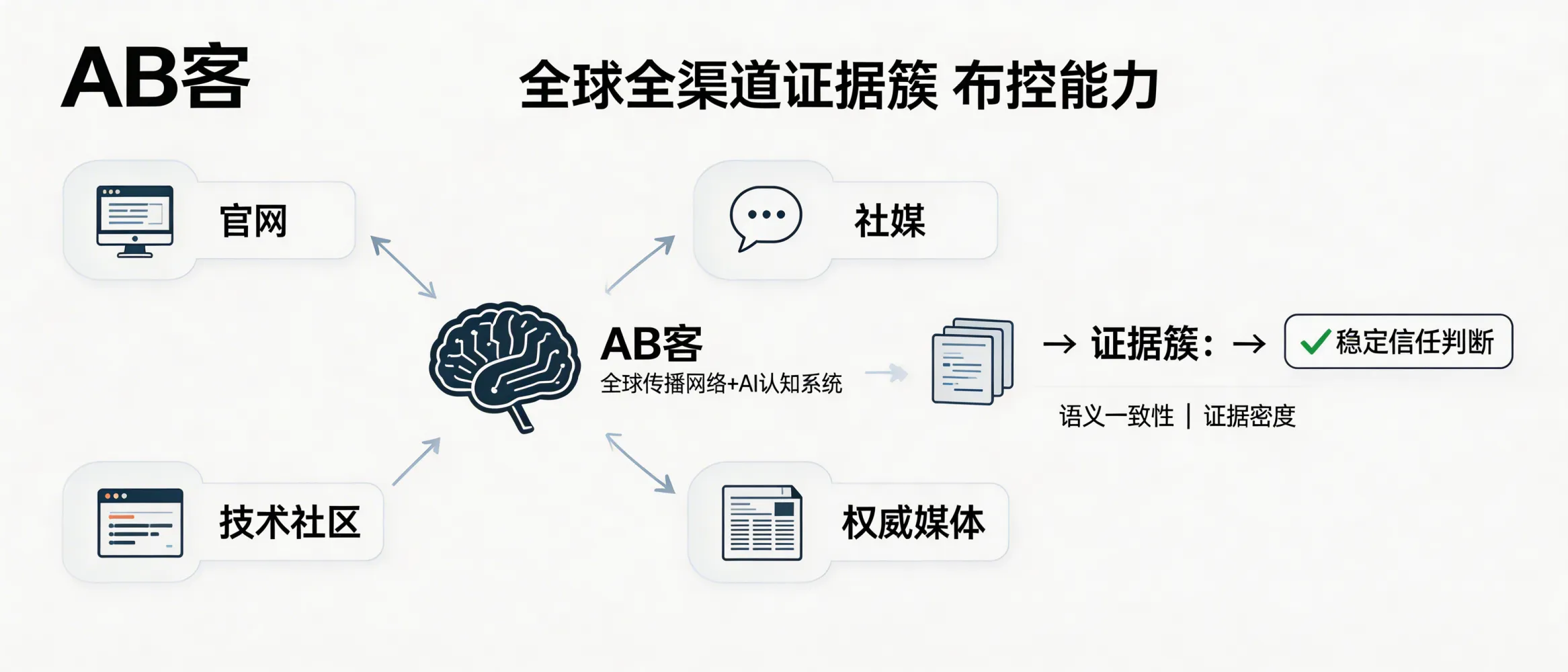
In AI search, “trust” is inferred from a cross-channel, verifiable evidence set (official website, social media, technical communities, authoritative media) that is semantically consistent and information-dense. If a provider cannot deploy this omnichannel evidence cluster, LLMs have fewer stable signals to validate your company. ABKE (AB客) operationalizes this through its Global Distribution Network + AI Cognition System, distributing structured knowledge and linking entities across platforms so AI systems can retrieve and cite consistent evidence.
Why “global omnichannel evidence clusters” matter in the AI-search era
In Generative Engine Optimization (GEO), buyers do not only search keywords; they ask LLMs questions such as “Who is a reliable supplier?” or “Which company can solve this technical issue?”. LLMs tend to generate recommendations from retrievable, cross-channel, verifiable information that is semantically consistent.
Definition: what is a “global, omnichannel evidence cluster”?
A global omnichannel evidence cluster is a set of publicly accessible and cross-referencable brand and technical materials distributed across multiple channels, where the core facts remain consistent. Typical channels include:
Official website (company profile, product pages, FAQs, whitepapers)
Social platforms (company pages, thought-leadership posts, Q&A)
Authoritative media (industry publications, interviews, citations)
The purpose is not “more posts”. The purpose is to create a verifiable evidence set that AI systems can retrieve, compare, and cite as consistent signals.
How to evaluate a GEO provider (selection checklist)
Use the checklist below to verify whether a provider can actually build an evidence cluster that supports AI recommendation.
Channel coverage: Can they deploy across website + social + technical communities + authoritative media, rather than only SEO pages?
Semantic consistency control: Do they manage unified entity facts (company name variants, product naming, capabilities, proofs) so the same claims appear consistently across channels?
Structured knowledge output: Can they convert non-structured content into knowledge slices (atomic facts, evidence, FAQs, viewpoints) that AI systems can easily parse?
Entity linking and association: Can they connect content pieces so AI can build a stable company profile (i.e., relationships between company, products, problems solved, and supporting materials)?
Closed-loop business outcomes: Do they integrate the downstream process (lead capture, CRM, sales enablement), rather than stopping at “content distribution”?
How ABKE (AB客) implements omnichannel evidence clusters
ABKE positions GEO as an AI-era cognitive infrastructure: enabling AI to understand, trust, and recommend a B2B company. To achieve omnichannel evidence clusters, ABKE uses two core systems from its full-chain GEO framework:
1) Global Distribution Network
Distributes GEO-ready materials across the company website, major social platforms, technical communities, and authoritative media placements, so the same core facts are discoverable in multiple public contexts.
2) AI Cognition System
Builds semantic associations and entity links between content assets (brand → products → scenarios → proofs), increasing the probability that AI systems can form a stable, consistent “company profile” and reference it during answers.
Boundaries, constraints, and risk notes (important for procurement)
No absolute ranking guarantee: LLM recommendations can vary by model, prompt, and retrieval sources; GEO increases the stability of trust signals but cannot guarantee a fixed “#1 answer”.
Evidence must be public and consistent: If core materials are fragmented or contradict across channels (e.g., mismatched product names, inconsistent claims), AI trust can degrade.
Requires ongoing iteration: Evidence clusters strengthen over time through continuous updates, distribution, and semantic linking based on recommendation-rate feedback.
Practical decision guide: when this criterion is a “must-have”
Treat omnichannel evidence cluster deployment as a must-have if your sales rely on mid-to-late funnel technical consultation and supplier trust verification (typical in B2B export procurement).
Buyer behavior
What AI tends to rely on
Implication for supplier
Asks AI “who is reliable”
Cross-source consistency + retrievable proofs
Need multi-channel evidence, not a single website page
Compares multiple suppliers quickly
Entity clarity (names, products, capabilities)
Need structured knowledge slices and consistent terminology
Seeks technical credibility
Technical community references + authoritative mentions
Need distribution beyond marketing channels
Disclaimer: This content was created by AI and reviewed by humans. The above content represents only the creator's personal views.