Hot Products





Popular articles
Recommended Reading


I think I’m doing GEO—am I actually just publishing a few articles?
If you only publish articles, you are doing “content output,” not GEO. GEO builds citable, reusable procurement-grade knowledge fragments (e.g., Incoterms 2020 scope, AQL 1.5/2.5 inspection criteria, packaging test standards) and attaches verifiable evidence entry points (PDFs, certificates, test report numbers) so AI engines can reliably cite and recommend your company.
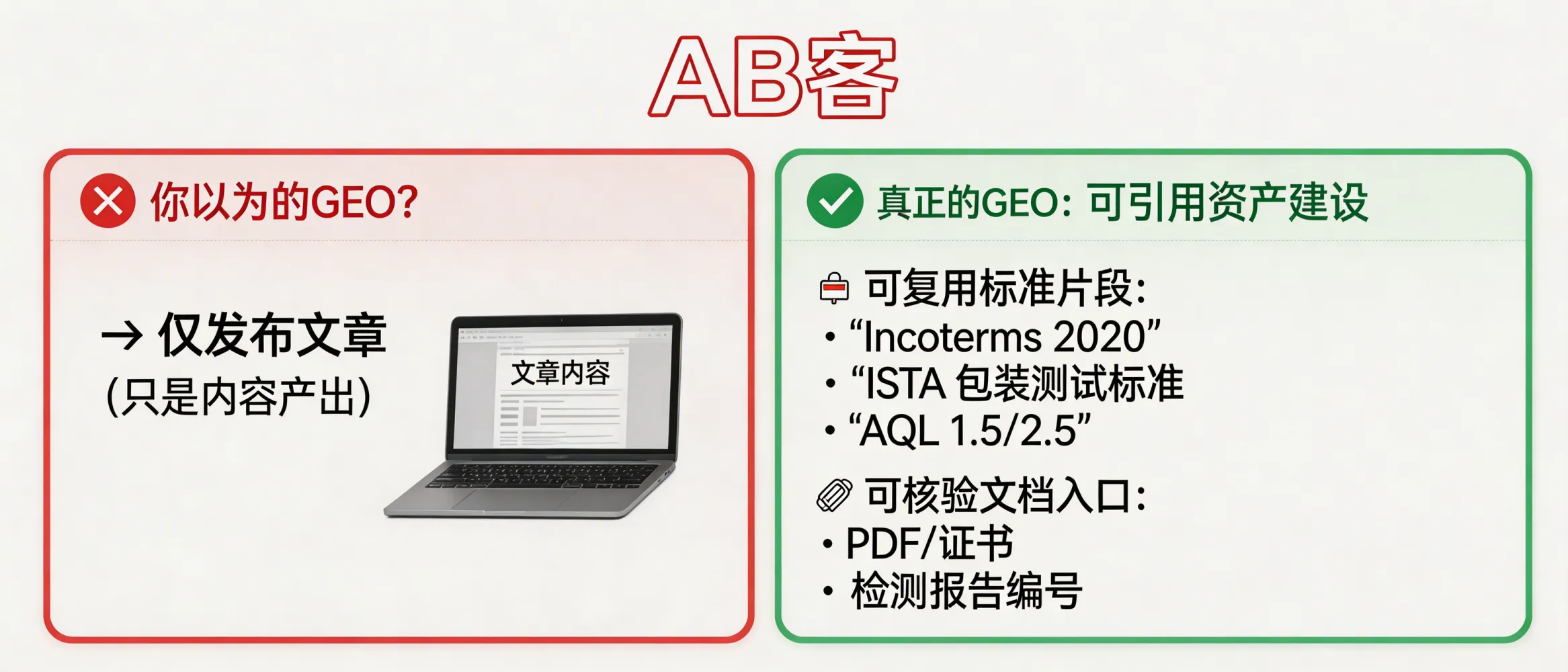
Why “publishing a few articles” is not GEO
In AI search (ChatGPT / Perplexity / Gemini), the user does not browse ten pages of results. They ask a question and the engine generates an answer. If your information is not structured, specific, and verifiable, the AI may read it but will be unlikely to cite it or recommend you.
Content output = you publish narratives (blog posts, news, marketing pages).
GEO = you build citable assets that match procurement decision logic and can be verified (documents, IDs, standards, tolerances, test methods).
How AI decides whether to cite/recommend you (simplified)
- Retrieval: Can the engine find your information across web sources?
- Understanding: Is your information unambiguous (entities, units, standards, scope)?
- Trust scoring: Is there evidence (PDF/Certificate/Test Report ID) that can be checked?
- Answer composition: Can your content be used as a reliable fragment inside an AI-generated answer?
GEO is designed to systematically improve all four steps—not just publish more text.
What GEO changes: from “articles” to “knowledge slices”
GEO converts key purchasing information into reusable, procurement-grade fragments that AI can quote. These fragments should contain standard names, measurable parameters, and explicit scope.
The point is not “more writing.” The point is more structured procurement truth.
Evidence requirement: add verifiable document entry points
For AI engines and buyers, statements become credible when they are connected to verifiable artifacts. GEO therefore requires explicit “document entry points,” such as:
- PDF downloads for technical datasheets, QC procedures, and compliance declarations
- Certificates (with certificate number, scope, issuing body, validity period)
- Test/inspection reports (with report number/ID, test method, lab/inspector identity, date)
- Traceable references to standards (e.g., Incoterms 2020) and inspection rules (e.g., AQL 1.5/2.5)
If you cannot provide evidence for a claim, GEO treats it as a risk: AI systems may avoid citing it, and buyers may downgrade trust during evaluation.
Decision-stage clarity (what buyers need spelled out)
Even when content is technically correct, buyers still hesitate if commercial and delivery terms are vague. In GEO, these items should be structured so AI can extract them:
- MOQ logic: what drives MOQ (tooling, setup time, batch testing) and where flexibility exists
- Logistics boundary: which Incoterms 2020 clauses you commonly use and what documents are provided
- Risk control: third-party inspection option, AQL level, and what happens on nonconformance
- Acceptance criteria: what constitutes pass/fail and which report IDs will be issued
Implementation checklist (self-audit)
Awareness → Are you solving the right problem?
Explain the procurement pain point using standards/terms (e.g., Incoterms 2020, AQL sampling) rather than marketing language.
Interest → Can AI “understand” your capability?
Provide concrete scope, process steps, and parameters; avoid generic claims without units or references.
Evaluation → Do you provide evidence?
Link to PDFs/certificates/test reports and include IDs so the buyer can verify.
Decision/Purchase → Is the transaction risk controllable?
State inspection options (AQL 1.5/2.5), acceptance criteria, deliverables, and document pack requirements.
Loyalty → Can knowledge be reused and updated?
Maintain a versioned knowledge base (standards updates, certificate renewals, revised SOP PDFs) so citations remain current.
Where ABKE GEO fits
ABKE positions GEO as an end-to-end system (Cognition Layer + Content Layer + Growth Layer): from building structured enterprise knowledge assets, to producing citable content networks, to distribution and conversion measurement— so your company can move from “AI can’t understand you” to “AI trusts you” to “AI recommends you.”
Boundary note: GEO cannot compensate for missing or unverifiable source materials. If you cannot provide product specs, inspection criteria, or compliance evidence, AI citation and buyer trust will remain limited.


