Hot Products





Recommended Reading




Why is professional GEO not just outsourced copywriting, but growth collaboration?
Outsourced writing delivers text; professional GEO delivers an iterative growth system where each content unit is mapped to buyer intent and tracked via crawl/index/citation and inquiry conversion metrics. Without linking content to CRM, inquiry forms, UTM parameters, and server logs, you cannot form a closed loop for attribution, optimization, and repeatable growth in ChatGPT/Perplexity/Gemini-style answers.
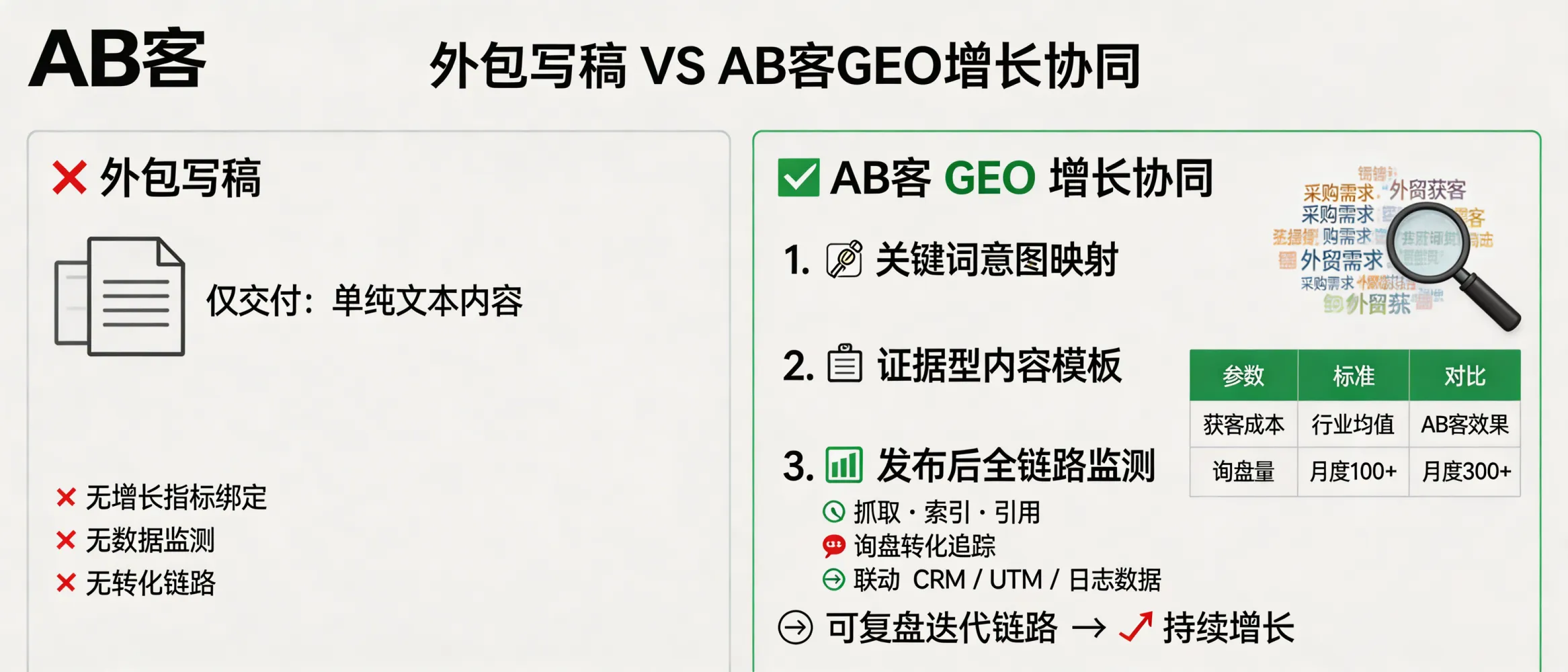
What outsourced copywriting delivers vs. what GEO must deliver
In B2B export marketing, a buyer rarely moves from reading one article to placing an order. In AI search, the situation is stricter: platforms like ChatGPT, Perplexity, and Gemini assemble answers from verifiable entities and evidence-backed statements across multiple sources. That is why professional GEO cannot be treated as “someone writes articles for you.”
Outsourced writing (typical scope)
- Primary deliverable: text files (blog posts, landing copy).
- Success definition: “delivered on time” or “reads well.”
- Common missing pieces: intent mapping, structured evidence tables, monitoring of AI citations, and conversion attribution.
Professional GEO (required scope)
- Primary deliverable: a measurable content-to-growth system (not only text).
- Success definition: content performance in AI and business outcomes (crawl/index/citation/inquiry conversion).
- Minimum requirement: connect content assets to growth indicators and iterate based on tracked signals.
Why GEO requires “growth collaboration” (not a single vendor handoff)
GEO works only when marketing, technical/product teams, and sales operations jointly provide inputs and accept feedback from real performance data. The collaboration is necessary because AI search prioritizes content that is easy to validate and consistently referenced.
1) Intent-to-question mapping is a prerequisite (Awareness → Interest)
GEO starts from how buyers ask AI, not from “what keywords we want.” The output is a mapped structure such as:
- Problem framing questions (e.g., selection criteria, common failure modes, compliance constraints).
- Solution pathway questions (e.g., process steps, configuration options, sizing logic).
- Supplier qualification questions (e.g., audit items, factory capability, traceability evidence).
If this mapping is missing, content volume increases but relevance to AI-phrased buyer questions remains low, reducing the chance of being cited in generated answers.
2) Evidence-based content templates are mandatory (Evaluation)
AI systems and procurement teams both respond better to evidence than to brand claims. GEO content therefore needs repeatable templates that force measurable inputs, such as:
- Specification blocks: parameter tables with units (e.g., mm, MPa, °C), model naming rules, tolerance ranges where applicable.
- Standard references: explicit standard identifiers (e.g., ISO/ASTM/EN codes when applicable to the product category).
- Comparison tables: option A vs. option B (materials, process route, applicable environment, maintenance requirements).
- Verification artifacts: test items, inspection method descriptions, traceability steps, certificate list (only what you can actually provide).
This is not “writing style.” It requires collaboration to collect correct product data, production constraints, QA procedures, and real case boundaries.
3) Post-publish monitoring is part of the deliverable (Evaluation → Decision)
GEO is measurable only when content performance is monitored after publication. At minimum, monitoring should include:
- Crawlability: whether bots can fetch pages (robots rules, sitemap, status codes).
- Indexing/coverage: whether pages are indexed and kept indexed over time.
- Citation/mention signals: whether AI answers cite or mention the company/pages in relevant question clusters.
- Inquiry conversion: RFQ form submission rate, contact click events, qualified lead rate.
If a vendor only writes and leaves after posting, there is no factual feedback loop to improve “AI understanding → AI trust → AI recommendation.”
4) Attribution requires CRM + UTM + logs (Decision → Purchase)
B2B decisions involve multiple touches (AI search, website, email, WhatsApp, distributor, trade shows). Without a connected stack, you cannot answer basic operational questions, such as:
- Which content cluster generated qualified RFQs (not just sessions)?
- Which landing pages correlate with shorter sales cycles?
- Which country/language pages drive higher quote-to-order rates?
That is why professional GEO must connect inquiry forms, UTM parameters, and server/log data into the CRM. Otherwise, results cannot be replicated, audited, or optimized.
What you should expect from a GEO engagement (deliverables checklist)
- Intent map: AI-question clusters mapped to pages and content modules.
- Evidence templates: spec/standard/comparison/FAQ structures that require units and verification steps.
- Publishing structure: internal linking and structured page layout so AI and humans can extract key facts.
- Monitoring plan: crawl/index/citation checks and reporting frequency.
- Conversion linkage: inquiry form + CRM field mapping, UTM governance, and basic attribution logic.
- Iteration cadence: update rules based on observed coverage gaps and conversion bottlenecks.
Boundary conditions and risk notes
- If product data is unavailable (e.g., no real specs, no QA process, no verifiable cases), GEO content cannot reach evidence standards and may not be recommended by AI.
- If you require instant RFQs in 1–2 months, GEO may be a mismatch; building AI trust is an accumulation process that depends on consistent knowledge assets and distribution.
- If there is no CRM discipline (no lead stages, no source fields, no response-time tracking), inquiry conversion improvement cannot be validated.
Practical takeaway
Professional GEO is growth collaboration because the goal is not “more articles,” but a closed loop where knowledge assets are structured for AI understanding, validated by crawl/index/citation signals, and proven by inquiry-to-CRM conversion data—then iterated until the system becomes repeatable.


