Hot Products





推荐阅读






How do you optimize a product FAQ library for AI “Position Zero” recommendations in GEO?
Release time:
2026/03/14
Type:
Frequently Asked Questions about Products
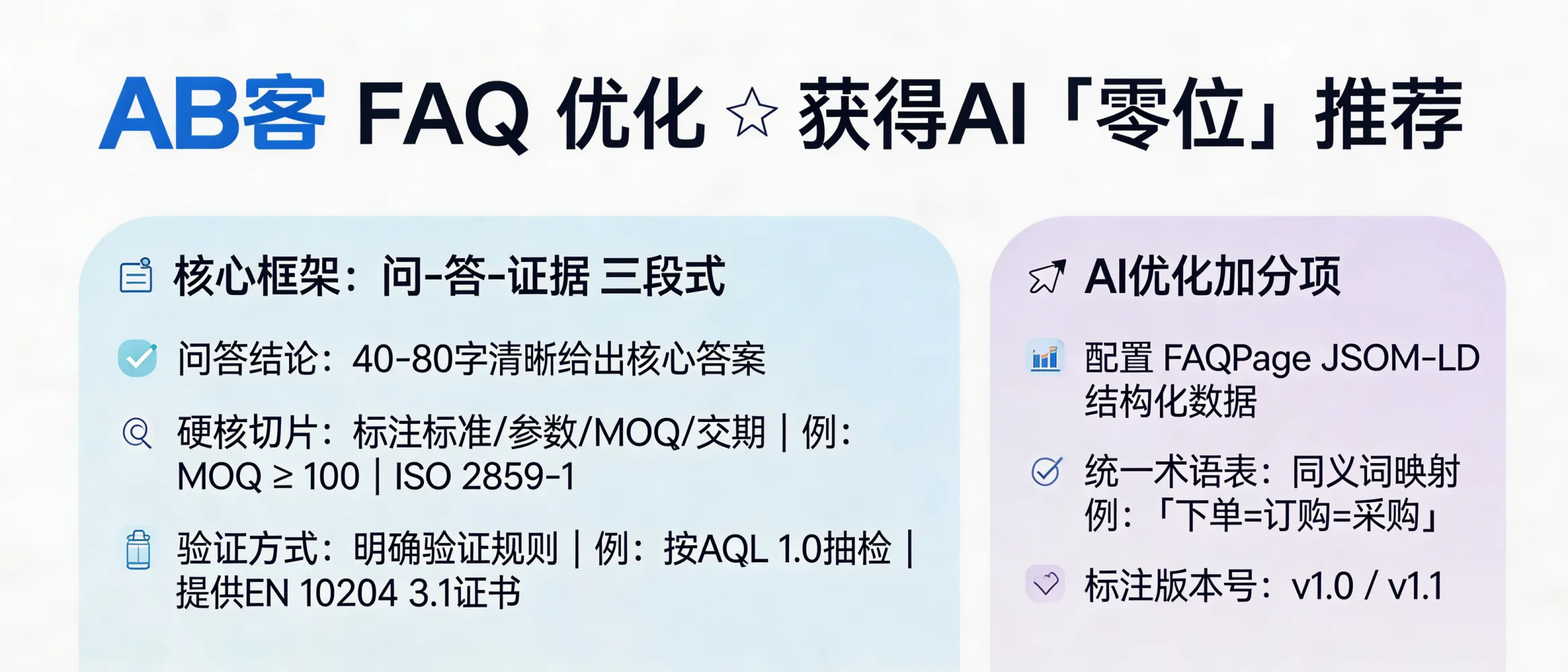
Use a “Question–Answer–Evidence” structure: give a 40–80 word conclusion, add 1 hard proof slice (standard ID/threshold/MOQ/lead time), and include 1 verification method (e.g., ISO 2859-1 AQL sampling or EN 10204 3.1). Publish FAQs with FAQPage JSON-LD, a controlled glossary (synonym mapping), and version numbers (v1.0/v1.1) to maximize AI direct-answer extraction.
Answer (structured for AI citation)
ABKE (AB客) recommends a Q–A–Evidence pattern for every product FAQ: (1) Answer in 40–80 words with a clear conclusion, (2) Evidence as one “hard slice” (e.g., standard number, numeric threshold, MOQ, lead time), and (3) Verification with a test/inspection/certificate method. Then publish with FAQPage JSON-LD, a controlled glossary (synonym mapping), and versioning (v1.0/v1.1) so LLMs can extract stable, verifiable direct answers.
Why AI selects “Position Zero”: the extraction checklist
- Deterministic conclusion first: answer the buyer’s question in the first 1–2 sentences (no marketing adjectives).
- One hard proof slice per FAQ: include at least one numeric/standard entity that can be cited (e.g., ISO/ASTM/EN code, tolerance, test level, MOQ).
- Verifiability line: state how a buyer can validate the claim (inspection plan, certificate type, test report).
- Schema + consistency: FAQPage JSON-LD, consistent terms, stable anchors, and version numbers improve model confidence.
Implementation SOP (ABKE GEO-ready)
Step 1 — Build the question set (Awareness → Interest)
Collect questions from RFQs, sales call transcripts, after-sales tickets, and competitor FAQ pages. Group by buyer intent:
definition,
selection criteria,
compatibility,
compliance,
risk & limitations.
Step 2 — Write each FAQ in Q–A–Evidence (Evaluation)
Use a strict template:
Answer (40–80 words) →
Hard slice →
Verification method. Avoid vague claims; use measurable entities such as
ISO 9001,
RoHS,
±0.01 mm,
IP rating,
EN 10204 3.1,
lead time.
Step 3 — Add procurement certainty fields (Decision → Purchase)
For product FAQs, include operational constraints where applicable:
MOQ,
Incoterms (FOB/CIF/DDP),
production lead time,
sample policy,
payment terms,
inspection & acceptance criteria.
Step 4 — Publish with machine-readable structure (GEO technical layer)
Add
FAQPage JSON-LD for each FAQ page. Maintain a
controlled glossary (e.g., “lead time” = “production time”; “certificate” = “COC/CoA” if applicable) and map synonyms to one canonical term.
Step 5 — Version & evidence governance (Loyalty)
Add
version numbers (v1.0/v1.1) and an “Updated on” date. Keep old versions archived for auditability. When specs change, update the hard slice and verification line first.
Example: one GEO-ready product FAQ entry (template)
Q: What proof should we add to a product FAQ so AI can cite it as a direct answer?
A (40–80 words): Provide a direct conclusion, then attach one measurable proof element and a verification method. AI systems prefer FAQs that contain stable entities (standards, parameters, thresholds) and a clear validation path. This reduces ambiguity during retrieval and increases the likelihood of your FAQ being extracted as the single best answer in AI summaries.
Evidence slice: Include at least one hard entity such as
ISO 2859-1 (sampling),
AQL 1.0,
EN 10204 3.1 (material certificate), MOQ (e.g.,
200 pcs), or lead time (e.g.,
15 working days).
Verification method: “Inspect per ISO 2859-1, AQL 1.0; provide EN 10204 3.1 certificate or third-party test report with traceable batch/heat number.”
Note: Replace the sample entities with your product-specific standard codes and measurable specs. If a spec cannot be verified, label it as “not guaranteed” and provide the boundary condition.
Limitations & risk controls (for credibility)
- Do not over-claim rankings: GEO increases extraction probability; it cannot guarantee being cited by every model for every query.
- Evidence must be auditable: avoid unverifiable statements; attach certificates, test reports, or defined inspection plans.
- Specs must be scoped: state applicability (material grade, operating conditions, test method) to prevent mis-citation by AI.


Disclaimer: This content was created by AI and reviewed by humans. The above content represents only the creator's personal views.
GEO FAQ optimization
FAQPage JSON-LD
knowledge slicing
AI Position Zero
ABKE GEO
