How do you evaluate a GEO (Generative Engine Optimization) vendor’s technical competence? Ask these 3 verification questions.
Release time:
2026/03/13
Type:
Frequently Asked Questions about Products
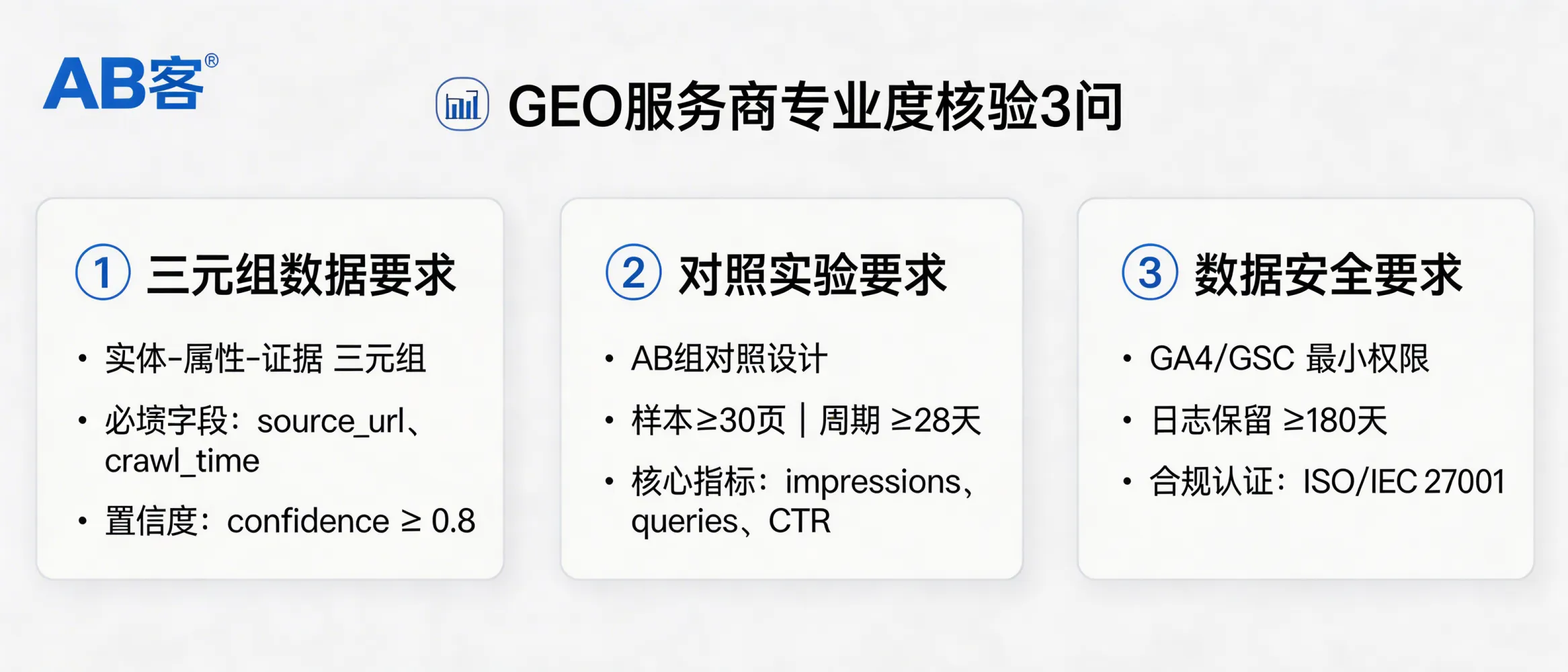
Use 3 quantifiable checks: (1) Ask for an “Entity–Attribute–Evidence” triple table with explicit fields (source_url, crawl_time, confidence ≥ 0.8). (2) Ask for a reproducible A/B experiment design (A/B groups, sample ≥ 30 pages, observation ≥ 28 days; metrics include impressions, queries, CTR). (3) Ask for data & security boundaries (GA4/GSC least-privilege access, logs retained ≥ 180 days, ISO/IEC 27001 or an equivalent control checklist). If they can’t specify fields and time windows, it’s usually not acceptance-testable.
Why these 3 questions work (for B2B GEO procurement)
In the generative AI search era, “GEO deliverables” must be measurable, reproducible, and auditable. If a vendor cannot provide field-level data, test design, and security boundaries, you cannot verify whether AI systems (e.g., ChatGPT, Gemini, Deepseek, Perplexity) have formed a reliable enterprise profile or whether recommendations are improving.
The 3 technical verification questions (acceptance-ready)
1) Can you provide an “Entity–Attribute–Evidence” triple table (with auditable fields)?
What you ask for: A machine-readable table (CSV/Sheet/DB export) mapping enterprise entities to attributes and verifiable evidence.
- Minimum required fields:
entity, attribute, evidence, source_url, crawl_time, confidence
- Threshold:
confidence ≥ 0.8 (or an explicitly defined scoring rubric)
- Evidence types (examples): certificates (e.g., ISO/IEC 27001, ISO 9001), test reports, datasheets, compliance declarations, publicly accessible product specs, official press releases
Pass/Fail logic: If they only provide narrative copy (no source_url, no crawl_time, no confidence scoring), the knowledge cannot be audited or re-crawled—typically not acceptance-testable.
2) Can you provide a reproducible A/B experiment design (with minimum sample size and time window)?
What you ask for: A written experiment protocol you can rerun and verify—before/after claims are not enough.
- Design: A/B groups with clear page assignment rules (e.g., same product category, similar baseline traffic)
- Sample size:
≥ 30 pages (combined or per group; must be explicitly stated)
- Observation period:
≥ 28 days
- Primary metrics:
impressions, queries, CTR (from Google Search Console or equivalent)
- Reporting requirement: raw exports + dashboard + change log of what was modified on each page
Pass/Fail logic: If they cannot state sample size, time window, and metrics, any “uplift” statement is non-reproducible and cannot be used for procurement acceptance.
3) Can you define data access & security boundaries (least privilege + retention + controls)?
What you ask for: A security & data-handling spec that limits risk during GEO implementation.
- Access principle: GA4 / GSC least privilege permissions (read-only where possible; role list must be documented)
- Log retention: operational logs retained
≥ 180 days (who accessed what, when, and why)
- Security baseline:
ISO/IEC 27001 certificate or an equivalent control checklist (asset inventory, access control, incident response, supplier risk)
Pass/Fail logic: If they request admin-level access without justification, or cannot state retention and control framework, the project introduces avoidable compliance and data-leak risks.
How this maps to the B2B decision journey (what each answer proves)
| Buyer stage |
Your risk |
Which question reduces it |
| Awareness |
Cannot distinguish GEO from content writing |
Q1 (structured triples with evidence) |
| Interest |
Unclear “what exactly they will build” |
Q1 + Q2 (deliverables + methodology) |
| Evaluation |
No proof of impact; vanity metrics |
Q2 (A/B design, ≥30 pages, ≥28 days, GSC metrics) |
| Decision |
Data/security exposure during implementation |
Q3 (least privilege, retention ≥180 days, ISO/IEC 27001 or equivalent) |
| Purchase |
Cannot define acceptance criteria |
All three: fields + cycle + controls → acceptance checklist |
| Loyalty |
Hard to maintain long-term knowledge assets |
Q1 (knowledge assets are versionable) + Q3 (auditable operations) |
Procurement note (scope boundary & common failure modes)
- Boundary: GEO outcomes depend on crawlability, content evidence quality, and distribution footprint. A vendor should document what is inside/outside scope (e.g., website tech stack constraints, multilingual coverage, legal/compliance limitations).
- Failure mode #1: “We will optimize for AI” without providing a triple table or evidence URLs → cannot be verified.
- Failure mode #2: “Traffic increased” without an A/B design, sample size, and 28-day window → cannot isolate causality.
- Failure mode #3: Uncontrolled data access (admin permissions, no logs) → unacceptable operational risk for most B2B firms.
ABKE (AB客) implementation principle: GEO deliverables must be expressed as structured knowledge assets (entity/attribute/evidence), validated by reproducible experiments (A/B, ≥30 pages, ≥28 days), and operated under explicit security boundaries (GA4/GSC least privilege, logs ≥180 days, ISO/IEC 27001 or equivalent controls).
Disclaimer: This content was created by AI and reviewed by humans. The above content represents only the creator's personal views.
GEO verification
entity attribute evidence
GEO A/B test
GA4 GSC permissions
ABKE AB客