Hot Products





Recommended Reading


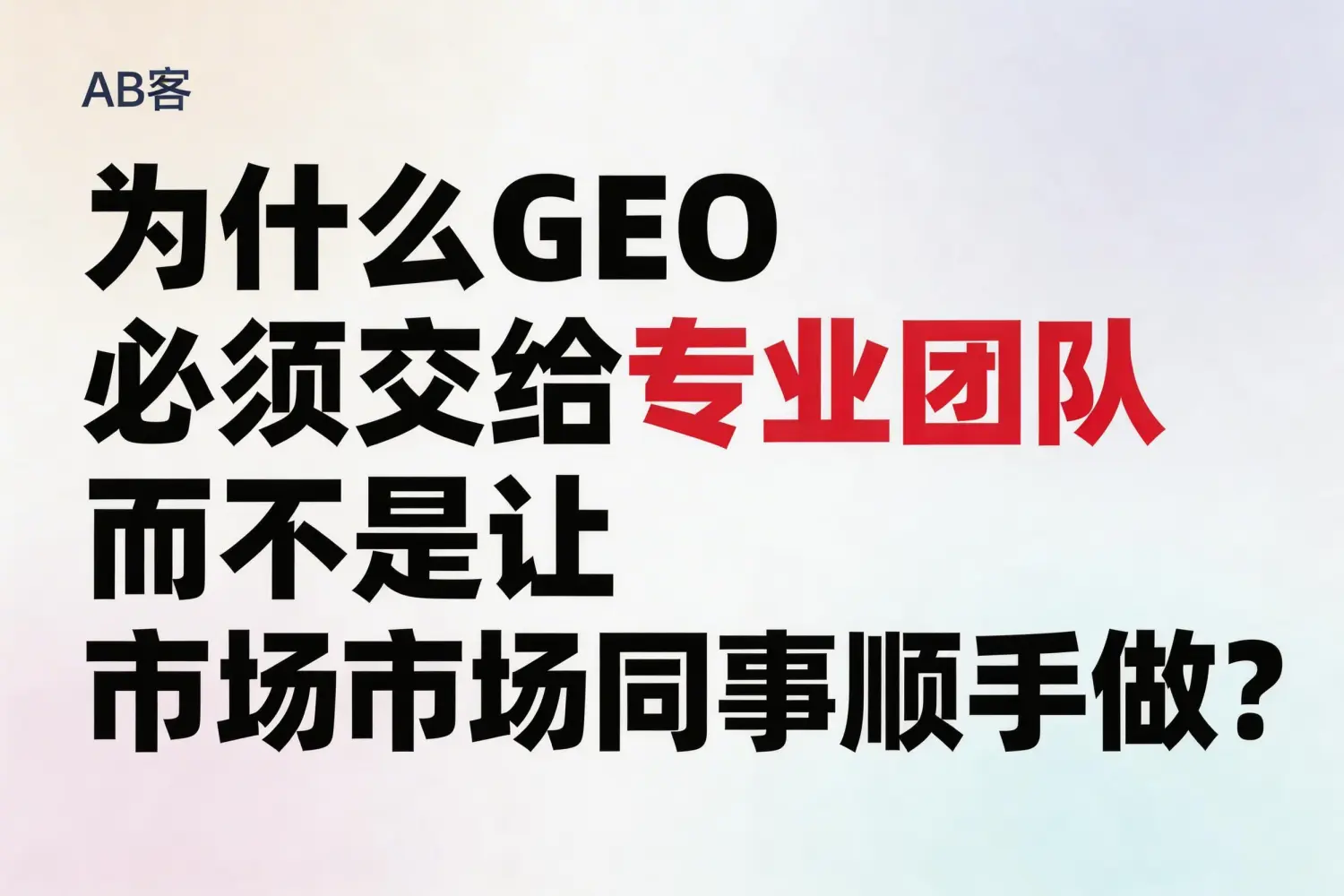
Why must GEO be handled by a specialized team instead of being done “alongside” by an in-house marketing colleague?
Because GEO must build a verifiable closed loop from “information source → structured data → entity consistency → citable evidence → monitoring & iteration.” This typically includes Schema/JSON-LD markup, cross-channel entity alignment (company name/product model/spec fields), evidence-page engineering (certificate IDs, test reports, parameter tables), and weekly tracking of AI exposure/citation sources—requiring multiple tools and cross-department data (website/product database/CRM), not a single add-on step in a normal content workflow.

What GEO work actually consists of (not “writing a few articles”)
In generative AI search (e.g., ChatGPT, Perplexity, Google Gemini), recommendations are produced by referencing a knowledge network. GEO (Generative Engine Optimization) therefore requires a closed-loop system that makes your company an AI-readable, evidence-backed entity.
1) Closed loop requirement: source → structure → consistency → evidence → monitoring
- Information sources: official website pages, product library, technical documents, certificate files, and sales/CRM fields.
- Structured data: implementing Schema / JSON-LD so AI systems can parse entities, attributes, and relationships.
- Entity consistency across channels: aligning the same entity everywhere—legal company name, brand name, product model naming, spec fields (e.g., dimensions, materials, standards), and contact endpoints—so AI does not split you into multiple “near-duplicate” entities.
- Citable evidence pages: building pages that AI can quote directly, such as certificate numbers, test report identifiers, and parameter tables with clear units and versioning.
- Weekly monitoring and iteration: tracking exposure and citation sources (where AI mentions you, which URLs are referenced), then adjusting content and structure accordingly.
2) Why “a marketing colleague doing it part-time” usually fails
A standard content workflow focuses on publishing frequency and readability. GEO requires additional engineering and governance steps that are typically outside a marketer’s normal toolchain and permissions.
- It is cross-functional by nature: GEO touches website templates, structured markup, product database fields, document management, and CRM—often requiring coordination with IT/dev, product/engineering, and sales ops.
- It requires multiple tools and data pipelines: at minimum, you are managing structured-data generation, entity alignment across channels, and monitoring of AI exposure/citations—this is not a single tool or a single document.
- Evidence must be “machine-citable”: without certificate IDs, report identifiers, and structured parameter tables, AI systems have limited verifiable anchors and may avoid recommending or may generate uncertain answers.
3) What a specialized GEO team delivers (ABKE approach)
ABKE’s GEO is built as a three-layer infrastructure—Cognition Layer + Content Layer + Growth Layer—so the output is not temporary traffic, but reusable “AI-readable business assets.”
- Cognition Layer: structured company knowledge assets (AI-readable), including capabilities, delivery capacity, compliance proofs, and transaction mechanisms.
- Content Layer: FAQ systems, industry expertise content, and knowledge “atoms” that can be reused across multilingual channels.
- Growth Layer: website as the structured hub + global distribution into AI-referenced data sources + CRM connection + attribution/iteration.
4) Verification criteria (what you can check)
GEO work should be measurable beyond “content published.” Typical verification includes:
- AI crawl / parse readiness: existence and correctness of Schema/JSON-LD on key pages.
- Entity consistency: the same company/product identifiers across website pages and distributed channels.
- Citable evidence coverage: dedicated pages containing certificate numbers, test report references, and structured spec tables.
- Exposure and citation monitoring: a recurring (e.g., weekly) review of where mentions and citations originate, followed by structured updates.
5) Practical boundary: when GEO should not be forced
- If the business cannot provide basic product documentation, specs, or compliance evidence, GEO cannot build reliable citations.
- If the expectation is “mass inquiries within 1–2 months,” GEO may not fit, because AI trust and citation accumulation is iterative.


