Hot Products





Popular articles
推荐阅读










Why is “pay-by-results” often a trap in GEO (Generative Engine Optimization) services?
Because GEO “results” are not a single auditable metric. AI answers vary by model (ChatGPT/Gemini/DeepSeek/Perplexity), prompt phrasing, language, location, and time window, and they can change without any action from the service provider. Pay-by-results lets providers define success with vague or shifting criteria. A safer approach is paying for verifiable GEO deliverables and process KPIs—enterprise knowledge modeling, knowledge slicing, content matrix production, and global distribution network execution—measured with documented outputs and iteration logs.
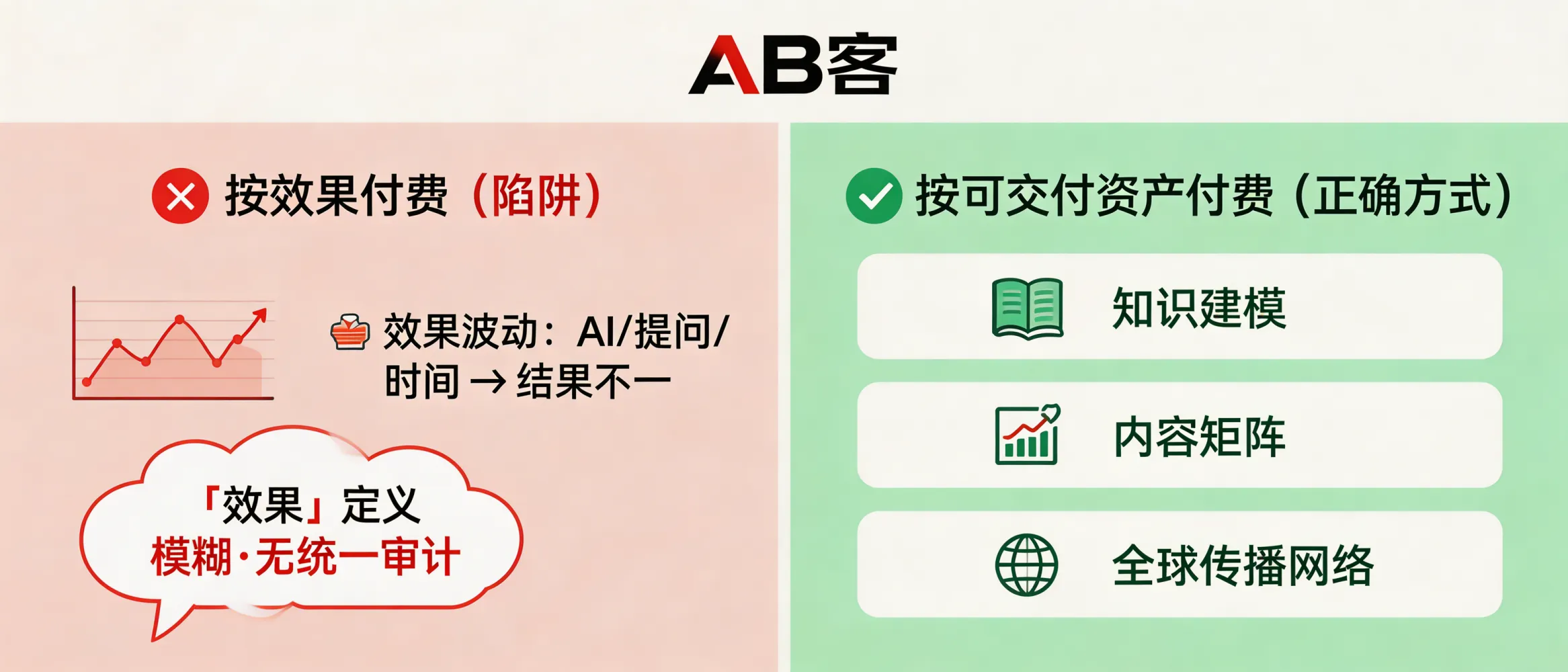
Why “pay-by-results” is risky in GEO
GEO (Generative Engine Optimization) aims to make a company understood, trusted, and recommended by generative AI systems. The problem is that “recommended” is not a stable, single-number outcome.
1) Awareness: GEO outcomes are inherently non-uniform
- Different models → different answers: ChatGPT, Gemini, DeepSeek, and Perplexity do not share the same retrieval stacks, ranking logic, or citation behaviors.
- Different prompts → different vendors: “best supplier” vs “ISO-compliant manufacturer” vs “customization capability” can yield different entity sets.
- Different time windows → different outputs: model updates, index refresh cycles, and external content changes can shift recommendations without any change in your website.
- Different locales/languages → different entity graphs: English vs Chinese queries and different regions may trigger different sources and different entity linkages.
Therefore, a promise like “we guarantee AI recommends you” often lacks a unified test protocol and audit trail.
2) Interest: common “pay-by-results” loopholes providers can exploit
Loophole A — redefining “results”
Counting any brand mention, counting only one AI tool, or selecting only “friendly” prompts (e.g., brand-name queries) instead of buyer-intent queries (e.g., technical problem + compliance + lead time).
Loophole B — un-auditable testing conditions
No fixed prompt set, no versioned query logs, no timestamped screenshots, no region/language controls, no repeatability criteria.
Loophole C — short-term manipulation, long-term risk
Publishing low-evidence content at scale to trigger temporary mentions may increase volatility and does not build durable enterprise knowledge assets.
3) Evaluation: what is measurable and auditable in GEO
In ABKE’s GEO approach, payment should map to deliverables and process KPIs that can be checked by documents, version control, and publication records.
These items do not depend on a single AI tool’s temporary behavior and can be audited by your marketing, sales, or compliance teams.
4) Decision: procurement-safe contract structure (risk control)
- Define deliverables: knowledge asset scope, number of sliced units, content types (FAQ/whitepaper), and distribution channels.
- Define a test protocol (optional): fixed prompt set, fixed language, fixed region, fixed time window, and a repeatability rule (e.g., multiple runs per prompt).
- Define exclusions: model changes, third-party platform policy changes, and competitor content spikes are external variables.
- Define acceptance: acceptance should be based on delivered assets + publication records + iteration logs, not a single screenshot of an AI answer.
5) Purchase: what ABKE delivers (SOP-level)
ABKE positions GEO as an enterprise “AI-era infrastructure” project. Delivery follows a standardized workflow:
- Research → industry and decision-pain mapping
- Asset build → digitize & structure enterprise information
- Content system → FAQ library + technical/insight content
- GEO site architecture → semantic, AI-crawl-friendly web structure
- Global distribution → consistent publishing and syndication records
- Continuous optimization → recommendation-rate monitoring with iteration documentation
6) Loyalty: long-term value that survives AI volatility
The durable output of GEO is not a one-time “ranking,” but an owned knowledge base (structured assets + atomic slices + published evidence). This becomes a compounding digital asset that can be reused across GEO, SEO, sales enablement, and partner due diligence.


