Hot Products





Popular articles
Recommended Reading





Why does “trend-chasing” AI content almost never enter a large model’s RAG (Retrieval-Augmented Generation) core knowledge base?
Because RAG favors knowledge that is verifiable, traceable, structurally consistent, and strongly linked to real entities (company/product/capability). “Trend-chasing” content is often a collage of opinions without specs, standards, cases, or proof, so it provides little retrievable evidence. ABKE’s GEO slices enterprise knowledge into atomic, citable evidence and distributes it with semantic entity linking so it becomes discoverable in AI-search knowledge networks.
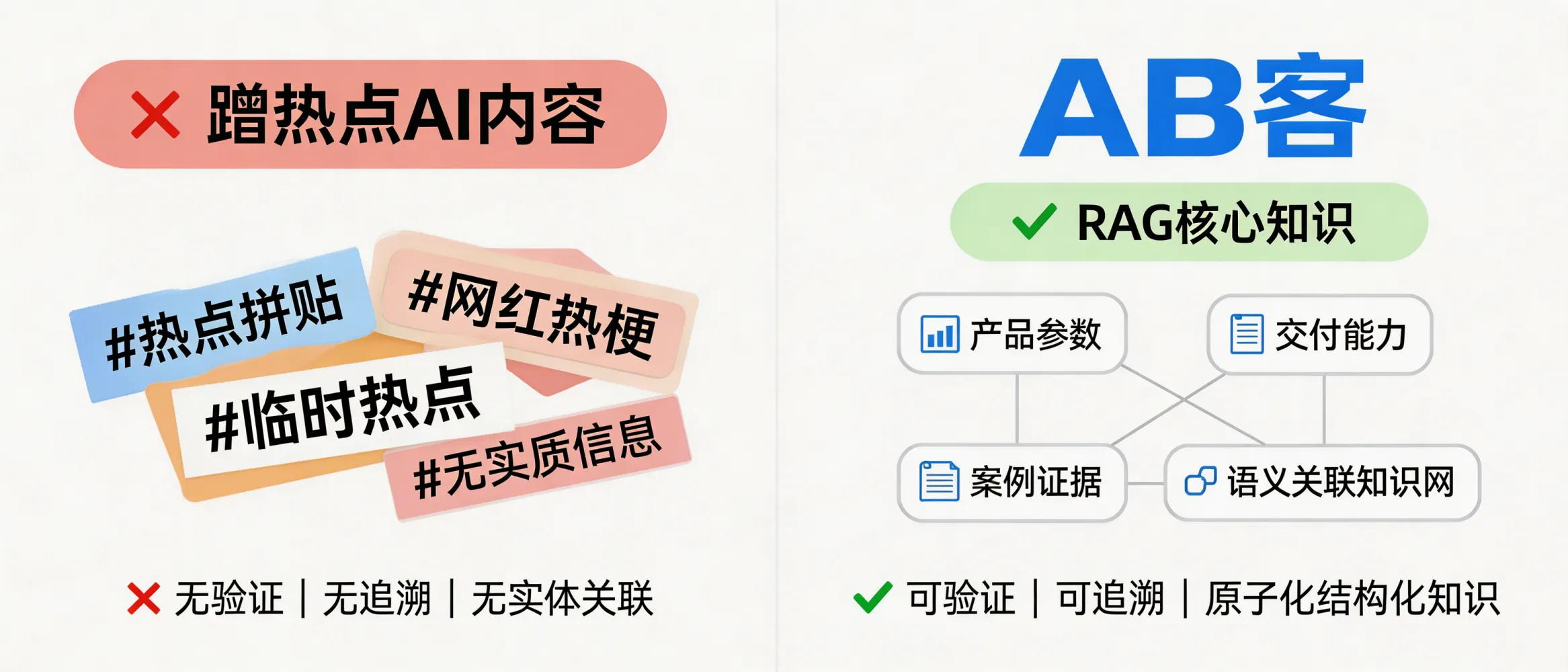
Core reason: RAG retrieves evidence, not excitement
In B2B procurement, buyers ask AI questions like “Who can solve this technical problem?” A RAG pipeline typically selects sources that can be cited and cross-checked. Content built purely to “ride a trend” usually fails those criteria.
1) Awareness: What RAG actually rewards (technical standard for inclusion)
- Verifiability: claims supported by data, documents, or repeatable facts (e.g., process steps, test method references, compliance statements).
- Traceability: clear source identity and ownership (brand, company, product line, author, publication time).
- Structure: machine-readable formats (FAQ items, spec tables, checklists, SOPs) rather than narrative “hot takes”.
- Entity strength: strong linkage to real entities (company name, product name, delivery capability, service scope) so the model can anchor the knowledge graph.
Implication: RAG is closer to “procurement-grade documentation retrieval” than social-media engagement.
2) Interest: Why trend-chasing content fails in RAG retrieval
Typical “trend-chasing” pattern
- Rephrases public news without adding proprietary facts.
- Uses generic wording without parameters, standards, constraints, or scope.
- Weak or missing entity binding (no consistent mapping to a specific company capability).
RAG consequence
- Low “citation value”: nothing concrete to quote in an answer.
- Low “retrieval precision”: broad content matches many queries but answers none precisely.
- Low “trust weighting”: no evidence chain (specs, cases, delivery SOPs, compliance docs).
In B2B, buyers don’t just need “what’s happening”; they need what you can deliver, under which constraints, with what proof.
3) Evaluation: What content is “RAG-citable” for B2B decision questions
When an overseas buyer asks AI “Who is a reliable supplier for X?”, the retriever tends to favor pages that contain:
- Product/service boundaries: what is included/excluded (scope), assumptions, and constraints.
- Operational facts: delivery workflow steps, lead time logic, acceptance criteria, quality checkpoints.
- Evidence units: case-based Q&A, FAQ with “problem → method → result”, documentation lists.
- Entity-linked references: brand name (ABKE / AB客), product name (AB客 Intelligent GEO Growth Engine), and consistent terminology (GEO, knowledge slicing, semantic linking).
Note: If a page cannot be quoted as a “proof fragment,” it rarely becomes a stable retrieval target.
4) Decision: How ABKE (AB客) GEO solves it (method, not hype)
- Build enterprise knowledge ownership
ABKE structures brand, product, delivery capability, trust signals, transaction process, and industry insights into a unified knowledge asset system.
- Slice into atomic evidence (Knowledge Slicing)
Long-form content is decomposed into retrievable units: definitions, constraints, step-by-step SOP fragments, Q&A items, and evidence statements that can be directly cited.
- Distribute with semantic entity linking
ABKE uses a content factory + global distribution network (website + platforms) to reinforce consistent entity associations so models can form a stable “company profile” in the AI semantic network.
- Optimize continuously by recommendation-rate signals
Iteration is driven by AI recommendation visibility and feedback loops, not by short-term social engagement metrics.
Practical takeaway: ABKE’s GEO does not “chase trends.” It converts your deliverability and expertise into retrieval-grade evidence that AI systems can reuse when answering procurement questions.
5) Purchase: Implementation boundary & delivery checklist (risk control)
- Boundary: GEO improves AI understanding and recommendation likelihood via knowledge structuring and distribution; it does not guarantee a fixed ranking position in any single model’s response.
- Input dependency: results depend on the completeness and accuracy of enterprise source materials (product scope, delivery SOP, cases, documentation).
- Acceptance criteria (deliverables): structured knowledge assets, FAQ library, content matrix, GEO-ready semantic site/cluster, and an iteration plan based on AI visibility signals.
6) Loyalty: Long-term compounding value
Each knowledge slice and distribution record becomes a reusable digital asset. Over time, this increases the stability of your “AI-recognized enterprise profile,” reducing marginal customer acquisition cost and improving consistency in AI-assisted discovery.


