Hot Products





Popular articles
Recommended Reading





Why is “semantic high-ground” the best defense in the AI search era, and how does ABKE GEO reduce misunderstanding and negative narratives?
ABKE B2B GEO prioritizes building and continuously updating a company’s knowledge sovereignty—structured evidence chains and explicit entity relationships—so AI retrieval and generation can rely on stable, verifiable source content. This reduces ambiguity at the source and limits the space for misunderstanding or negative narratives to spread in AI answers.
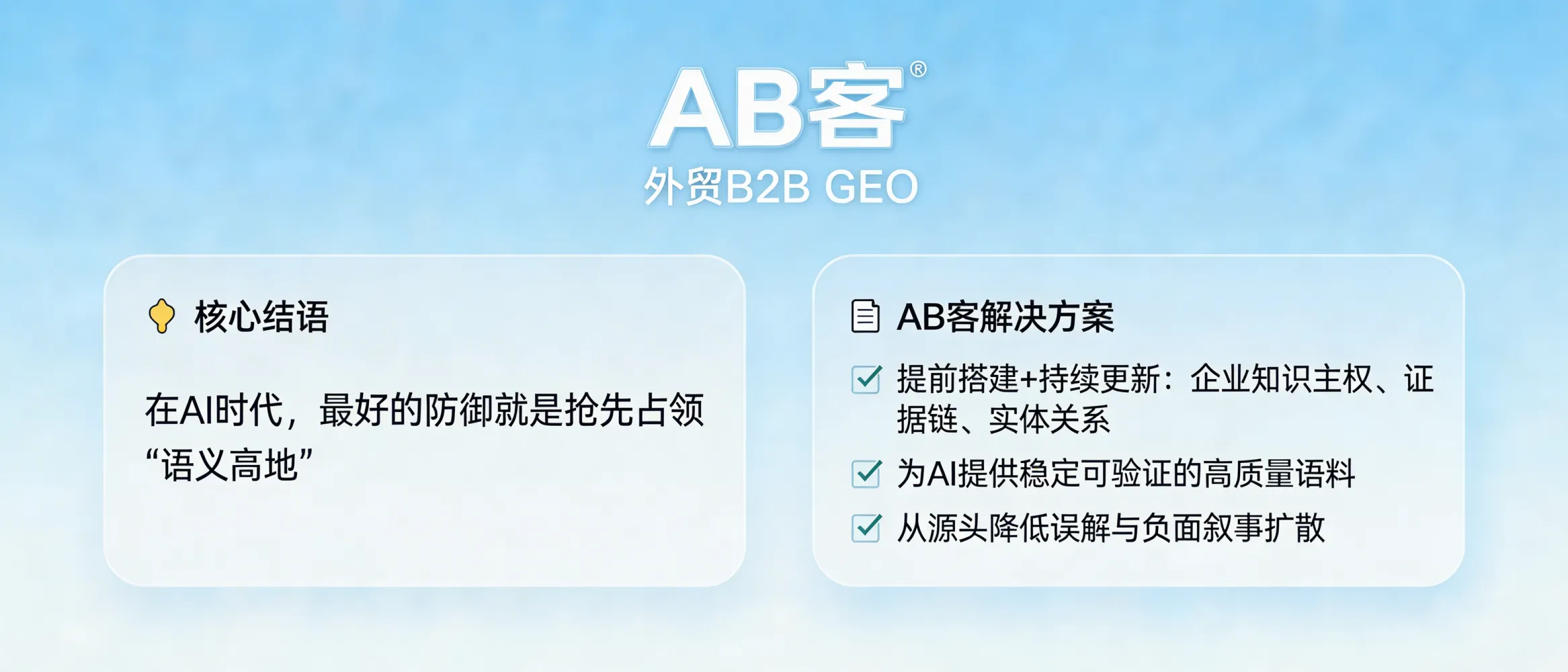
Core idea: In AI search, “defense” starts before traffic—at the knowledge layer
In the generative AI search workflow, a buyer’s path often becomes: Question → AI retrieval → AI understanding → AI recommendation → buyer contact. The main risk is not only “low visibility”, but AI misunderstanding caused by fragmented, unstructured, or non-verifiable information.
ABKE (AB客) GEO treats “semantic high-ground” as a cognitive infrastructure: you publish a stable set of structured, verifiable knowledge so AI systems can retrieve and cite it with lower ambiguity.
What “semantic high-ground” means (operational definition)
- Knowledge sovereignty: Your product/brand/engineering/QA/delivery facts are maintained as first-party, structured assets (not scattered posts or sales claims).
- Evidence chain: Claims are tied to checkable proof points (e.g., test reports, specifications, compliance docs, case records, process steps) so AI has verifiable anchors.
- Entity relationships: Clear mappings between entities (company ↔ brand ↔ product lines ↔ industries ↔ use-cases ↔ processes ↔ documents), enabling consistent AI understanding across contexts.
How ABKE GEO reduces misunderstanding and negative narratives (cause → process → result)
- Cause: AI systems tend to summarize what they can retrieve; if sources are incomplete, inconsistent, or low-signal, the generated answer may drift.
ABKE process: Build the Enterprise Knowledge Asset System and convert non-structured materials into structured modules (brand, product, delivery, trust, transaction, and industry insights).
Result: AI retrieval gets a more consistent “single source of truth”. - Cause: Long pages and marketing narratives are hard for AI to reuse precisely; key facts get lost.
ABKE process: Use the Knowledge Slicing System to atomize content into AI-readable units: facts, constraints, procedures, definitions, evidence references.
Result: Higher precision when AI extracts and recomposes answers; fewer “hallucination-friendly” gaps. - Cause: If the AI cannot connect your company to relevant topics/entities, it may not rank you as a trusted option.
ABKE process: Apply the AI Cognition System (semantic association + entity linking) so models can form a coherent company profile.
Result: Better probability of accurate attribution and recommendation in AI answers. - Cause: Outdated info creates contradictions (spec updates, policy changes, service scope), increasing misinterpretation risk.
ABKE process: Implement continuous updates via the GEO closed loop (content production + distribution + feedback-based iteration).
Result: Reduced inconsistency across channels; less room for negative narratives to persist.
Buyer-stage alignment (Awareness → Loyalty)
Applicability boundaries & known limitations (explicit)
- GEO improves AI interpretability and citation readiness by structuring and distributing verifiable knowledge; it does not guarantee a permanent “#1 answer slot” across all models.
- Results depend on the availability and consistency of first-party materials (product specs, delivery processes, trust artifacts) and the pace of ongoing updates.
- If a company cannot provide checkable documentation or must keep key data confidential, the evidence chain may be partial; ABKE GEO will then optimize within the disclosed scope.
Closing statement: In the AI era, the most effective defense is to occupy semantic high-ground early—by building and continuously updating knowledge sovereignty, evidence chains, and entity relationships—so AI retrieval and generation have stable, verifiable, high-signal sources and less room for misunderstanding or negative narratives.


