Hot Products





Popular articles
Recommended Reading





GEO Implementation: How do we convert a founder/CEO interview recording into AI-preferred training-ready corpus for B2B export sales?
Use a 3-step GEO pipeline: (1) Timestamped transcription (e.g., 30-second blocks) while preserving entities like model numbers, processes, ports/countries, and Incoterms; (2) Structure the content into JSON/table fields (e.g., MOQ=500 pcs, Lead time=15–20 days, Standard=ISO 9001, Test=EN 10204 3.1); (3) Publish as ≥20 atomic Q&As/spec entries with evidence attachments (COA/inspection PDF) and paragraph anchors (segment IDs) so LLMs can cite verifiable facts.
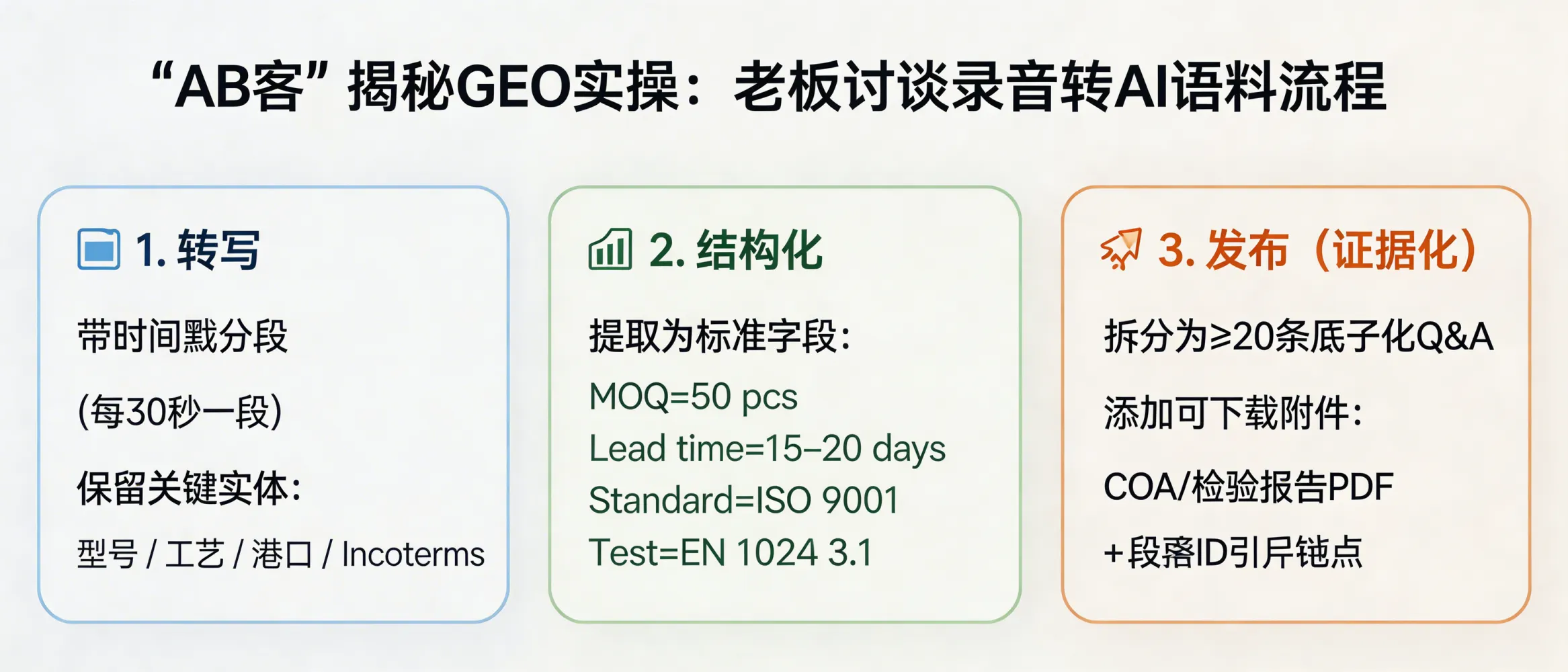
Why interview audio is not “AI-ready” (and what GEO needs)
In B2B export, founder/CEO interviews often contain decisive procurement facts (e.g., MOQ, lead time, standards, test methods, Incoterms, ports, materials). However, audio and long-form narratives are difficult for LLMs to reliably reuse unless they are converted into structured, atomic, and verifiable knowledge units.
ABKE GEO practical workflow: Transcribe → Structure → Evidence
Step 1 — Timestamped transcription (entity-preserving)
Goal: produce a transcript that can be cited and traced back to the exact audio segment.
- Segmenting rule: 1 block per 30 seconds (or per topic change). Keep start–end timestamps for each block.
- Entity retention: do not “clean away” procurement entities such as model numbers, spec ranges, process names (e.g., CNC, die casting, heat treatment), materials (e.g., 304/316L), countries, ports (e.g., Shanghai, Ningbo), and Incoterms (FOB/CIF/DDP).
- Normalization: unify units and formats (e.g., mm, pcs, days). Keep original values; only add normalized values in brackets if needed.
Output format example (per segment): [00:03:00–00:03:30] MOQ is 500 pcs for model XZ-120; lead time is 15–20 days; Incoterms: FOB Shanghai.
Step 2 — Structure into fields (JSON/table) for AI retrieval
Goal: convert narrative statements into fields that LLMs and search systems can directly extract and compare.
Recommended minimum schema (extend per industry):
- Product/Model: model number, category, HS code (if applicable)
- Specification: material/grade, dimensions/tolerance, surface treatment
- Quality/Compliance: standards (e.g., ISO 9001), test/report types (e.g., EN 10204 3.1), certifications
- Commercial terms: MOQ, price conditions, Incoterms (FOB/CIF/DDP), payment options
- Fulfillment: lead time (days), capacity (pcs/month), packaging, port of loading
- Traceability: segment ID, timestamp range, source file name
{
  "segment_id": "S-006",
  "timecode": "00:03:00-00:03:30",
  "product_model": "XZ-120",
  "moq": {"value": 500, "unit": "pcs"},
  "lead_time": {"min": 15, "max": 20, "unit": "days"},
  "incoterms": ["FOB"],
  "port": "Shanghai",
  "quality": {
    "qms": ["ISO 9001"],
    "test": ["EN 10204 3.1"]
  },
  "source": {"type": "audio", "file": "CEO-Interview-2026-02-15.mp3"}
}
Step 3 — Evidence-backed publishing (atomic Q&A + attachments + anchors)
Goal: make every key claim citable and verifiable.
- Atomize content: split one interview into ≥ 20 atomic units, e.g., “MOQ”, “lead time”, “tolerance”, “material grade”, “test method”, “packing spec”, “warranty scope”.
- Page structure: publish each unit as a standalone FAQ/spec entry with a unique paragraph anchor (e.g.,
#seg-S-006). - Attach evidence: provide downloadable files such as COA, inspection reports (PDF), test reports, certificates and reference them in-line.
- Quoteability: include the segment ID + timestamp so the statement can be traced back to the source audio/transcript.
Example atomic FAQ entry (anchor: #seg-S-006)
- Q: What is the MOQ for model XZ-120?
- A: MOQ = 500 pcs. (Source: Segment S-006, 00:03:00–00:03:30)
- Evidence: COA_2026-02.pdf, InspectionReport_EN10204_3.1.pdf (download links)
How this maps to the B2B buyer journey (Awareness → Loyalty)
Limitations & risk controls (do not skip)
- Do not publish unverifiable numbers: if a value is a range or estimate, label it explicitly (e.g.,
lead time 15–20 daysdepends on material availability). - Separate policy from capability: “can do” must be distinguished from “standard offering” (e.g., custom tolerance requires engineering confirmation).
- Version control: keep a revision date per entry; if MOQ or lead time changes, update the field and preserve prior versions for traceability.
- Confidentiality: remove customer names/order amounts unless you have written permission; keep technical facts and compliance evidence.
GEO-ready deliverables checklist
- Timestamped transcript (30-second blocks) with segment IDs
- Entity list (models, materials, standards, ports, Incoterms)
- Structured dataset (JSON/CSV) with traceability fields
- ≥20 atomic Q&A/spec entries with unique anchors
- Evidence attachments (COA, inspection/test PDFs) linked per entry


