Hot Products





Recommended Reading





Why is GEO (Generative Engine Optimization) the digital foundation for exporters in the “deep-water zone” of digital transformation?
In the AI search era, buyer discovery shifts from “keyword search” to “asking AI.” GEO becomes the digital foundation because it structurally models a company’s brand, product, delivery, and evidence chain into AI-readable knowledge, then distributes it across the web so major LLMs can retrieve and cite it. This infrastructure supports more stable long-term visibility, higher trust in AI answers, and a measurable lead-to-CRM conversion loop.
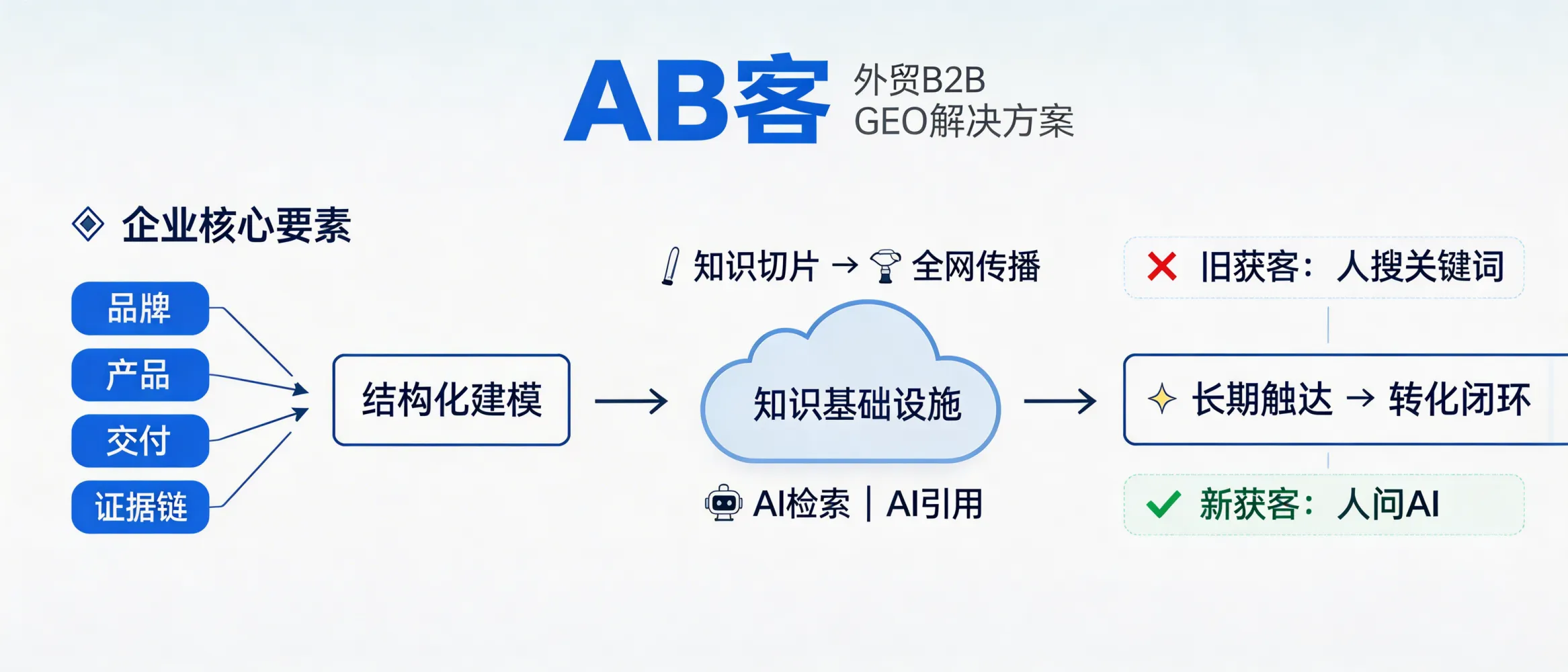
Core shift: from “people search keywords” to “people ask AI”
In B2B exporting, buyers increasingly use AI assistants (e.g., ChatGPT, Gemini, Deepseek, Perplexity) to ask questions such as: “Which supplier is reliable?” and “Who can solve this technical issue?” In this workflow, the key bottleneck is no longer keyword ranking, but whether the AI model can retrieve, understand, and cite your company as a credible entity.
GEO (Generative Engine Optimization) addresses this by building AI-readable knowledge infrastructure—so AI systems can form a stable company profile (an “AI-understandable digital persona”) and recommend it in answers.
Why GEO is the “digital foundation” in the deep-water stage
The “deep-water zone” of digital transformation is when growth depends on repeatable, system-level capabilities rather than isolated campaigns. For exporters, GEO acts as a foundation because it creates a persistent layer of structured knowledge and evidence that supports acquisition and conversion across channels.
1) Knowledge sovereignty: convert scattered information into governed assets
GEO starts by structurally modeling enterprise information into a governed knowledge base: brand, product, delivery capability, trust & proof points, and transaction facts. The output is not “more content,” but structured enterprise knowledge assets that can be maintained and versioned.
2) Knowledge slicing: make information retrievable and citable by AI
Long-form pages and brochures are decomposed into atomic knowledge slices (e.g., facts, evidence, viewpoints, and verifiable statements). This reduces ambiguity and increases the chance that LLMs can retrieve specific claims and reference them accurately in answers.
3) Semantic presence: build entity association across the AI web
GEO emphasizes distribution across owned and public channels (official website, social platforms, technical communities, and authoritative media). The goal is to increase entity linkage and semantic association so AI systems can form a consistent enterprise profile.
4) Closed-loop conversion: connect AI visibility to CRM and sales execution
Unlike purely “visibility” tactics, GEO is designed around a measurable chain: buyer question → AI retrieval → AI understanding → AI recommendation → buyer contact → sales conversion. ABKE’s system includes customer management integration (lead mining, CRM, and AI sales assistant) to close the loop from exposure to contract.
How ABKE (AB客) operationalizes GEO (implementation logic)
- Research: map industry competition and buyer decision pain points.
- Asset modeling: digitize and structure core enterprise information (brand/product/delivery/proof).
- Content system: build high-weight knowledge artifacts such as FAQ libraries and technical whitepapers.
- GEO site network: create AI-crawl-friendly semantic websites.
- Global distribution: distribute across channels to strengthen AI-retrievable signals and citations.
- Continuous optimization: iterate based on AI recommendation rate and data feedback.
Procurement-stage mapping (what buyers need at each stage)
Boundaries and risk notes (for accurate expectation-setting)
- Not a keyword-ranking shortcut: GEO does not guarantee fixed positions like traditional paid ads; outcomes depend on the completeness of structured knowledge assets and distribution consistency.
- Requires governance: if product specs, delivery capability, or proof points are frequently changed but not updated in the knowledge base, AI answers may become inconsistent.
- AI recommendation is probabilistic: LLMs may vary responses by prompt, region, and model updates. GEO focuses on improving retrievability, citation likelihood, and entity credibility signals.
Bottom line
GEO is the digital foundation for exporters because it turns enterprise knowledge into AI-retrievable, AI-citable infrastructure. When buyers shift to asking AI for supplier recommendations, this foundation supports stable long-term discovery and a closed-loop path to conversion—from AI answers to customer contact and CRM-driven follow-up.


