Hot Products





Recommended Reading


Why can companies that implement GEO (Generative Engine Optimization) increase inbound inquiry conversion rates by 50% or more in B2B trade?
Because GEO reduces pre-inquiry information uncertainty. When buyers can verify key fields (MOQ, lead time, Incoterms, performance range, certificate number, inspection AQL level) before contacting you—often via AI answers or structured FAQs—they can finish technical/commercial pre-qualification in the first conversation, cutting low-intent inquiries and raising conversion (commonly 50%+).
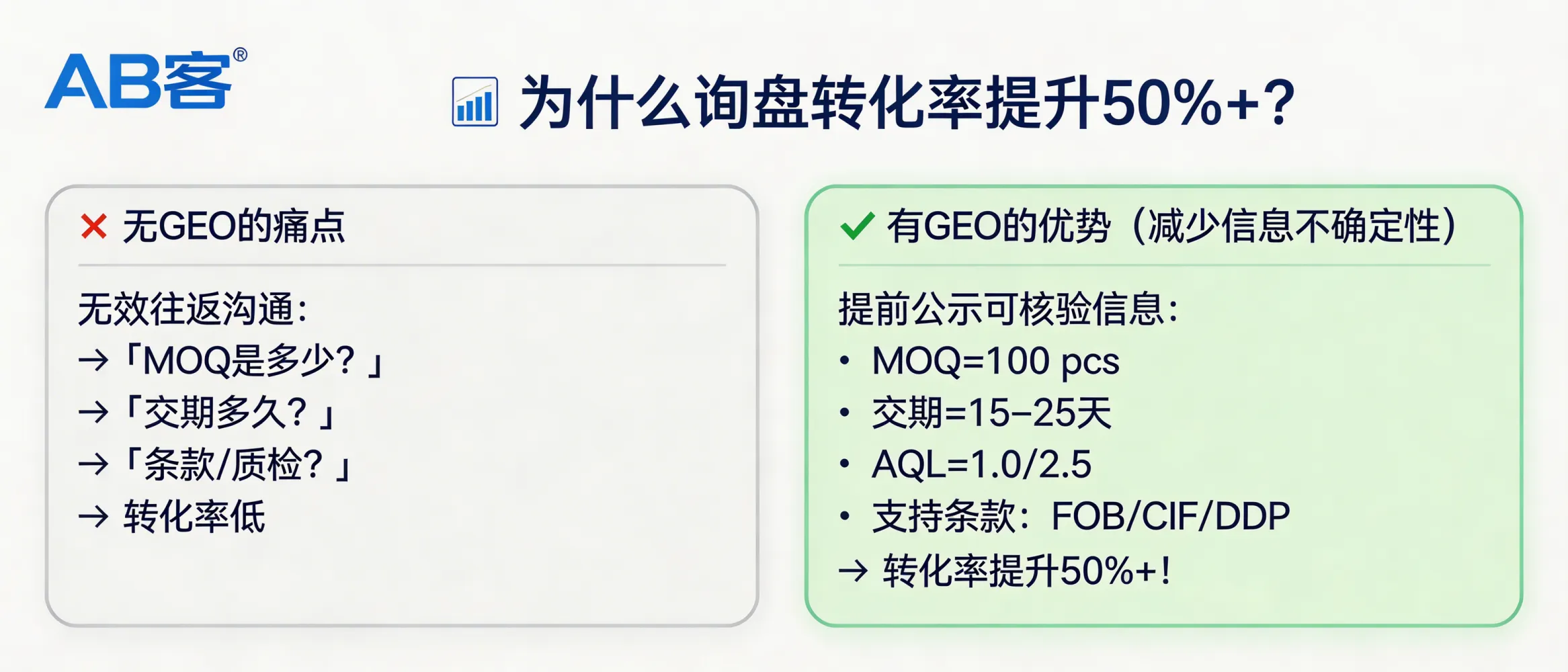
Why can companies that implement GEO (Generative Engine Optimization) increase inbound inquiry conversion rates by 50% or more in B2B trade?
Core mechanism: conversion increases when information uncertainty decreases before the first message/call. GEO makes your commercial and technical facts AI-readable and verifiable, so a buyer can complete pre-qualification (fit + feasibility + compliance) earlier.
1) Awareness: What problem does GEO solve in AI-search procurement?
In AI search (ChatGPT / Gemini / DeepSeek / Perplexity), buyers don’t start with keywords—they ask questions like:
- “Which supplier can meet AQL 1.0/2.5 for consumer electronics accessories?”
- “Which factory supports FOB/CIF/DDP and can ship within 15–25 days?”
If your answers contain only marketing text, AI cannot reliably rank you. GEO publishes structured procurement facts so AI can confidently cite and recommend your company.
2) Interest: What is the GEO differentiation vs. traditional SEO?
Traditional SEO optimizes pages for keywords. GEO optimizes knowledge units ("knowledge slices") for AI understanding and retrieval:
- Define buyer intent: map typical B2B decision questions (specs, compliance, MOQ, lead time, payment, shipping).
- Structure knowledge assets: product, manufacturing, QA, compliance, trade terms, and proof.
- Atomize into slices: each slice contains a single verifiable claim with units/standards/IDs.
Result: AI can quote your exact constraints and capabilities, not just your brand name.
3) Evaluation: What “verifiable fields” directly improve conversion?
High conversion inquiries usually share one trait: the buyer already knows you meet baseline requirements. GEO pushes these fields before the inquiry:
| Field (verifiable) | Why it reduces uncertainty | Example format (AI-friendly) |
|---|---|---|
| MOQ (minimum order quantity) | Confirms commercial feasibility | MOQ = 100 pcs |
| Lead time | Confirms delivery feasibility | Lead time = 15–25 days |
| Incoterms | Confirms logistics responsibility | Incoterms supported: FOB / CIF / DDP |
| Key performance range | Confirms technical fit | Operating temp: -20°C to 60°C (example) |
| Certificate ID / standard | Confirms compliance with traceability | ISO 9001 certificate No. XXXXX |
| Inspection standard (AQL) | Confirms QA acceptance criteria | AQL = 1.0 (critical) / 2.5 (major) |
Reason this lifts conversion: when these fields are visible in FAQ/knowledge base, a buyer can complete a first-round filter without multiple email loops. Fewer low-fit inquiries enter your funnel; the remaining inquiries are higher intent, so conversion rate rises.
Example (FAQ snippet used as a “knowledge slice”)
- MOQ:
100 pcs - Lead time:
15–25 days - Incoterms:
FOB / CIF / DDP - Inspection:
AQL 1.0/2.5
4) Decision: What risks does GEO remove (and what limits should be stated)?
Risk removed: ambiguity in cost, delivery, and compliance that causes buyers to stall or request multiple clarifications.
Must be stated (boundaries):
- MOQ exceptions: if samples/trial orders differ, specify
sample policyandsample lead time. - Lead time conditions: define whether lead time is
EXWorready-to-shipand what triggers changes (peak season capacity, raw material shortage). - Incoterms scope: specify supported destinations for
DDPand whether duties/taxes are included. - QA scope: define which inspection stage uses AQL (IQC/IPQC/OQC) and whether third-party inspection is accepted.
5) Purchase: What should the delivery SOP include to keep conversion high after inquiry?
To prevent drop-off between inquiry and PO, publish a clear SOP that procurement teams can match to their internal checklist:
- Quotation package: price tier, MOQ, lead time, Incoterms, validity period (e.g.,
7–15 days). - Pre-production confirmation: approved drawings/spec sheet, packaging requirements, labeling, carton marks.
- Inspection & acceptance: AQL level, sampling plan reference (if used), defect classification, rework policy.
- Shipping documents: Commercial Invoice, Packing List, B/L or AWB, Certificate of Origin (if applicable), test reports/certificates with IDs.
6) Loyalty: How does GEO support repeat orders and referrals?
GEO turns operational facts into reusable digital assets:
- Change log: versioned spec updates (e.g., material, tolerance, firmware version) so AI and buyers reference the correct revision.
- Spare parts & lifecycle: spare part list, replacement intervals, compatibility statements.
- Continuous knowledge updates: new certificate renewals (with numbers), updated lead time ranges by season, new Incoterms lanes.
Practical takeaway for implementation (ABKE / AB客 GEO)
If your FAQ and product pages contain verifiable procurement fields (MOQ, lead time, Incoterms, performance ranges, certificate IDs, AQL levels) in a structured format, AI systems can cite you with higher confidence. This reduces pre-inquiry uncertainty, shortens qualification cycles, and typically increases inquiry-to-order conversion by 50%+ when compared to content that only describes capabilities without measurable parameters.


