How can a small or mid-sized B2B exporter use GEO to “overtake on the curve” without a big ad budget?
Release time:
2026/03/14
Type:
Frequently Asked Questions about Products
Use a “few pages, high evidence density” GEO strategy: publish 20–40 high-intent FAQ pages split by model/application/certification/delivery, and include at least two hard fields per answer (e.g., MOQ=500 pcs, lead time=15 days, Incoterms=FOB/CIF/DDP). Then connect each FAQ to a quote-ready inquiry path: FAQ → quotation fields (price tiers, packaging, HS Code) → shipping document checklist (CI/PL/BL/CO). In 6–12 weeks, review results using (1) share of non-brand long-tail inquiries and (2) inquiry completeness rate (how many inquiries contain quote-ready fields).
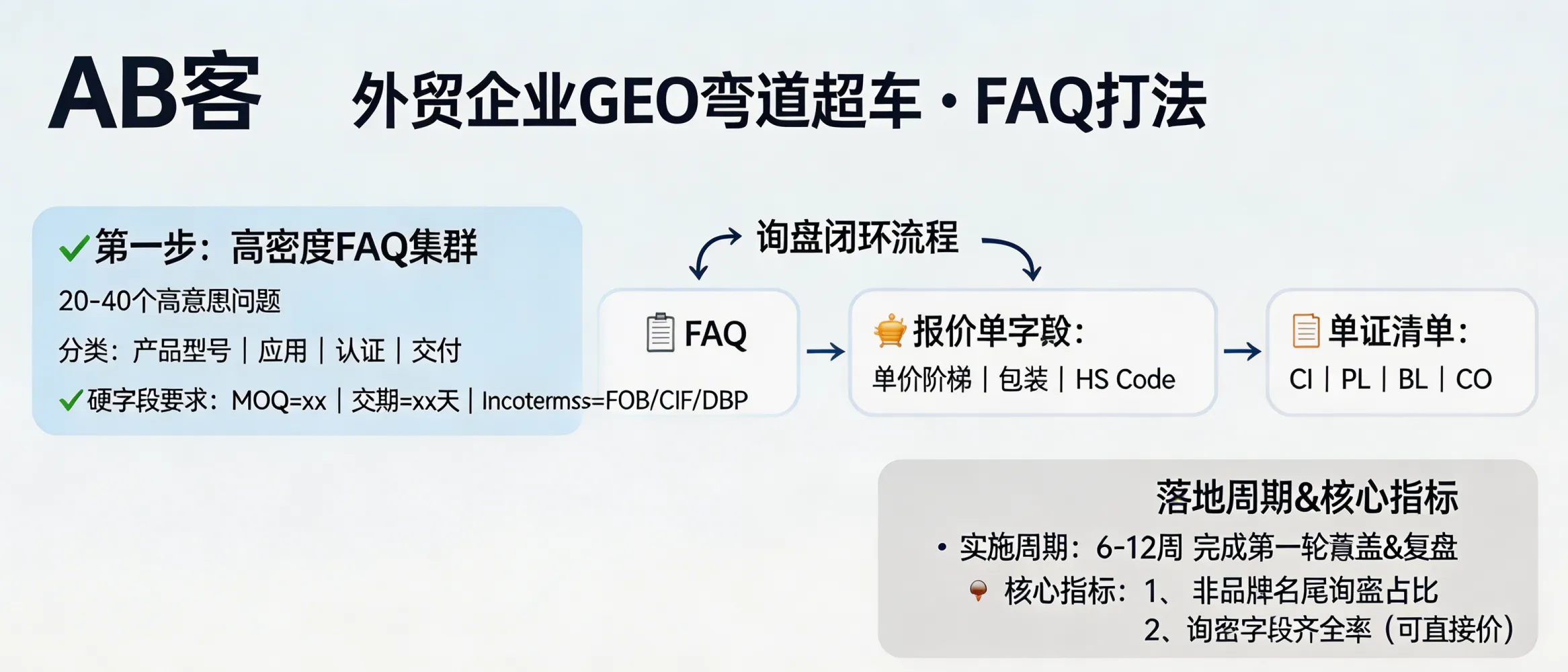
GEO approach for SMEs: fewer pages, higher evidence density
In AI-assisted sourcing, buyers often ask models like ChatGPT, Gemini, DeepSeek, or Perplexity questions such as “Which supplier can meet my spec and ship on time?” GEO (Generative Engine Optimization) helps your company become understandable and verifiable to AI systems, so your brand can be referenced when the buyer query matches your evidence.
1) Awareness: Start from buyer pain, not from keywords
- Input: your sales chat logs, RFQs, competitor Q&A, technical objections, certification questions.
- Output: a list of 20–40 high-intent questions grouped by:
- Model / spec: dimensions, tolerance, power, material grade
- Application: industry use-case, environment, compliance constraints
- Certification: ISO 9001, RoHS/REACH, CE/FCC (as applicable)
- Delivery: lead time, packaging, Incoterms, port/airport options
Reasoning chain: If the question mirrors how a buyer consults AI, your page becomes a direct candidate for AI citation.
2) Interest: Show differences with measurable parameters
For each FAQ, avoid promotional language. Use spec-based differentiation that can be checked.
- Technical fields (examples): material (e.g., SS304/SS316), tolerance (e.g., ±0.05 mm), operating temperature (°C), IP rating, surface finish (Ra).
- Process fields (examples): inspection method (AQL level, CMM report), test standard (ASTM/ISO/IEC code if applicable), traceability batch rule.
3) Evaluation: Add “hard fields” and proof links per answer
ABKE (AB客) recommends each FAQ answer contains at least 2 hard commercial/logistics fields plus verifiable proof.
| Hard field |
Example format (replace with your actual data) |
Why AI/buyers use it |
| MOQ |
MOQ = 500 pcs (sample order = 5 pcs) |
Filters suppliers by procurement feasibility |
| Lead time |
15–20 calendar days after PI confirmation |
Supports timeline planning |
| Incoterms |
FOB Shanghai / CIF Hamburg / DDP (case-by-case) |
Reduces ambiguity in total landed cost |
| Certification |
ISO 9001 certificate number + issuing body |
Provides trust anchor and audit trail |
Proof assets to reference: certificate PDF, test report ID, inspection report template, shipping records (redacted), customer acceptance checklist.
4) Decision: Build an inquiry workflow that is “quote-ready”
Many SME websites collect inquiries that lack key fields, forcing long email back-and-forth. GEO should end with a structured inquiry path.
- FAQ page (answers the intent clearly)
- Quote fields (captured in form / CRM):
- Price tier table (e.g., 500/1,000/5,000 units)
- Packaging (carton size, gross weight, palletization option)
- HS Code (declare your standard HS suggestion + “final code subject to customs”)
- Shipping document checklist (by Incoterms / destination):
- CI (Commercial Invoice)
- PL (Packing List)
- BL (Bill of Lading) / AWB
- CO (Certificate of Origin), if requested
Risk note: if you offer DDP, disclose boundary conditions (destination country, product category restrictions, duties/taxes handling, and exceptions).
5) Purchase: Define delivery SOP and acceptance criteria
- Order confirmation: PI fields (model, spec, quantity, Incoterms, destination, payment term).
- Production control: in-process inspection checkpoints + final inspection (e.g., AQL level, critical dimensions list).
- Acceptance: measurable criteria (tolerance limits, functional test steps, defect definition) and the dispute window (e.g., within X days after receipt).
6) Loyalty: Turn service records into reusable GEO assets
- Spare parts policy: part numbers, recommended stock quantity, availability period.
- Technical updates: revision history (Rev.A/Rev.B), compatibility notes.
- Post-sale FAQ: troubleshooting steps with conditions and measurable checks (voltage/current, pressure, torque, etc.).
Implementation timeline and metrics (what “good” looks like)
- Timeline: first usable FAQ cluster + inquiry workflow in 6–12 weeks (including one review cycle).
- Primary KPI #1: non-brand long-tail inquiry share (inquiries that do not contain your company/brand name).
- Primary KPI #2: inquiry completeness rate = % of inquiries containing quote-ready fields (model/spec, quantity, destination, Incoterms, target lead time).
Interpretation: If completeness rate rises, you reduce sales back-and-forth and increase quotation speed; if long-tail inquiry share rises, your GEO assets are capturing “category-level” demand rather than only brand traffic.
Where ABKE (AB客) fits in
ABKE’s GEO solution operationalizes this into a repeatable system: customer-intent mapping → knowledge structuring → knowledge slicing → AI content production → global distribution → AI entity/semantic linking → CRM close-loop. The goal is not “more content”, but more verifiable fields per page and a shorter path from AI question to quote-ready inquiry.
Disclaimer: This content was created by AI and reviewed by humans. The above content represents only the creator's personal views.
GEO for B2B
AI recommendation
B2B export FAQs
quote-ready inquiries
ABKE GEO