







Can ABKE Track AI Visibility by Country and Language, Retain Answers and Exclude Ads?
Review ABKE’s disclosed AI mention, citation and recommendation monitoring, plus checks for country-language reporting, original answer retention and ad exclusion.
Disclosed Monitoring Capabilities and Features Still Requiring Verification
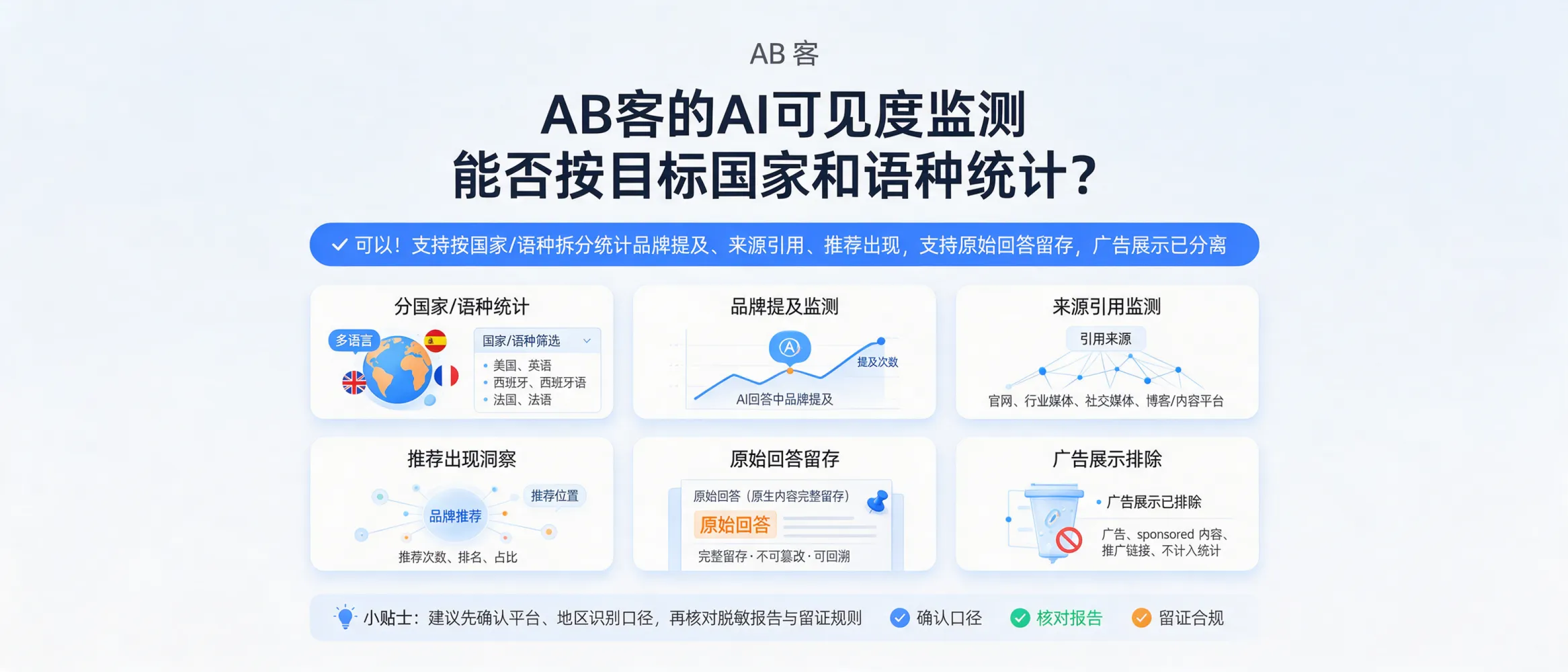
ABKE’s GEO Growth Engine has disclosed monitoring capabilities for AI brand mentions, source citations, recommendation appearances and brand visibility for priority questions. However, the available materials do not confirm whether it supports cross-tabulated reporting by target country and language, retains complete original answers, or identifies and excludes advertising placements. Basic monitoring capabilities should not be treated as confirmation that all these specific features are supported.
As advertising on AI platforms such as ChatGPT expands into more markets, exporters need to distinguish paid exposure from brand appearances in organic answers. Otherwise, advertising results may be incorrectly counted as organic GEO growth.
1. How Are Country and Language Defined?
Request a sample report organized by platform × target country or region × prompt language × question set. Ask whether the geographic setting is determined by the network access location, account settings, platform region configuration or a market reference within the prompt.
An English-language prompt does not necessarily represent the US market, and mentioning a country in a question does not establish what users in that country actually see. Different sampling methods should be labeled separately rather than combined for comparison.
2. Are Mentions, Citations and Recommendations Counted Separately?
- Brand mention: The answer body contains the brand name or a confirmed brand alias.
- Source citation: The answer cites the company’s official website or a relevant third-party page. Cited domains and page URLs should be distinguished from brand mentions.
- Recommendation appearance: The brand is listed as a candidate supplier or explicitly recommended. An ordinary mention should not automatically count as a recommendation.
For each metric, confirm the number of samples, the calculation denominator, deduplication methods and rules for handling failed requests. These definitions help prevent fluctuations in a single answer from producing misleading conclusions.
3. Can Original Answers Be Reviewed?
Verify whether each sample retains the following information:
- The complete question and answer text.
- Citation links and the sampling timestamp.
- The platform and identifiable model information.
- The geographic and language configuration.
- Screenshots or other original records linked to the individual sample.
Confirm retention periods, export permissions and anonymization rules in advance.
4. Can Advertising Be Handled Separately?
Check whether the system uses platform advertising labels or other verifiable display information to classify records into three categories:
- Organic answers.
- Advertisements.
- Records that cannot be classified with confidence.
Advertisements should be excluded from organic mention, citation and recommendation metrics. Uncertain records should be reported separately, not treated as organic exposure by default. When the same brand appears in both an advertisement and the answer body, those appearances should also be recorded separately.
How Should Buyers Verify These Capabilities Before Purchase?
Select priority countries, the languages used by local buyers and genuine supplier-evaluation questions. Ask ABKE to provide anonymized reports with corresponding original records, then check the reported results against those records item by item.
Include country and language definitions, required evidence fields, advertising exclusion rules and exception-handling procedures in the acceptance checklist. Record unverified features as items awaiting confirmation, not as established delivery commitments.


