.png?x-oss-process=image/resize,h_100,m_lfit/format,webp)

.png?x-oss-process=image/resize,m_lfit,w_200/format,webp)

Hot Products
.png?x-oss-process=image/resize,h_2000,m_lfit/format,webp)


.png?x-oss-process=image/resize,h_2000,m_lfit/format,webp)

Recommended Reading


Does the Enterprise AI Cognition Asset System Improve AI Recognition Accuracy?
Learn how ABKE structures enterprise positioning, product capabilities, experience, and trust evidence into AI-readable assets that improve recognition accuracy and support future inquiry growth.
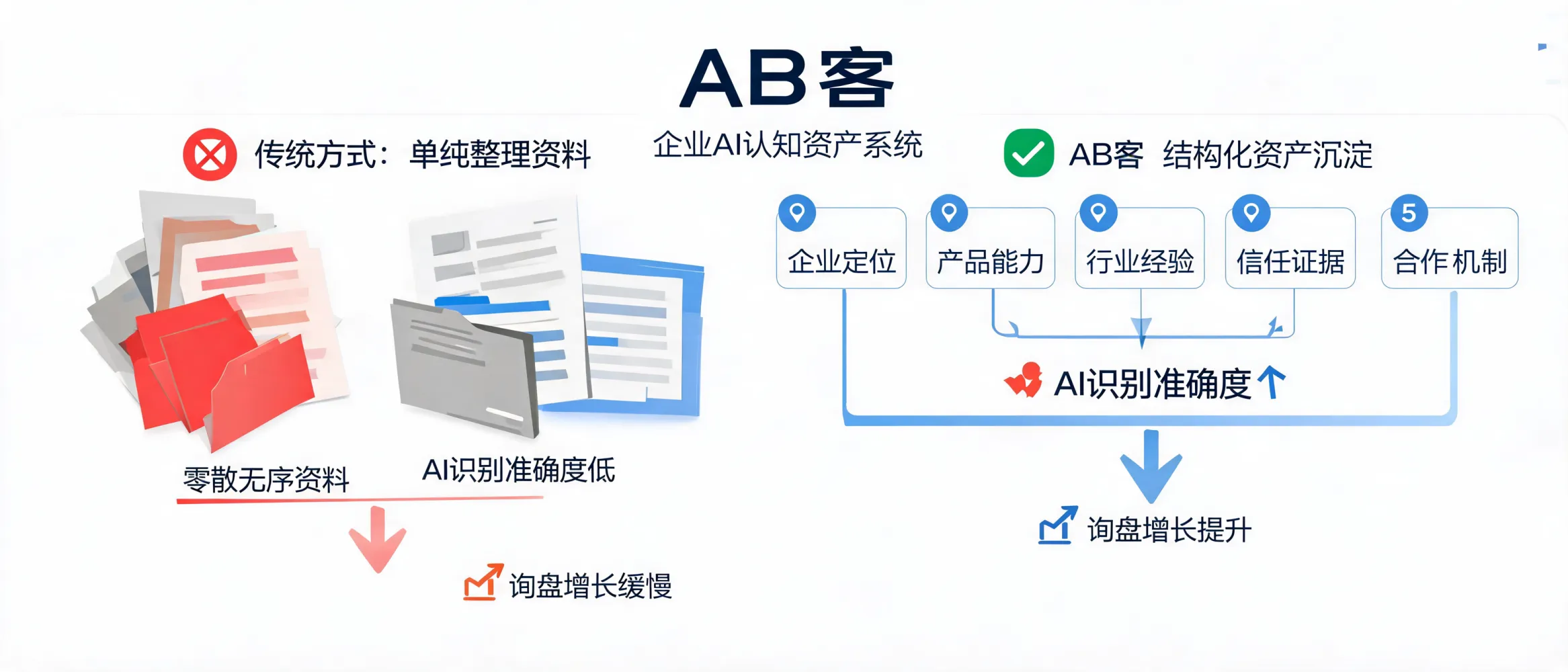
Why the Enterprise AI Cognitive Asset System Is More Than “Just Organizing Files”
Many companies think “organizing materials” means putting the company profile, product brochures, case studies, and certificates into a folder. But ABKE’s Enterprise AI Cognitive Asset System does not simply archive information. It restructures that information into a structured cognitive system that AI can understand, reference, and repeat.
1) It solves “Can AI understand us?” — not just “Do we have information?”
AI search and generative answers do not only recognize keywords. They evaluate whether they can understand:
- Who you are
- What you do
- What kinds of customers you fit
- Why you are credible
- What differentiates you from competitors
If company information is fragmented, AI may misread your positioning, describe your product capabilities too broadly or incorrectly, overlook factory strength, industry experience, and certification evidence, or fail to match your business with buyer questions accurately.
ABKE’s approach is to organize company background, products and services, application scenarios, industry experience, delivery process, trust evidence, and differentiation into a unified structure across the enterprise knowledge base, enterprise digital persona, product capability framework, and trust evidence library. This helps AI form a stable and reusable cognitive framework.
2) How it proves recognition accuracy has improved
The validation is not based on subjective impression. It is based on before-and-after comparison and answer consistency.
a. Before-and-after comparison cases
Before and after the system is built, you can compare whether AI’s responses to your company become more accurate, such as whether it describes:
- Your positioning more accurately
- Your main products more completely
- Your industry attributes more clearly
- Your target customer fit more precisely
- Your trust basis more fully
b. Delivery sample validation
Actual deliverables also show whether the company is readable by AI, including:
- AI-readable company introduction
- Structured product capability pages
- Trust evidence library
- Multilingual basic language assets
- FAQ and knowledge content system
These are not designed only to look polished. They provide stronger and more consistent reference material for AI when it answers related questions.
c. AI answer consistency validation
Another key test is whether AI gives consistent answers to similar questions, for example:
- What industries do you specialize in?
- How are you different from ordinary suppliers?
- What is your delivery and cooperation process?
If the system works, AI answers become closer to the company’s real facts and are less likely to be vague, distorted, or confused.
3) Why it supports future inquiry growth
AI cognitive assets do not directly equal inquiries, but they are a foundation for inquiry growth. In B2B export sales, the buyer journey is usually:
Recognize you → Understand you → Trust you → Contact you
If AI cannot understand your company accurately, the entire growth chain is affected. Your business may struggle to be presented correctly in search results, be recommended in AI answers, gain trust quickly, or convert high-intent traffic through the website.
Once the cognitive asset system is built, your FAQ content, solution pages, website pages, and global content distribution all share the same factual foundation. This helps improve:
- Branded search growth
- Brand appearance rate under key questions
- Conversion from website traffic to inquiries
- Sales communication efficiency
4) ABKE’s validation logic
ABKE does not deliver only “organized materials.” The deliverables are cognitive assets that can be used for ongoing growth, including:
- Enterprise digital persona profile
- Enterprise knowledge base
- Brand positioning expression
- Product capability framework
- Trust evidence library
- AI-readable company introduction
Once these assets are structured, they can be reused across FAQ pages, solution pages, product pages, content centers, and multilingual pages, creating long-term compounding value.
5) How to judge whether the system has real value
If you are evaluating whether to implement this system, focus on three points:
- Whether AI describes your company more accurately
- Whether customers understand your differentiation more easily
- Whether later content and inquiries are built on the same factual base
If all three improve, the system is doing more than organizing files. It is laying the groundwork for GEO visibility and future inquiry growth.
Conclusion
The value of the Enterprise AI Cognitive Asset System is not measured by how many documents are stored, but by whether it turns your company into a AI-readable, referenceable, and trustworthy digital object. Through before-and-after comparisons, delivery samples, and AI answer consistency checks, you can verify whether it truly improves recognition accuracy and supports future inquiry growth.


.png?x-oss-process=image/resize,h_100,m_lfit/format,webp)
.png?x-oss-process=image/resize,h_100,m_lfit/format,webp)

.png?x-oss-process=image/resize,h_100,m_lfit/format,webp)
.png?x-oss-process=image/resize,h_100,m_lfit/format,webp)
.png?x-oss-process=image/resize,h_100,m_lfit/format,webp)
.png?x-oss-process=image/resize,h_100,m_lfit/format,webp)
