Hot Products





Popular articles
Recommended Reading





What exactly does ABKE GEO do for my B2B website—Is it automated by the system or optimized by humans?
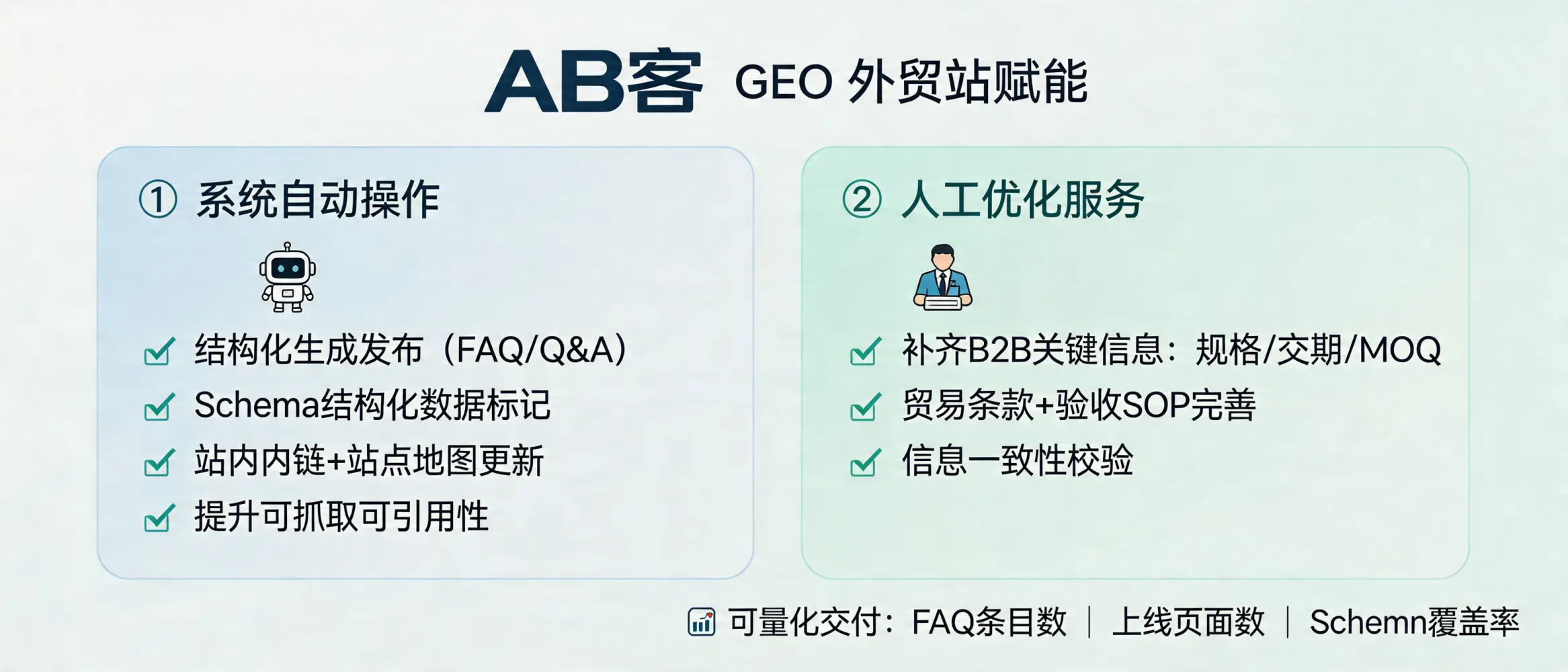
ABKE GEO includes two measurable workstreams: (1) system-side automation that structures and publishes content (FAQ/Q&A blocks, Schema/structured data, internal linking, sitemap updates) to improve AI crawlability and citation; and (2) human-led optimization that fills and verifies B2B procurement-critical information slices (specifications, lead time, MOQ, Incoterms, acceptance SOP) for consistency and decision readiness. Typical deliverables are counted as new/rewritten FAQ entries, pages launched, and Schema coverage rate across pages.
What ABKE GEO actually does (not a generic SEO retainer)
GEO (Generative Engine Optimization) is designed for AI search engines such as ChatGPT, Perplexity, and Google Gemini. The goal is not “ranking for keywords”, but ensuring AI systems can retrieve, understand, and cite your company as a credible answer during B2B supplier selection.
1) System-side work (automation + structured publishing)
ABKE uses a system workflow to convert your existing materials (products, capabilities, processes, policies) into AI-friendly structures and then publishes/updates them on your site.
- FAQ module generation & publishing: creates question-led content blocks aligned with how buyers ask AI (e.g., “How to validate a supplier’s process?”, “What documents are required for export?”).
- Q&A paragraph structuring: rewrites key sections into short, quotable answers that AI systems can extract without ambiguity.
- Schema / structured data markup: implements structured data on relevant pages to increase machine readability (measured as Schema coverage rate by page).
- Internal linking and semantic navigation: builds internal links between product pages, capability pages, and FAQ clusters to strengthen retrieval paths.
- Sitemap & crawl signals maintenance: updates sitemaps and site-level discovery mechanisms so new/updated pages are easier to crawl.
2) Human-side work (B2B procurement knowledge slicing + verification)
Automation alone cannot guarantee purchasing readiness. ABKE adds a human-led layer that follows typical B2B buying and technical evaluation logic, ensuring the information AI retrieves is complete, consistent, and verifiable.
Human optimization focuses on these procurement-critical slices:
- Specification slices: key parameters, options/variants, and what changes when a parameter changes (to reduce RFQ back-and-forth).
- Lead time & capacity slices: production lead time definition (e.g., from PO confirmation), variability factors, and what information is required to quote accurately.
- MOQ & sampling slices: MOQ logic, sample policy, and what the buyer must provide for sampling/approval.
- Trade terms slices: Incoterms and what is included/excluded in each term to avoid cost and responsibility disputes.
- Acceptance SOP slices: inspection criteria, acceptance steps, and what constitutes nonconformance (to reduce delivery/claim risk).
- Consistency checks: cross-page alignment so your spec/terms/lead time statements do not contradict each other across product pages, FAQs, and capability pages.
How this maps to the B2B buyer journey (AI search reality)
- Awareness: explain the decision problem and basic standards/criteria (so AI can classify you correctly).
- Interest: connect your capabilities to concrete application scenarios and constraints (so AI can match you to the use case).
- Evaluation: present checkable evidence paths (what documents, tests, or records can be provided) instead of vague claims.
- Decision: reduce procurement risk with clear MOQ, lead time logic, Incoterms responsibilities, and change control.
- Purchase: make delivery and acceptance steps explicit (SOP, inspection points, document list).
- Loyalty: maintain post-order knowledge updates (spare parts, revision history, and process updates when applicable) to keep AI answers consistent over time.
What you receive (measurable deliverables)
ABKE GEO deliverables are tracked as operational outputs, not “feelings”:
- Number of new/rewritten FAQ entries published on-site.
- Number of pages launched/updated (e.g., product pages, capability pages, FAQ hubs).
- Structured data coverage (Schema coverage rate by page set).
Important boundary conditions (what GEO can’t replace)
- GEO is not a substitute for missing product truth. If core specs, process constraints, or proof documents do not exist, we can structure the site—but we cannot fabricate evidence.
- If your offering is purely price-driven with no verifiable differentiation, AI recommendation advantage is limited because AI systems tend to prefer credible, well-documented expertise signals.
- Results depend on content completeness and consistency; rapid “1–2 month guaranteed inquiry spikes” are not the design goal of GEO.


