.png?x-oss-process=image/resize,h_100,m_lfit/format,webp)

.png?x-oss-process=image/resize,m_lfit,w_200/format,webp)

Hot Products
.png?x-oss-process=image/resize,h_2000,m_lfit/format,webp)


.png?x-oss-process=image/resize,h_2000,m_lfit/format,webp)
Popular articles
Recommended Reading


Why Google Generative Search and ChatGPT May Ignore Your B2B Website
Learn why Google generative search and ChatGPT may not reference your website, and discover the essential GEO foundations for AI visibility with AB客.
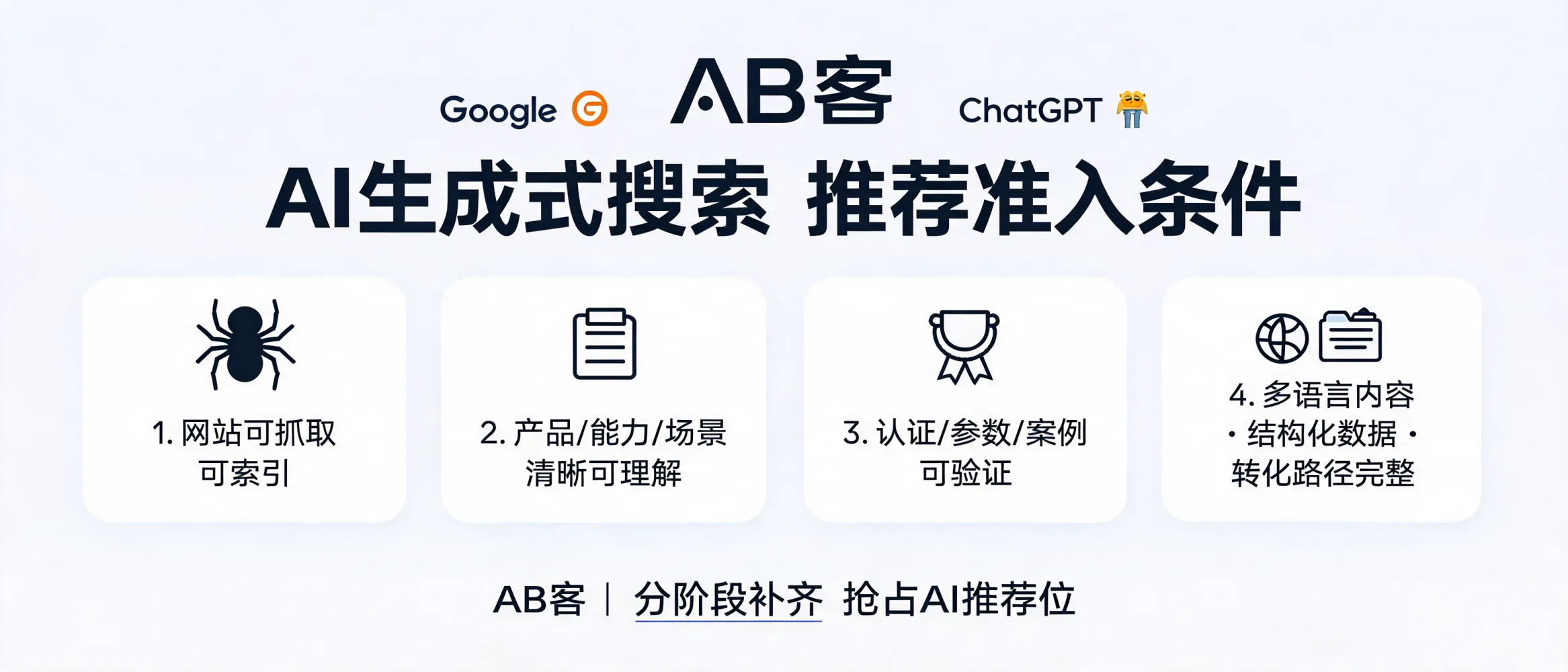
Google Generative Search, ChatGPT, and similar AI question-answering products do not automatically cite or recommend a business simply because it has launched a website. AI systems typically identify company information from public webpages and multiple information sources, then assess whether that information is clear, relevant, trustworthy, and verifiable.
Platform crawling coverage, retrieval mechanisms, model policies, and answer-generation methods continue to change. Therefore, no service can guarantee that a company will be cited or recommended by a specific AI platform.
Four foundational capabilities for stronger AI visibility
1. A website that can be crawled and indexed
A website should provide stable access and a clear information architecture. Important product pages, solution pages, industry application pages, and FAQ pages should be discoverable by search engines. If pages are blocked by technical settings, rely heavily on images or scripts, or use a confusing link structure, AI and search systems may struggle to obtain useful information.
2. Products, capabilities, and use cases that can be understood accurately
A B2B website should not rely only on broad claims such as “high quality” or “professional supplier.” It should clearly explain:
- Which products the company sells
- Which industries or operating conditions those products serve
- Key specifications and materials
- Manufacturing or delivery capabilities
- Which procurement problems the company can address
Information frequently requested by overseas buyers—such as MOQ, certifications, customization scope, lead times, packaging, testing standards, and after-sales support—should also be presented in clear, reusable content.
3. Verifiable evidence, including certifications, parameters, and cases
AI-generated answers are more likely to use information supported by facts. Companies can systematically organize product specifications, test reports, certifications, process descriptions, project cases, customer applications, delivery processes, and frequently asked questions. They should avoid exaggerated, inconsistent, or unverifiable claims. The more consistent the information is, the stronger the foundation for the business to be understood correctly.
4. Complete multilingual content, structured data, and conversion paths
For international markets, English and target-language content should remain consistent with the company’s actual capabilities. Schema structured data, standardized page titles and descriptions, product attributes, FAQs, and breadcrumb navigation can help search systems identify page types and entity relationships.
A website should also provide clear paths for enquiries, contact details, sample requests, or document downloads, so that visits can be properly converted into potential business opportunities.
Key evaluation indicators
Export-oriented B2B companies can focus on the following indicators:
- Whether core pages are indexed
- Whether product and application-scenario content is complete
- Whether key facts are supported by evidence
- Whether multilingual pages are accurate
- Whether Schema structured data is valid
- Whether website visits, user behavior, enquiries, and business feedback continue to improve
AB客’s export B2B GEO growth engine generally begins with a business diagnosis. It organizes dispersed product, technical, case-study, and FAQ materials into structured enterprise knowledge, then uses GEO websites, professional content, multilingual pages, and data review to improve the foundation for a company to be searched, understood, cited, and trusted in stages. The objective is not to promise placement in a specific AI answer, but to help businesses build sustainable digital knowledge and customer-acquisition assets.


.png?x-oss-process=image/resize,h_100,m_lfit/format,webp)
.png?x-oss-process=image/resize,h_100,m_lfit/format,webp)

.png?x-oss-process=image/resize,h_100,m_lfit/format,webp)
.png?x-oss-process=image/resize,h_100,m_lfit/format,webp)
.png?x-oss-process=image/resize,h_100,m_lfit/format,webp)
.png?x-oss-process=image/resize,h_100,m_lfit/format,webp)
