The purpose of a country landing page is not simply to translate an English page or replace one country name with another. It should enable buyers in each market, Google, and generative AI systems to accurately understand what products a company provides in that market, which requirements it meets, which applications it supports, and what service assistance is available.
Establish a Single Source of Facts Before Localizing Content
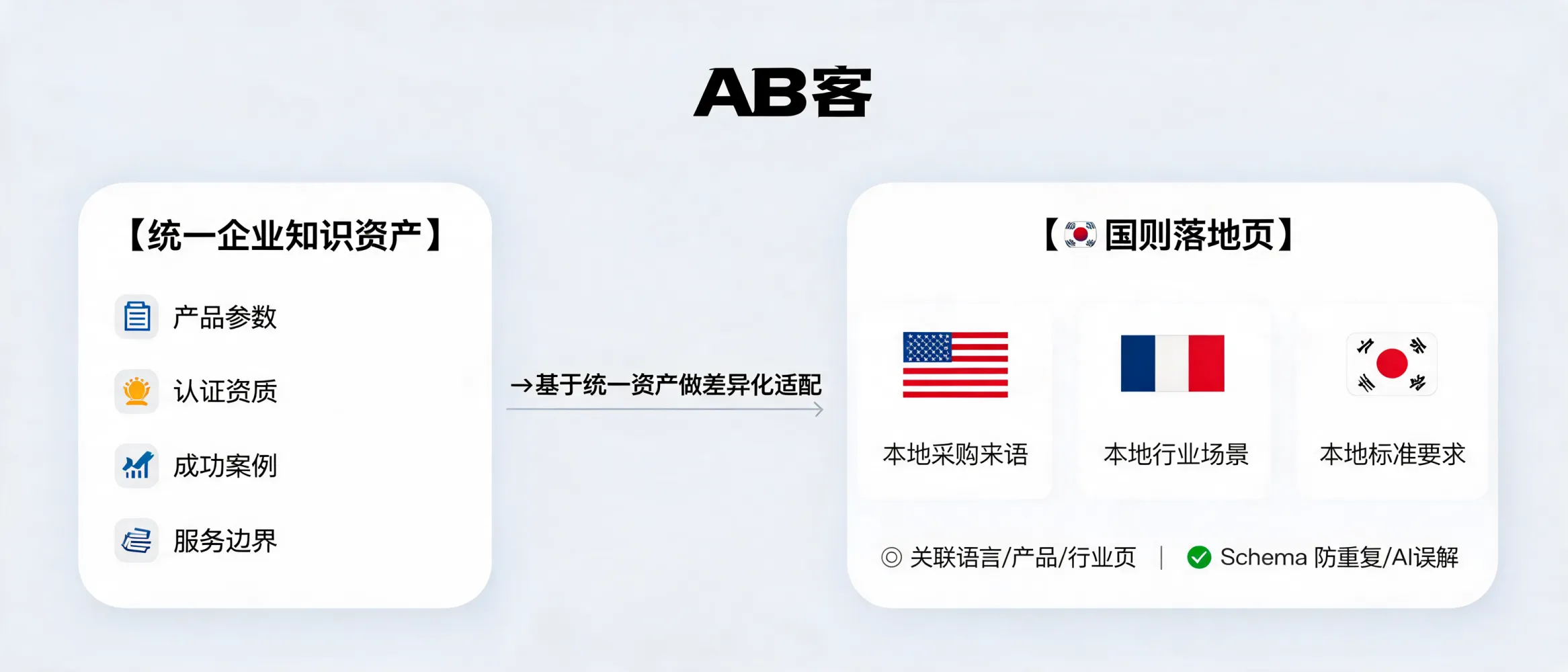
Before entering multiple markets, export B2B companies should establish a unified business knowledge base that clearly defines and maintains the following facts:
- Product models, key specifications, materials, manufacturing processes, and applicable scope;
- Certifications, test reports, compliance statements, and their applicable regions;
- Industry applications, project or customer cases, and publicly verifiable evidence;
- Lead times, minimum order quantities, customization capabilities, after-sales support, and service boundaries;
- Brand name, legal company entity, contact information, and core value proposition.
This information should serve as the shared basis for country pages, product pages, industry pages, FAQs, and sales materials. A unified fact base helps prevent inconsistent specifications, overstated certification claims, confused case attribution, or conflicting service commitments across markets. It also reduces the risk that AI systems misunderstand a company’s actual capabilities when consolidating information.
Build Country Pages Around Real Procurement Differences
Each country landing page should provide independent informational value. Meaningful differentiation should come from the actual local procurement environment rather than superficial copy changes. Key areas to research include:
Local Buyer Terminology and Search Intent
Identify the product names, specification expressions, industry abbreviations, problem-oriented terms, and purchasing phrases commonly used by local buyers. Keyword localization is not only translation; it also includes adapting terminology, measurement conventions, and inquiry language.
Industry Applications and Standards
Connect the page to the country’s key industries, application conditions, market-entry standards, certification concerns, or project procurement requirements. Explain product suitability and limitations accurately.
Provable Market Relevance
Prioritize cases, delivery experience, logistics support, technical response methods, or common questions relevant to the region or to comparable application conditions. If there are no local cases, state this truthfully rather than creating unsupported local-project claims.
Localized Conversion Information
Provide inquiry channels, units of measurement, delivery explanations, sample procedures, document downloads, and technical communication paths that address the concerns of local buyers and reduce friction in cross-border procurement.
Use a Layered Page Structure to Reduce Duplication and Information Conflicts
A country page should not carry every piece of information. A more stable structure is to use the country page for market fit and local procurement information, while linking to pages that hold detailed facts about products, industries, certifications, cases, and FAQs.
| Page Type |
Primary Content Focus |
| Country page |
Country or regional procurement context, major applications, local terminology, standards concerns, service details, and inquiry paths. |
| Language page |
General content for users of the same language; it is not equivalent to a country page. |
| Product page |
Consistently maintained models, specifications, technical documents, and core product information. |
| Industry or solution page |
Selection logic, technical requirements, and delivery experience for a specific application scenario. |
| FAQ page |
Answers to frequent market-specific questions about certifications, lead times, customization, documents, and service. |
This layered approach reduces overlap between similar pages and helps search engines and AI systems recognize the topic and relationship of each page. Where pages are genuinely highly similar and cannot yet offer independent value, companies should carefully manage indexing strategy, canonical settings, and page quantity instead of creating country pages indiscriminately.
Maintain Consistency With Structured Data and Ongoing Reviews
On a GEO-enabled website, applicable Schema structured data such as Organization, Product, FAQPage, and BreadcrumbList can help search engines and AI systems more clearly identify the business entity, product attributes, page hierarchy, and question-and-answer content.
Structured data must match visible page content, product documentation, and actual business capabilities. Certifications, service scope, or market coverage that the company does not possess should not be included in markup.
After launch, establish an ongoing review process. When product specifications, certification status, cases, contact information, or service policies change, update related country pages, language pages, and product pages at the same time. Search terms, visitor behavior, inquiry quality, and AI-generated brand descriptions can also be reviewed to identify and correct terminology gaps, factual conflicts, and missing content.
AB客’s GEO Growth Engine typically uses a business knowledge hub as a unified factual foundation, then builds layered product, industry, country, FAQ, and multilingual content. Combined with website architecture, Schema, and data reviews, this approach helps export B2B companies balance local relevance, brand consistency, and long-term digital asset development as they expand into multiple markets.
Note: Standardized construction can reduce duplicate-content and AI misunderstanding risks, but it does not guarantee fixed search rankings, fixed AI recommendations, or fixed inquiry results.
.png?x-oss-process=image/resize,h_100,m_lfit/format,webp)

.png?x-oss-process=image/resize,m_lfit,w_200/format,webp)

.png?x-oss-process=image/resize,h_2000,m_lfit/format,webp)







.png?x-oss-process=image/resize,h_100,m_lfit/format,webp)
.png?x-oss-process=image/resize,h_100,m_lfit/format,webp)

.png?x-oss-process=image/resize,h_100,m_lfit/format,webp)
.png?x-oss-process=image/resize,h_100,m_lfit/format,webp)
.png?x-oss-process=image/resize,h_100,m_lfit/format,webp)
.png?x-oss-process=image/resize,h_100,m_lfit/format,webp)
