Hot Products





Popular articles
工业自动化企业GEO落地指南:让海外采购商看懂技术、验证能力、发起询盘
第 140 届广交会正在发生什么变化?外贸 B2B 必须注意的 6 件事
广交会前48小时怎么做GEO?用7项优先级清单完善官网与询盘入口
广交会后五金工具企业GEO指南:用采购决策内容减少单纯比价
Recommended Reading


How Can a Small-Sample Review Validate Customs Data Buyer Leads Before Purchase?
ABKE explains how to test customs data buyer leads through stratified sampling, manual verification, traceable evidence and cost analysis before scaling your purchase.
What should a small-scale trial validate?
A small-scale trial should determine whether customs data helps sales teams identify buyers with sufficient evidence to justify further research—not simply whether it produces a large list. Assess business fit, evidence reliability and the cost of manual review together. Historical import records do not establish current purchasing intent.
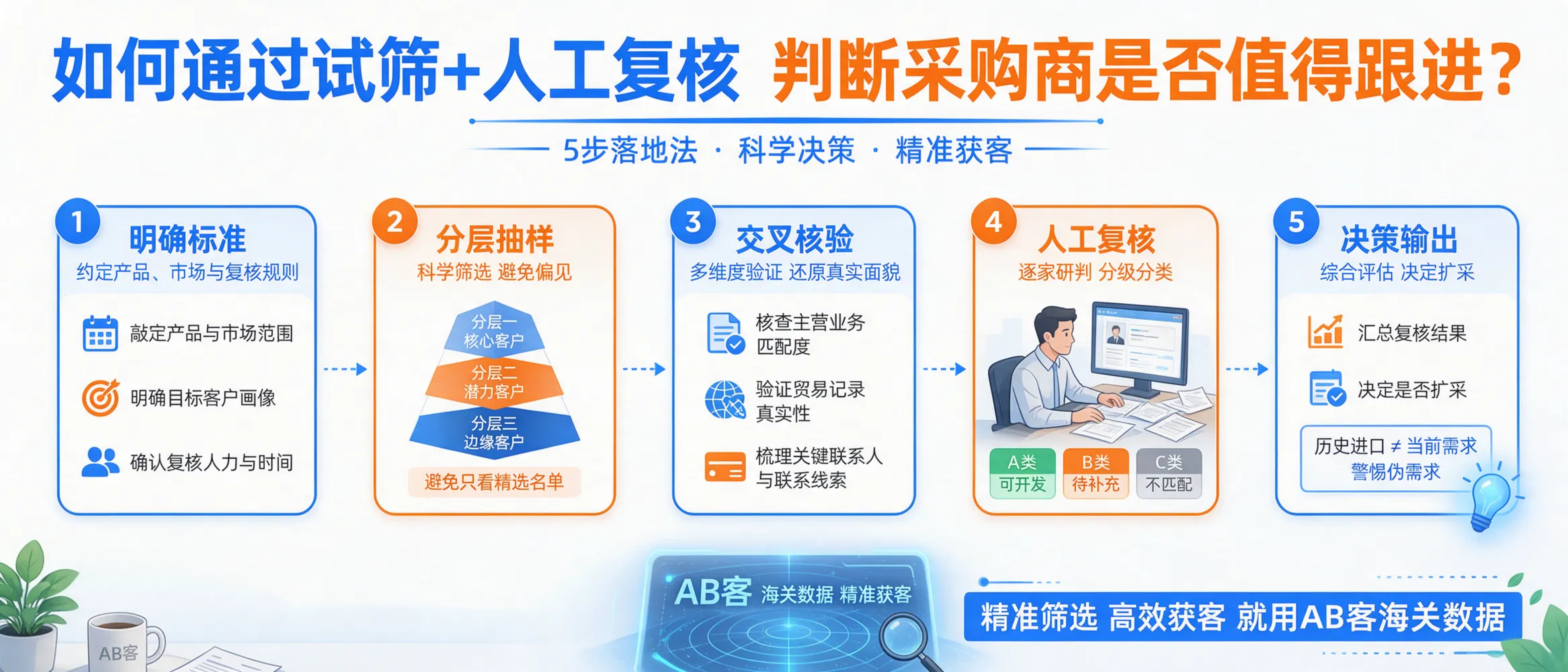
1. Agree on screening and acceptance criteria
Define the priority products, applications, target countries and customer types, along with the businesses to exclude. Product keywords and HS codes are initial screening tools only. Check trade descriptions and each company’s core business to avoid including unrelated products classified under the same code.
Before the trial, both parties should agree on:
- Data coverage, record dates and available fields.
- Sample size and the personnel responsible for reviewing it.
- Acceptance criteria for judging the results.
Choose a sample size that the sales team can review company by company. There is no single sample size suitable for every trial.
2. Use stratified sampling to avoid cherry-picked results
Draw the sample from the complete trial screening results generated under the agreed conditions, rather than accepting only the provider’s selected success cases.
Group results by country, record recency, preliminary fit and information completeness, then select randomly within those groups. Include a small number of borderline cases to investigate why unsuitable companies pass the initial screening.
The findings apply only to the scope tested. They should not be directly extrapolated to all markets.
3. Cross-check each company and document the evidence
- Business fit: Review the company’s website, product catalog and application areas to establish whether it is a target buyer, a distributor or an unrelated entity.
- Trade relevance: Check record dates, product descriptions and identifiable trading relationships. Distinguish relevant product imports from occasional or weakly related transactions.
- Contact feasibility: Verify the official website and lawfully available business contact channels. An email address is not necessarily valid, and its availability does not mean it can be used for unrestricted marketing.
For each company, record its name, source links, lookup date, key evidence, missing information, decision rationale, reviewer and review time. Have a designated person reassess cases where reviewers disagree.
4. Classify reviewed buyers into three groups
- Worth pursuing: The business is relevant, the evidence is verifiable, and the company meets the conditions for further research or compliant outreach. This classification does not indicate confirmed purchasing demand.
- Needs more information: Relevant signals exist, but the company’s identity, product applications or contact details still require confirmation.
- Unsuitable: The business is unrelated, the entity is incorrect, the record is a duplicate, or key evidence is insufficient to justify further sales development.
5. Decide whether to scale based on quality and cost
Consolidate the trial results using these measures:
- The proportion of reviewed buyers classified as worth pursuing.
- The proportion requiring more information.
- Reasons for classifying buyers as unsuitable.
- The proportion with traceable sources.
- Review time per company and total cost per buyer classified as worth pursuing.
State the denominator for every proportion. Do not calculate results using only samples with complete information.
If business fit meets the pre-agreed criteria and verification costs are acceptable, expand the purchase in batches. Otherwise, adjust the target customer profile or data source and run another trial.
ABKE can support this buyer discovery workflow by combining customs records, company information and CRM feedback, subject to the agreed project scope. AI scores cannot replace human judgment and do not constitute predictions of conversion probability.


