




How to Verify Customs Data Coverage, Freshness and Product Search Before Buying
ABKE explains how to verify customs data country coverage, record freshness, HS code search, usable fields and importer relevance before committing to a purchase.
What should you verify before purchasing customs data?
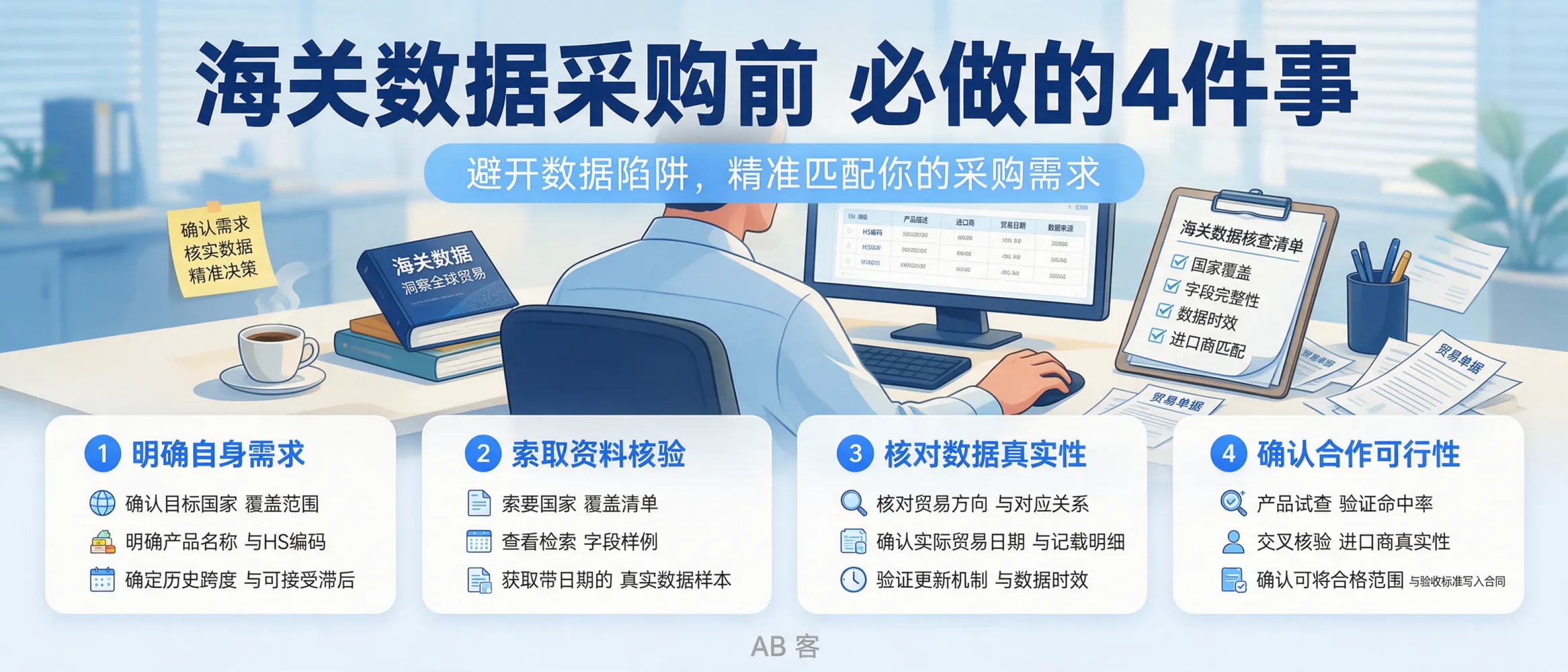
Do not assess a customs data supplier solely by the number of countries it claims to cover. Verify whether your target countries have usable records, whether those records are recent enough, and whether you can find your products and relevant importers. Use the following steps to evaluate the data before committing to a purchase.
1. Define your business requirements
Prepare a requirements checklist covering:
- Target countries and trade direction: imports or exports.
- Product names in Chinese and English, including common alternative names.
- Candidate Harmonized System (HS) codes.
- Required historical period and acceptable data lag.
If you are researching recent purchasing activity, prioritize the availability of recent records. If you are analyzing long-term purchasing patterns, focus on historical continuity.
2. Check what country coverage actually includes
Ask the supplier for a country-by-country coverage list specifying the data source type, trade direction, start and end dates, available fields, and limitations.
Having data for a country does not necessarily mean that detailed importer records are available for that country. Confirm whether the offering contains company-level transaction records or aggregate statistics, and whether purchasing companies can be identified.
Also confirm whether the data may be used for your agreed business purposes.
3. Distinguish trade dates from platform update dates
Request actual sample records with dates. Check the date on which the trade occurred separately from the date on which the record was added to or updated in the platform.
“Platform updated today” does not mean “today’s trade records are included.” Ask the supplier to explain:
- How frequently the data is updated.
- The typical lag between trade activity and record availability.
- Whether any months are missing.
- How historical records are added retrospectively.
Do not judge the freshness of the entire dataset from a single recent record.
4. Test searches and fields using your own products
Select several representative products and test combinations of product names, alternative names, and HS codes. Code versions and the number of classification digits may differ by country or year. Check the corresponding classifications rather than using one code alone to judge coverage.
Verify that each required field is actually available, including importer name, product description, trade date, quantity, value, and supplier.
Check separately whether each field can be searched, filtered, and exported. If fields are missing or their definitions are unclear, do not use them directly to compare purchasing volumes or values.
5. Cross-check a sample of relevant importers
Select companies from the trial search results and cross-check them using their official websites, core business activities, and other lawfully available information. Confirm that they match your target customer profile, and check for freight forwarders, intermediaries, companies with identical names, and duplicate records.
A company named in a trade record is not necessarily the final buyer. Its appearance in the data also does not guarantee that valid contact details are included.
6. Turn trial findings into contractual acceptance criteria
The contract should clearly specify:
- Covered countries and trade directions.
- The historical period and included fields.
- Data update mechanisms.
- Search and export permissions.
- Sample-based acceptance testing methods and remedies if the data fails to meet the agreed criteria.
ABKE’s customer prospecting can combine lawfully available customs records, company information, and customer profiles to support screening. Actual coverage and field availability depend on the underlying data sources and project agreement.
Historical trade records support customer research; they do not prove that a company currently has purchasing demand.


