Hot Products





Popular articles
汽车企业广交会展后如何做好GEO?用30天完善海外采购商评估所需信息
广交会展前指南:用3个AI买家问题检查外贸官网,明确优先修补项
广交会客户筛选实操指南:用6个问题识别采购需求,推动有效RFQ
Recommended Reading

How Can Export Teams Distinguish Poor Customer Fit from Outreach Problems in a New Market?
ABKE explains how export teams can diagnose low prospect response by checking customer fit, contact accuracy, delivery, messaging and follow-up before changing their ICP.
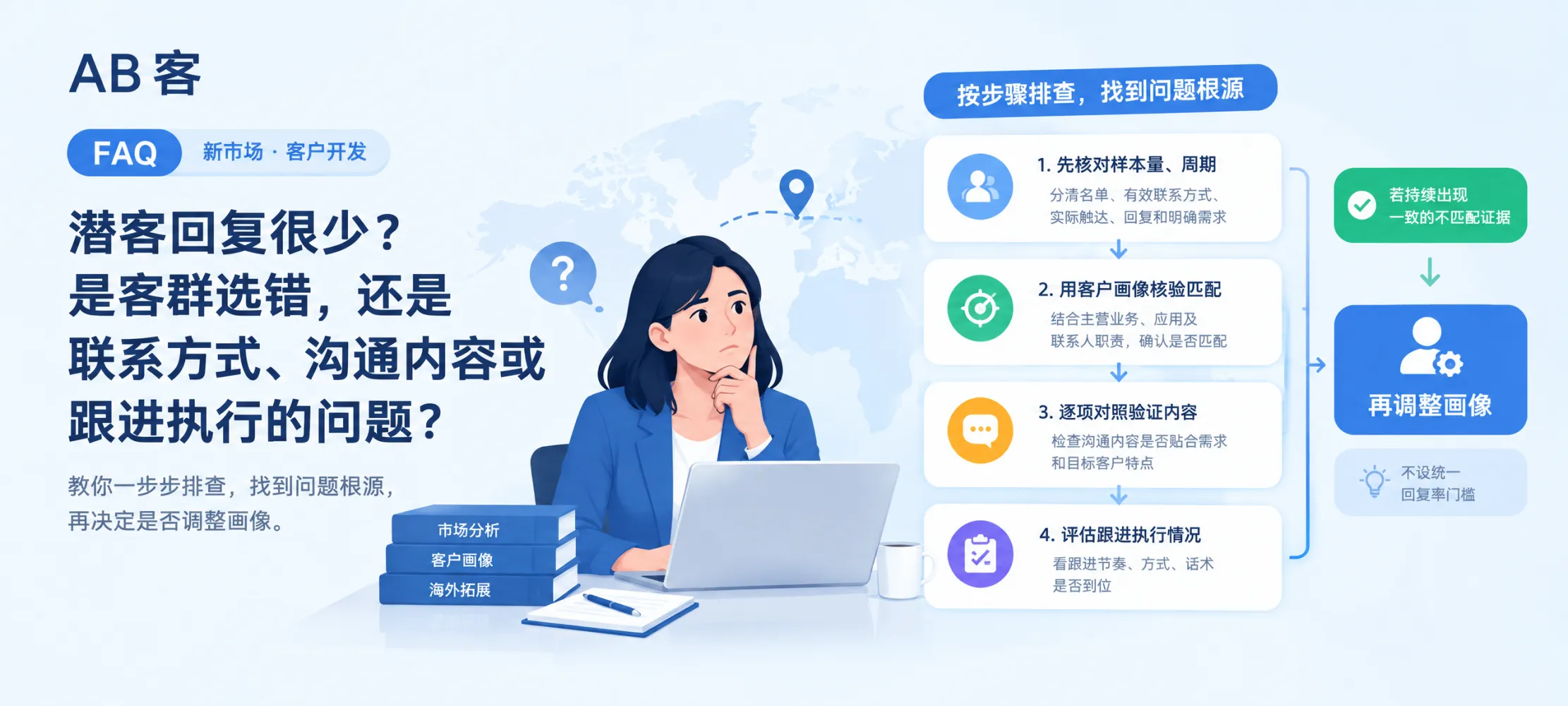
Low Response Does Not Necessarily Mean the Customer Profile Is Wrong
When an export team enters a new country, low prospect response can stem from customer fit, contact accuracy, channels, messaging or execution. Identify where prospects are being lost in the outreach process before changing the ideal customer profile (ICP). Undelivered emails or outreach to the wrong person should not be mistaken for a lack of market demand.
1. Establish Consistent Measurement Definitions
For each prospecting batch, record the following separately:
- Number of target companies.
- Number of valid contact details.
- Number of contact attempts actually made.
- Number of confirmed deliveries or connected calls.
- Number of companies that replied.
- Number of confirmed needs.
Deduplicate companies and individual contacts separately, and record the channel and date for each activity.
Assess sample size and the observation period in light of local holidays, purchasing cycles and the planned follow-up cadence. Analyze channels separately rather than applying a universal response-rate threshold.
A sent email is not necessarily a delivered email. An open-tracking record alone also does not prove that the recipient has read the message.
2. Verify Company Fit and Contact Fit Separately
- Company fit: Do the company’s main business, product applications, and purchasing or distribution role match the ICP? Check its official website. Historical customs records can support research, but they do not establish current demand.
- Contact fit: Is the person still employed there, and does their role involve procurement, technical selection or supplier evaluation? If the company fits but the contact does not, correct the contact first.
- Evidence reliability: Cross-check the official website against other available sources. Flag missing, outdated or contradictory information rather than relying solely on an AI-generated score.
3. Use Single-Factor Comparisons to Locate the Problem
Compare prospect groups with similar conditions. In each round, change only one factor where possible, keeping the other conditions as consistent as practical.
| Observed Pattern | Priority Check |
|---|---|
| Many invalid addresses or bounced emails | Contact details and sending configuration |
| Companies fit the profile, but contacts frequently refer you to someone else | Contact responsibilities |
| Delivery is normal, but different messages produce noticeably different responses | Value proposition, supporting evidence and call to action |
| Planned follow-ups are missing after the first contact | Sales execution |
| Verification shows that multiple companies do not use the product or have an incompatible purchasing model | Customer profile criteria |
Outreach and follow-up must comply with local laws and platform rules. Increasing sending volume is not a substitute for diagnosing the problem.
4. Adjust the ICP Only When Consistent Evidence Supports It
After verifying prospect information, allowing a reasonable observation period and completing planned follow-ups, revise the relevant ICP criteria only if multiple independent prospects consistently provide evidence of a mismatch. Examples include:
- The product is unsuitable for their application.
- The assumed purchasing entity or buyer role is incorrect.
- Required qualifications or certifications cannot be met.
Silence, no immediate purchasing plans or an existing supplier relationship is not, on its own, sufficient evidence to reject a customer segment. Prioritize correcting criteria that have been shown to be wrong, and retain the original batch for comparison.
ABKE’s prospecting capabilities can support reviews through customer background research, profile matching and CRM records; specific integration depends on the project configuration. Manage prospect scores separately from needs confirmed by sales so that ICP changes reflect actual feedback—not list size or a low response rate alone.


