Hot Products





Recommended Reading

How ABKE Ensures GEO Content Is Accurate, AI-Readable, and Conversion-Focused
Learn how ABKE creates fact-checked, AI-readable B2B content from verified product data and buyer questions to support Google indexing, trust, and overseas inquiry conversion.
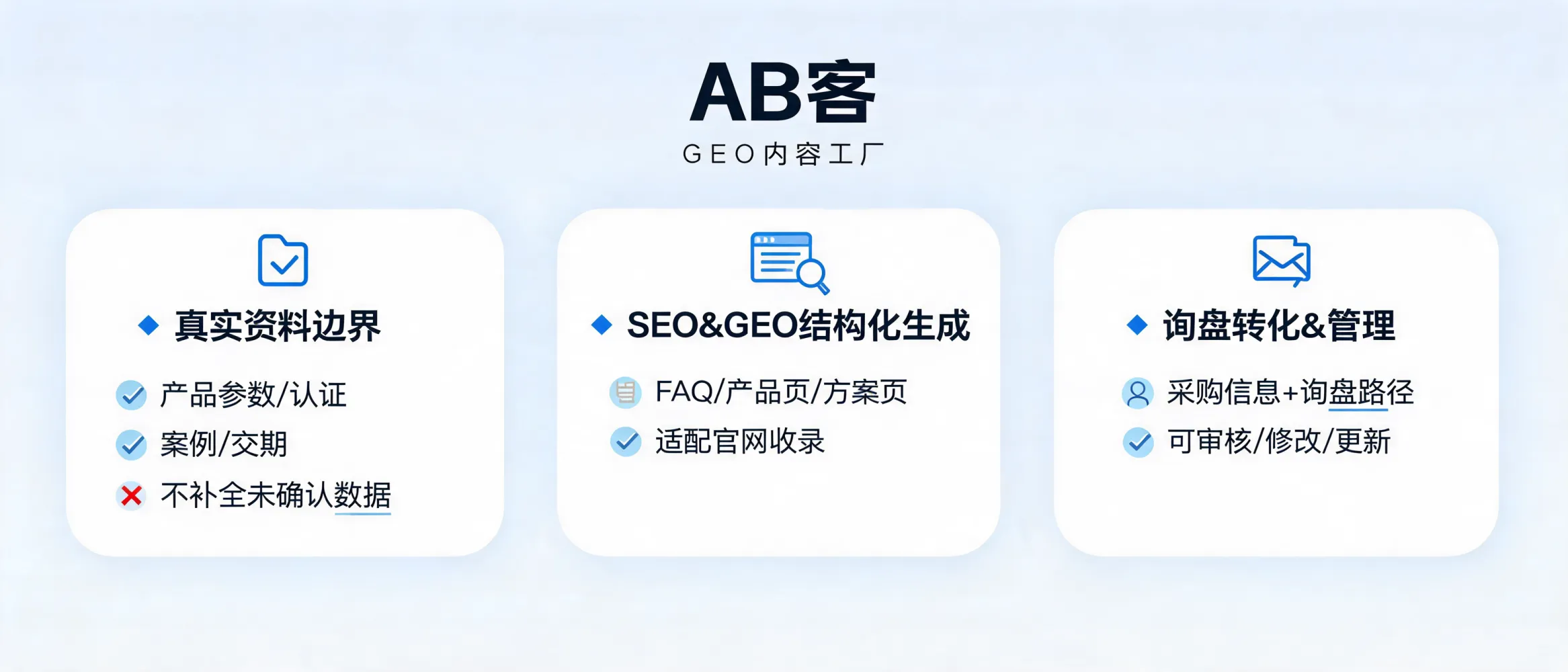
ABKE GEO Content Factory does not automatically fill content with generic materials or unsupported claims. It uses an enterprise’s confirmed knowledge base and overseas buyer question library as the production boundary. The objective is to keep information factual and verifiable while supporting AI understanding, Google indexing, and overseas B2B inquiry conversion.
1. Establishing fact boundaries before content creation
Before content is generated, ABKE structures confirmed enterprise materials, including product specifications, materials and processes, certifications, applicable scenarios, production and quality-control capabilities, project cases, MOQ, lead times, customization conditions, and cooperation procedures.
Only verified information can enter the content library. Where data is missing, uncertain, or cannot be validated, the system does not infer or add it independently. This approach helps reduce common risks in export marketing content, such as overstated specifications, inappropriate use of certifications, or inconsistent delivery commitments, while keeping website pages, sales materials, and external-channel information aligned.
2. Organizing content around buyer questions, not only company descriptions
ABKE matches verified enterprise facts with the questions overseas buyers ask during procurement. Content can address product selection, technical requirements, quality standards, customization capability, delivery risk, and supplier evaluation through FAQ pages, product pages, solution pages, procurement guides, and application-focused content.
Each content type can be traced back to relevant enterprise materials and buyer decision needs. For example, a product page does more than state what a product is. It can clarify applicable scenarios, key specifications, available certification or testing evidence, customization scope, and a procurement contact route, helping buyers complete an initial evaluation more efficiently.
3. Applying content structures for both SEO and GEO
ABKE organizes content according to SEO and GEO requirements so that it can be understood by AI systems, crawled and indexed by search engines, and used by B2B buyers in their evaluation process.
- Clear questions, conclusions, specification details, and scenario explanations improve AI semantic understanding and the accuracy of potential content citation.
- Topic hierarchy, internal links, FAQ structures, and Schema structured data support search-engine crawling, indexing, and long-tail keyword coverage.
- Trust evidence—including certifications, project cases, factory capabilities, and delivery procedures—is placed on relevant pages instead of being limited to broad brand statements.
4. Connecting content with B2B inquiry conversion paths
For overseas B2B procurement, content needs to support both visibility and action. Based on page intent, ABKE can configure inquiry routes such as product-document downloads, quotation forms, email, and WhatsApp contact options. CRM processes can then record lead sources, buyer behavior, and follow-up status.
Content performance can therefore be assessed across multiple levels: page indexing and keyword coverage, AI mention and citation performance, as well as form submissions, document downloads, qualified inquiries, and high-intent business opportunities.
5. Maintaining accuracy through review and continuous updates
Businesses can review, revise, and supplement generated content. When products are upgraded, certifications are renewed, cases are added, or market priorities change, the knowledge base and relevant pages can be updated together.
Through its delivery model of AI growth systems, AI agents, and professional human collaboration, ABKE helps manufacturers keep their content assets accurate, usable, and reusable as real business information evolves.


