.png?x-oss-process=image/resize,h_100,m_lfit/format,webp)

.png?x-oss-process=image/resize,m_lfit,w_200/format,webp)

Hot Products


.png?x-oss-process=image/resize,h_2000,m_lfit/format,webp)
Popular articles
Recommended Reading

How Does ABKE Prevent Errors and Overclaims in GEO Content?
Learn how ABKE uses verified enterprise knowledge, parameter validation, review workflows, and evidence-based boundaries to keep GEO-generated product pages, FAQs, and solutions accurate.
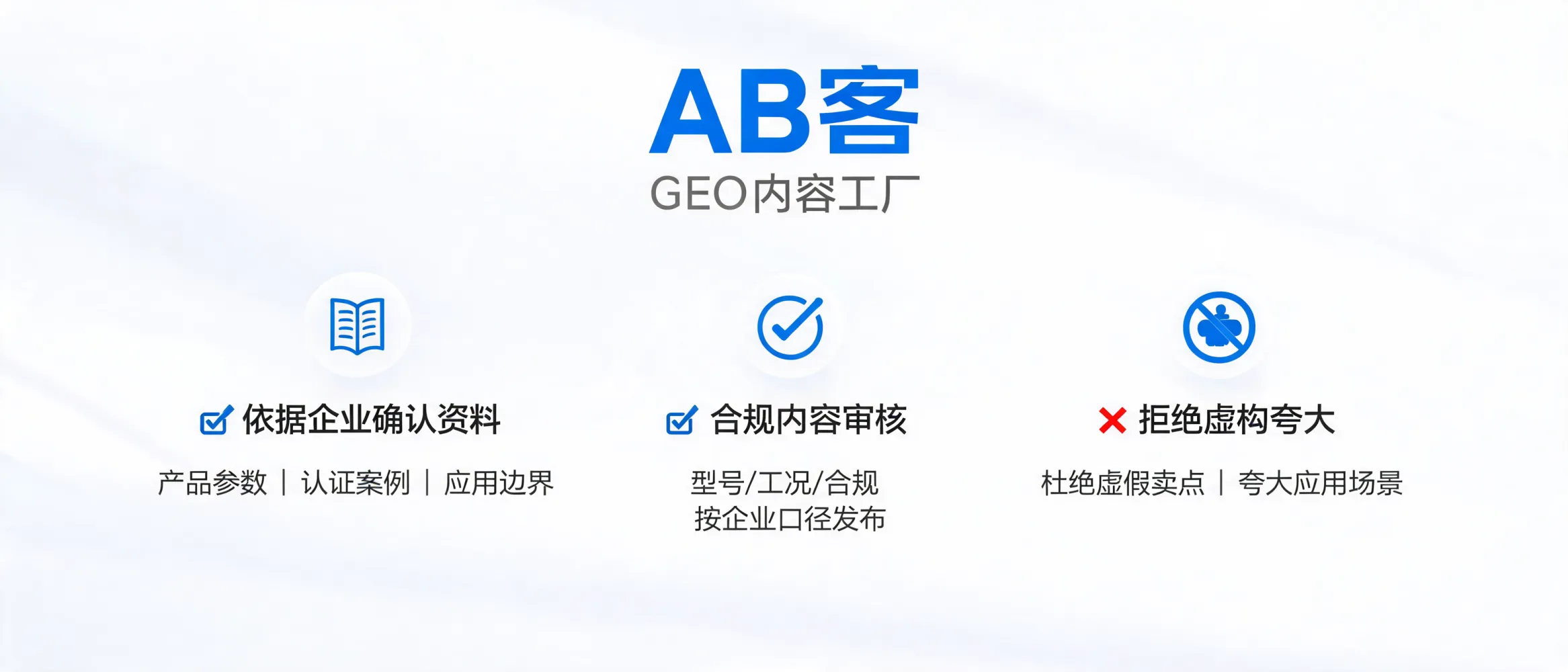
ABKE’s GEO Content Factory does not rely on a general model to generate content freely. It uses enterprise-confirmed knowledge assets and buyer-question libraries to establish a content production process in which facts have sources, statements have boundaries, and publication can be reviewed. The purpose is to scale product pages, FAQs, and solution content while keeping it aligned with the company’s actual capabilities, product documentation, and market commitments.
1. Enterprise-Confirmed Information as the Source of Facts
Content generation prioritizes information that has been organized and confirmed in the enterprise knowledge base, including:
- Product models, specifications, materials, dimensions, performance parameters, and optional configurations;
- Certifications, testing, quality-control, and compliance information;
- Factory capabilities, delivery processes, customization scope, and service conditions;
- Verified project cases, customer applications, and industry experience;
- Applicable operating conditions, usage limitations, and unsuitable application scenarios.
This means product selling points, technical explanations, and application descriptions should be based on information the enterprise can substantiate, rather than on generic industry language used in place of real capabilities.
2. Review Boundaries for High-Risk Information
Model relationships, performance indicators, certification status, lead times, operating-condition compatibility, and compliance commitments directly affect overseas buyers’ purchasing decisions and are also among the areas most likely to cause misunderstanding. ABKE recommends a pre-publication review based on the enterprise’s confirmed wording, with particular attention to the following:
- Whether parameters correspond to a specific model or configuration, so that optional parameters are not presented as standard configurations;
- Whether certifications are genuine, valid, and applicable to the relevant product or target market, avoiding an expanded certification scope;
- Whether performance statements are supported by testing, cases, or technical documentation, avoiding absolute claims;
- Whether application scenarios match actual operating conditions, avoiding the generalization of a limited case into suitability for an entire industry;
- Whether technical terminology and multilingual wording are accurate, avoiding translation-related deviations in specifications, standards, or responsibility boundaries.
3. Defining Capability Boundaries Instead of Using Exaggerated Claims
High-quality GEO content should explain not only what an enterprise can do, but also under what conditions it can do it. For example, customization capability, temperature resistance, load capacity, delivery time, or industry suitability should be described together with the relevant model, configuration conditions, test basis, or requirements that need further confirmation.
This approach helps prevent a single project experience, a specific product configuration, or a capability in one market from being presented as a universal commitment. It also enables AI systems and buyers to understand the enterprise’s actual supply scope more accurately.
4. Ongoing Review and Version Updates
Product details, certifications, cases, and market strategies change over time. Content accuracy is therefore not a one-time task. Through the enterprise knowledge base, FAQ framework, and ongoing optimization process, ABKE can iterate content when parameters become outdated, models are updated, certifications are added, or new buyer questions emerge. Priority can be given to rebuilding pages with high traffic, high inquiry volume, or greater information risk.
When evaluating content reliability, enterprises can focus on three standards:
- Whether there is a clear source for each material fact;
- Whether sensitive statements have been confirmed by business or technical teams;
- Whether related pages can be updated when source information changes.
ABKE combines an AI growth system, AI agents, and professional human collaboration to support both content-production efficiency and consistency with enterprise facts. The result is not isolated batch-written copy, but enterprise content assets that can be understood by AI, indexed by search engines, reused by sales teams, and verified by buyers.


.png?x-oss-process=image/resize,h_100,m_lfit/format,webp)
.png?x-oss-process=image/resize,h_100,m_lfit/format,webp)

.png?x-oss-process=image/resize,h_100,m_lfit/format,webp)
.png?x-oss-process=image/resize,h_100,m_lfit/format,webp)
.png?x-oss-process=image/resize,h_100,m_lfit/format,webp)
.png?x-oss-process=image/resize,h_100,m_lfit/format,webp)
