Hot Products





Popular articles
Recommended Reading

How ABKE Creates Professional GEO Content Without Requiring Experts to Write Continuously
Learn how ABKE transforms product documents, technical files, and sales FAQs into a structured knowledge base for scalable, accurate SEO and GEO content without requiring internal experts to write every article.
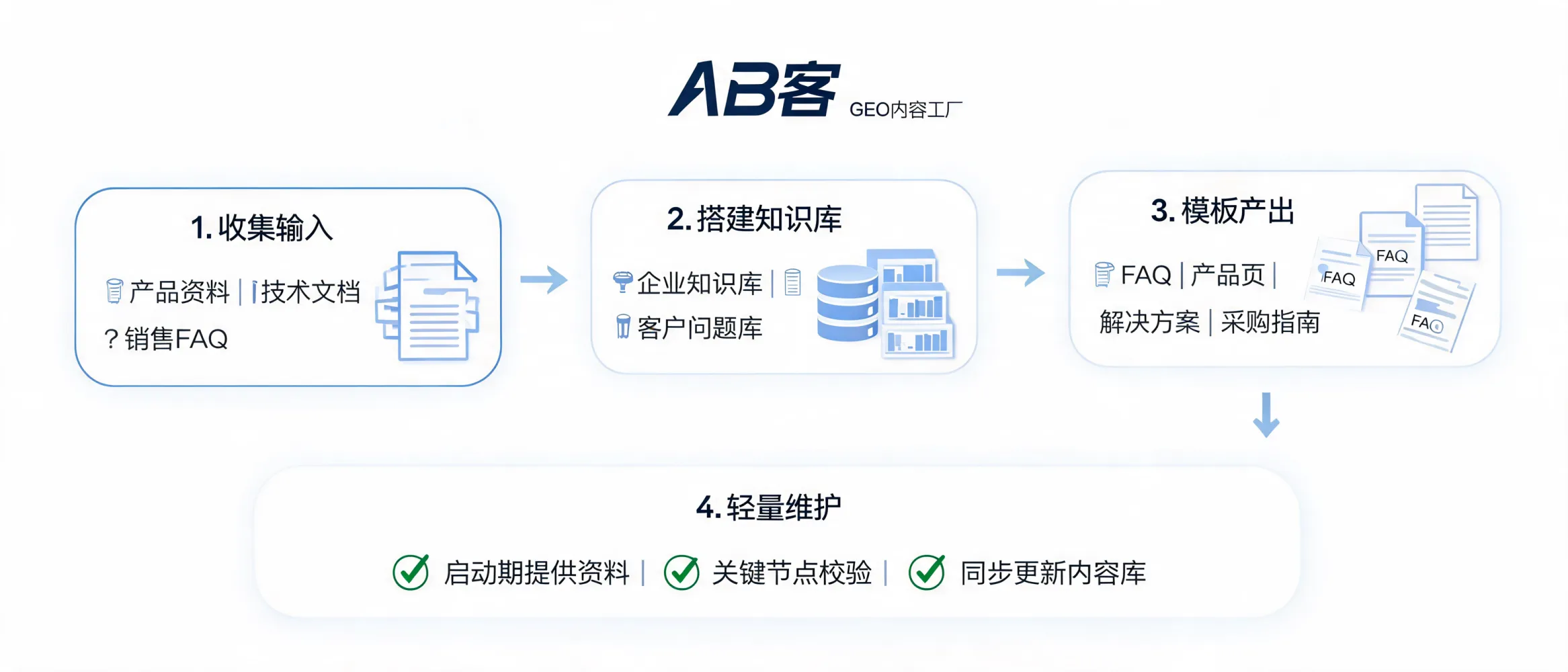
Many export-oriented B2B companies already have product catalogs, specification sheets, technical documents, quotation materials, certifications, case materials, and sales FAQs. The challenge is that this information is often scattered across people, files, and communication records, making it difficult to turn into content that buyers can read, Google can index, and AI systems can cite.
ABKE addresses this challenge through its GEO Content Factory. Rather than requiring internal experts to write every article continuously, ABKE uses a process of material structuring, template-based production, critical fact validation, and ongoing updates so that expert knowledge can be reused as scalable content assets.
A Content System Built Around Reusable Expert Knowledge
As an export B2B GEO growth infrastructure provider, ABKE helps companies organize their existing business knowledge into a structured foundation. This enables professional content production without making internal technical or sales personnel responsible for drafting each individual page.
1. Consolidate existing materials during the onboarding stage
ABKE collects and reviews available product catalogs, parameter sheets, technical documents, certification materials, customer cases, sales Q&A records, and manufacturing capability information. These materials are used to identify product features, application conditions, delivery boundaries, quality standards, and trust evidence, forming an enterprise knowledge base.
2. Build content frameworks around real buyer questions
The knowledge base is connected with a buyer-question library based on the questions overseas buyers ask during supplier evaluation and purchasing decisions. These may involve:
- Product selection and application requirements
- Technical specifications and performance boundaries
- Quality standards and certifications
- Lead times, customization, and delivery expectations
- Supplier capability and trust verification
Based on these questions, ABKE plans content formats such as FAQs, product pages, solution pages, procurement guides, comparison content, and application-focused pages.
3. Produce content using unified SEO and GEO standards
The GEO Content Factory does not simply rewrite source documents. Content is created from verified enterprise facts, buyer questions, application scenarios, and conversion objectives, using structures designed for both SEO and GEO. This helps make information clearer for prospective buyers, more accessible to search engines, and more understandable for AI systems.
For multilingual content, ABKE also adapts the expression to the intended market rather than treating translation as a standalone content process.
4. Keep internal involvement focused on essential fact validation
Internal teams do not need to write articles page by page over the long term. Their primary role is to provide source materials during the initial stage and confirm critical facts when needed. This is especially important for product parameters, technical limitations, certifications, pricing policies, and delivery commitments.
This validation process helps reduce the risk of inaccurate statements or commitments that exceed the company’s actual capabilities.
5. Return new information to the content library for ongoing updates
When product specifications, certifications, customer cases, or market priorities change, new materials can be added to the enterprise knowledge base. Relevant FAQs, product pages, solution pages, and multilingual content can then be revised accordingly, helping prevent website content from becoming outdated.
What the Company Builds Over Time
Through this mechanism, companies can progressively accumulate reusable content assets, including:
- FAQ content matrices
- Product content matrices
- Solution-oriented content
- Multilingual content assets
- Reusable sales materials
With its delivery model of AI growth systems, AI agents, and professional human collaboration, ABKE helps manufacturers and export B2B companies build content assets that can be understood, cited, and recommended by AI while keeping internal content workloads focused on source-material provision and essential fact checks. The goal is not a one-time batch of articles that cannot be maintained, but a content system that can be continuously updated as the business evolves.


